
YOUR QUESTION. A CLEARER NEXT STEP.
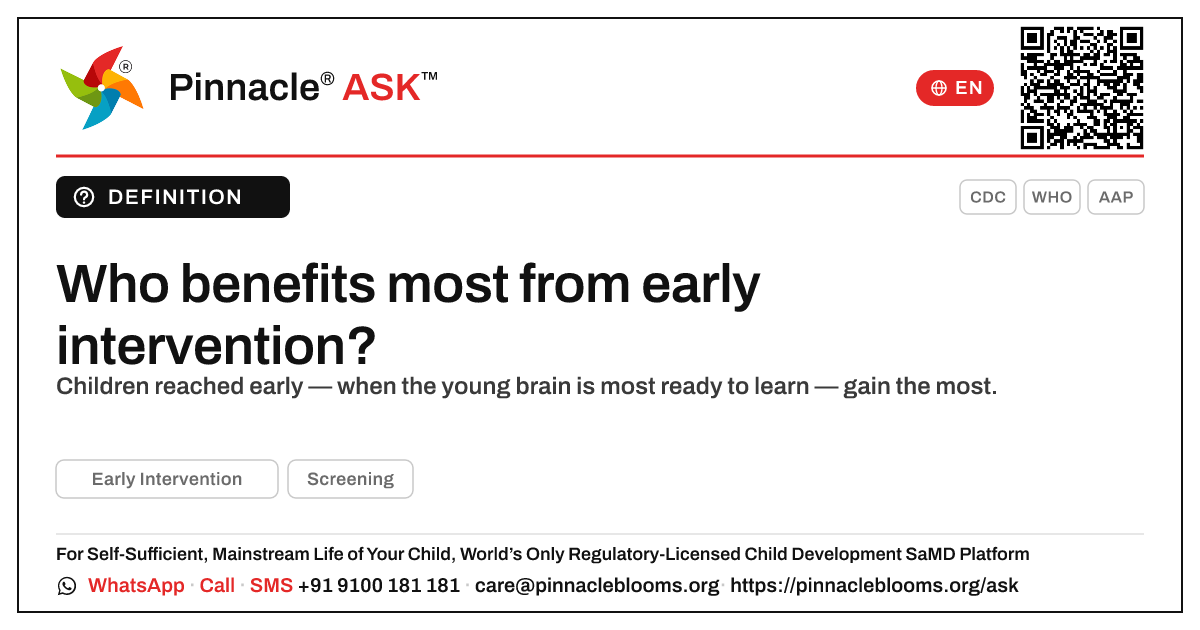
Which children benefit most from early intervention?
Early intervention benefits any child whose development is delayed, different or at higher risk — and the children who gain most are those reached early, when the young brain is most adaptable. This includes children with delays in talking, movement, social connection, play or learning; children with diagnosed conditions such as autism, cerebral palsy or Down syndrome; and children at raised risk from premature or complicated births. The common thread is timing: the same support produces more change when it begins early. You do not need a diagnosis to start.
In this answer 5 sections
Every child grows on their own timeline — and when a little extra support arrives early, it works alongside a young brain that is wonderfully ready to learn.
In short
Early intervention helps any child whose development is delayed, different, or at higher risk — and the children who benefit most are those reached early, when the brain is most adaptable. This includes children with delays in talking, movement, social connection, play or learning; children with diagnosed conditions such as autism, cerebral palsy or Down syndrome; and children at raised risk from premature birth, low birth weight or early medical complications. Earlier support means more growth from the same effort — but it is never too late to begin.
Which children gain the most
The science is encouraging: a baby and toddler's brain forms connections faster in the first few years than at any later stage, so well-timed support shapes skills as they are actively forming. Children who tend to benefit most include:
- Children with a developmental delay — slower-than-expected progress in speech and language, motor skills, social interaction, play, attention or self-help.
- Children with a diagnosed or recognised condition — such as autism, cerebral palsy, Down syndrome, hearing or vision differences, or a genetic condition.
- Children at higher biological risk — born premature, low birth weight, or with a complicated newborn period.
- Children with early 'red flags' — for example not babbling, limited eye contact, not responding to their name, or losing skills they once had.
The common thread is timing. The same therapy, sensory support or family coaching tends to produce more change when it begins early — because it works with, not against, the brain's natural readiness to learn. Crucially, early intervention also coaches families, so everyday play and routines become gentle therapy at home.
When to act
You do not need a diagnosis to start. If you notice your child is not meeting milestones, has lost a skill, or you simply have a worrying feeling, a developmental check is the right next step. Acting on a concern early — rather than waiting to 'see if they grow out of it' — is what gives a child the fullest head start.
The Pinnacle way
This is general information, not a diagnosis — a clinical AbilityScore® and any diagnosis are formed only at a Pinnacle Blooms Network centre, under qualified clinician care, never from an app or form. Across 70+ centres in 4 states, our team looks at the whole child, then builds an individualised plan drawing on speech therapy and family coaching as part of a wider early-intervention pathway — so support starts where it matters most. Begin with a simple developmental screen.
Trusted sources
The CDC and HealthyChildren explain why acting early on developmental concerns matters; the WHO Nurturing Care framework describes how responsive early support shapes a young child's development.
Next step — If your child has a delay, a diagnosis, or you simply have a concern, book a developmental screen today — earlier support gives the fullest head start.
CONNECT THE ANSWER TO YOUR CHILD’S DAY
Something to notice. Something to discuss.
What to notice
Slower-than-expected progress in talking, movement, social connection, play or self-help; not babbling, limited eye contact, or not responding to their name; losing skills once gained; or higher risk from premature birth, low birth weight or a complicated newborn period.
In everyday life
Turn everyday moments into gentle therapy: name what you see, pause and wait for your child to respond, follow their lead in play, and celebrate small attempts — responsive back-and-forth is one of the most powerful early-intervention tools, and it lives at home.
Bring your observations and questions to your child’s professional. Choose activities that suit your child’s comfort, abilities and agreed plan.
Bring your questions to a first visitQuestions families ask
Does my child need a diagnosis before starting early intervention?
No. Early intervention can begin on the basis of a noticed delay or concern — a diagnosis is not required to start. A developmental check helps clarify your child's strengths and needs and shapes the right support.
Is my child too young or too old for early intervention?
The earlier support begins the more the young brain can use it, so infancy and the toddler years are especially valuable. That said, it is never too late to begin — every child can make meaningful progress with the right support.
My baby was born premature — should I be watching their development?
Babies born premature or with a complicated newborn period are at higher risk of developmental delay, so gentle monitoring is wise. A developmental screen offers reassurance or an early head start if support would help.
FOLLOW THE SOURCE
References behind this answer.
- Source referenceCDC — Learn the Signs. Act Early.
- Organisation website · further readingWHO Nurturing Care Framework
- Source referenceHealthyChildren (AAP) — developmental concerns
References are supplied with this answer. An organisation homepage offers further reading; it does not establish an independent review of this page.
Content attribution: SETU Consortium · Pinnacle Blooms Network.
PEOPLE, TOPICS & DEVELOPMENT
See the connections.
Browse the wider question collections connected with this answer’s audience, developmental area and stage.
FROM UNDERSTANDING TO PURPOSEFUL SUPPORT
One question. Your child’s whole life.
Your child’s self-sufficient, mainstream-included life is the purpose from the beginning. At Pinnacle, that purpose shapes what we understand, the goals we choose, the people we bring together, everyday practice and review.
Connect this question with the right support.
Start with your child’s strengths, your observations and what you want everyday life to become.
Make the next conversation useful.
Bring the situations you notice at home or school. We’ll explain a suitable service, centre and first visit, including availability and fees, before you decide.
How PinnacleAI® connects the journeyExplore the seven stages
- 1Understand abilities
A starting picture of your child’s capabilities.
- 2Choose meaningful goals
Readiness and a plan shaped around the child.
- 3Bring the right support together
Suitable therapies and people for those goals.
- 4Carry practice into everyday life
Guidance for family, home and school.
- 5Track and correct
Use observations to adjust the plan.
- 6Reassess and review
Decide what to continue, change or do next.
- 7Grow independence and participation
The child’s life gives each step its purpose.
Explore the whole PinnacleAI® system → · Participation at school and in the community →
PINNACLE’S EVIDENCE, OPEN TO YOU
Look at the evidence behind our work.
Read our research, inspect the original regulatory documents and check what each institutional measure means.
General information supports a conversation with an appropriately qualified professional. Advice, goals and support depend on the individual child.