
YOUR QUESTION. A CLEARER NEXT STEP.
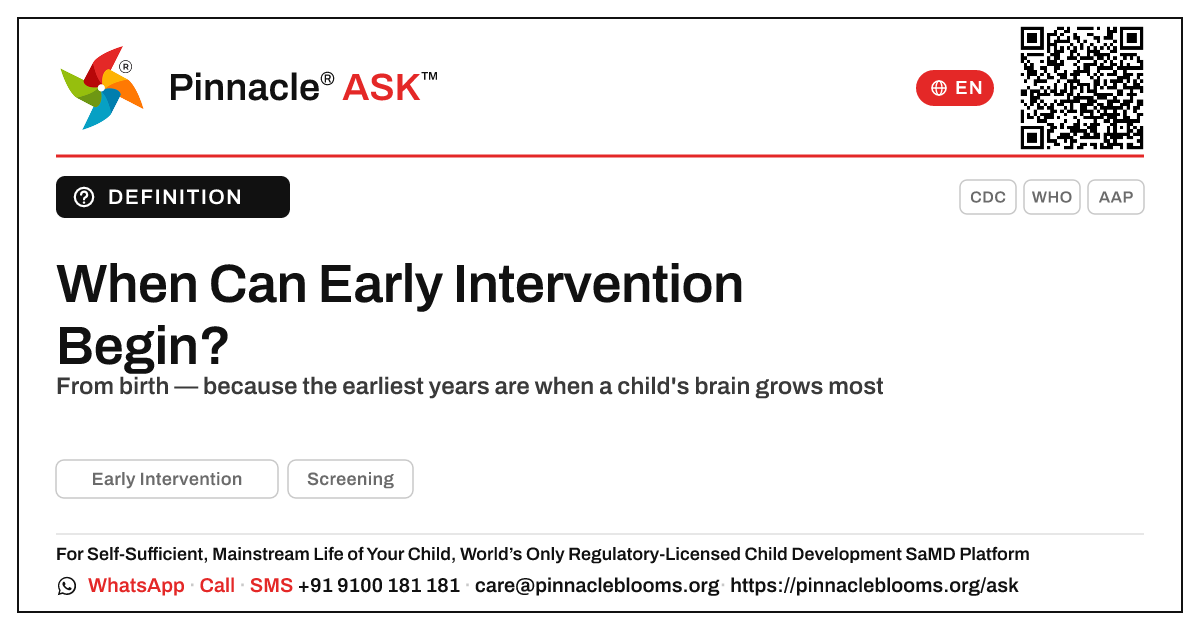
At What Age Can a Child Start Early Intervention?
Early intervention can begin as early as birth, with no minimum age — support starts the moment a developmental concern arises, often in the first months of life and through to about age 6. This works because a baby's brain is at its most adaptable in these early years, so well-timed support makes a real difference. You never need a confirmed diagnosis to begin; a concern alone is reason enough to seek a developmental check.
In this answer 5 sections
The most powerful word in early intervention isn't a milestone — it's "now". The earlier a child's developing brain gets the right support, the further it can grow.
In short
Early intervention can begin as early as birth — there is no minimum age. The moment a parent, paediatrician or screening raises a developmental concern, support can start, often within the first few months of life and right through the early years (broadly birth to about age 6). This window matters because a baby's brain is at its most adaptable — its neuroplasticity is greatest — in these first years, so even gentle, well-timed support can make a remarkable difference. You never need a confirmed diagnosis to begin; a concern is reason enough to look closer.
Why earlier is genuinely better
In the first years of life, the brain forms connections faster than at any other time — millions of new links every second. Early intervention works with this natural window, building communication, movement, play, feeding and social-emotional foundations while the brain is most ready to respond. This is why support can begin in infancy: for a premature or high-risk baby, developmental follow-up may start in the first weeks; for a toddler who isn't yet babbling, pointing or walking as expected, a review can begin the day you notice. Intervention is shaped to the child's age — for a tiny baby it looks like parent-coaching, responsive play and feeding support; for a toddler it grows into structured play-based speech, motor and sensory work. The earlier the start, the stronger the head-start.
When to act
You don't wait for a label. Seek a developmental check if your child isn't meeting milestones in their own time — for example, limited eye contact or social smiling in infancy, no babbling or gestures by around 12 months, no clear words by around 18 months, delays in sitting, crawling or walking, or any loss of skills once gained. Trust your instinct: a parent's quiet worry is one of the most reliable early signals, and acting early costs nothing but offers everything.
The Pinnacle way
This is general information, not a diagnosis — a clinical AbilityScore® and any diagnosis are formed only at a Pinnacle Blooms Network centre, under qualified clinician care, never from an app or form. Across 70+ centres and 4.95 lakh+ families supported, our team begins by understanding your child's whole picture — communication, movement, play and sensory world — then builds a warm, individualised plan, drawing on speech therapy and other supports as needed.
Trusted sources
The CDC and HealthyChildren on developmental milestones and acting early on concerns; the WHO Nurturing Care framework on early childhood development; NICE guidance on early developmental support.
Next step — If something about your child's development is on your mind, book an early developmental screening today — beginning early is always the gentlest, strongest choice.
CONNECT THE ANSWER TO YOUR CHILD’S DAY
Something to notice. Something to discuss.
What to notice
Limited eye contact or social smiling in infancy, no babbling or gestures by around 12 months, no clear words by around 18 months, delays in sitting, crawling or walking, or any loss of skills the child once had — and most of all, your own instinct that something needs a closer look.
In everyday life
Turn everyday moments into gentle development: talk through nappy changes and meals, name what you see on a walk, pause after a sound or gesture to invite a 'reply', and follow your baby's gaze and interest — responsive, face-to-face play is early intervention in its simplest, most powerful form.
Bring your observations and questions to your child’s professional. Choose activities that suit your child’s comfort, abilities and agreed plan.
Bring your questions to a first visitQuestions families ask
Is there a minimum age to start early intervention?
No — there is no minimum age. Support can begin as early as birth, especially for premature or high-risk babies, and the moment any developmental concern is noticed it is appropriate to seek a check.
Do I need a diagnosis before my child can start?
Not at all. A concern is reason enough to begin. Early support can start while assessment is ongoing, and beginning early often makes the biggest difference.
Why do the early years matter so much?
In the first years, the brain forms connections faster than at any other time — its neuroplasticity is greatest. Early intervention works with this natural window, so even gentle, well-timed support can have a lasting impact.
What does early intervention look like for a baby versus a toddler?
For a young baby it often means parent-coaching, responsive play and feeding support. For a toddler it grows into structured, play-based speech, motor and sensory work, always shaped to the child's age and needs.
FOLLOW THE SOURCE
References behind this answer.
- Source referenceCDC — Learn the Signs. Act Early.
- Organisation website · further readingWHO Nurturing Care Framework for Early Childhood Development
- Source referenceHealthyChildren (AAP) — Developmental Milestones
References are supplied with this answer. An organisation homepage offers further reading; it does not establish an independent review of this page.
Content attribution: SETU Consortium · Pinnacle Blooms Network.
PEOPLE, TOPICS & DEVELOPMENT
See the connections.
Browse the wider question collections connected with this answer’s audience, developmental area and stage.
FROM UNDERSTANDING TO PURPOSEFUL SUPPORT
One question. Your child’s whole life.
Your child’s self-sufficient, mainstream-included life is the purpose from the beginning. At Pinnacle, that purpose shapes what we understand, the goals we choose, the people we bring together, everyday practice and review.
Connect this question with the right support.
Start with your child’s strengths, your observations and what you want everyday life to become.
Make the next conversation useful.
Bring the situations you notice at home or school. We’ll explain a suitable service, centre and first visit, including availability and fees, before you decide.
How PinnacleAI® connects the journeyExplore the seven stages
- 1Understand abilities
A starting picture of your child’s capabilities.
- 2Choose meaningful goals
Readiness and a plan shaped around the child.
- 3Bring the right support together
Suitable therapies and people for those goals.
- 4Carry practice into everyday life
Guidance for family, home and school.
- 5Track and correct
Use observations to adjust the plan.
- 6Reassess and review
Decide what to continue, change or do next.
- 7Grow independence and participation
The child’s life gives each step its purpose.
Explore the whole PinnacleAI® system → · Participation at school and in the community →
PINNACLE’S EVIDENCE, OPEN TO YOU
Look at the evidence behind our work.
Read our research, inspect the original regulatory documents and check what each institutional measure means.
General information supports a conversation with an appropriately qualified professional. Advice, goals and support depend on the individual child.