
YOUR QUESTION. A CLEARER NEXT STEP.
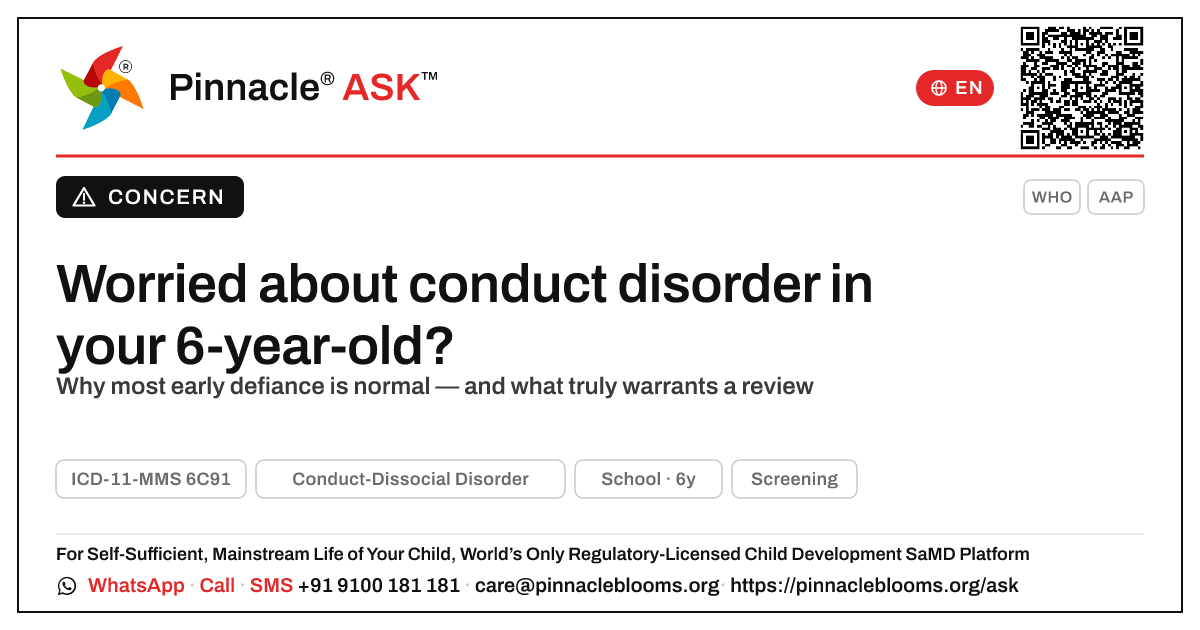
When to worry about Conduct-Dissocial Disorder in a 6-year-old
At six, most defiance, anger and rule-breaking is developmentally normal and softens with consistent, warm guidance. Conduct-Dissocial Disorder is rarely and cautiously applied this young, only by a clinician over time. Worry less about the label and more about a persistent, months-long pattern that genuinely harms relationships, learning or safety — and if you see that, seek a developmental and behavioural review, not a self-diagnosis.
In this answer 5 sections
If your spirited six-year-old has you reading worrying labels late at night, that protective instinct is worth honouring — and worth putting in its proper, calmer context.
In short
At six, a great deal of defiance, anger, rule-breaking and rough play is developmentally ordinary — young children are still learning to manage big feelings and impulses. Conduct-Dissocial Disorder is a serious clinical label that is rarely and cautiously applied at this age, and only by a qualified clinician after looking at the whole child over time. What is far more useful at six is to notice whether a persistent, repeated pattern of behaviour is genuinely harming your child's relationships, learning and safety — and if so, to seek a developmental and behavioural review, not a diagnosis from a list.
What is (and isn't) worth a closer look
Most six-year-olds argue, say "no", grab toys, hit when frustrated, tell fibs and have meltdowns. This is normal, and usually softens with consistent, warm guidance. A clinician becomes interested when behaviours are persistent (months, not days), frequent, and clearly beyond what's expected for the age — and when they cause real harm. Gentle flags worth a professional eye include:
- Aggression that hurts — repeatedly and deliberately hurting people or animals, well beyond ordinary scuffles.
- Serious rule violation — a sustained pattern of defiance that doesn't respond to consistent, kind boundaries.
- Destruction or deceit — deliberately destroying things, frequent lying or taking things, beyond the usual childhood phase.
- No remorse or empathy — seeming genuinely unbothered by others' distress, repeatedly.
- Impact — the behaviour is damaging friendships, school life, family calm or safety.
Importantly, behaviour like this at six far more often points to something treatable underneath — anxiety, unmet communication needs, attention differences, sensory overwhelm, sleep or a stressful change at home — rather than a conduct disorder. That is exactly why assessment, not self-labelling, is the right path.
When to seek a review
If a difficult pattern has lasted for months, is getting worse rather than better despite your steady efforts, or is putting your child or others at risk, arrange a developmental and behavioural check now. You are not over-reacting — you are gathering the right help early, when it works best.
The Pinnacle way
This is general information, not a diagnosis — a clinical AbilityScore® and any diagnosis are formed only at a Pinnacle Blooms Network centre, under qualified clinician care, never from an online list. Our clinicians look at the whole child, the patterns over time, and what might be driving the behaviour, then build support around your child's strengths. You can read more about Conduct-Dissocial Disorder, and explore how our behavioural therapy team supports emotional regulation and positive behaviour through warm, structured, play-based work.
Trusted sources
WHO ICD-11 describes Conduct-Dissocial Disorder (6C91) as a repetitive, persistent pattern of behaviour violating others' rights or age-appropriate norms, assessed clinically over time. The American Academy of Pediatrics (healthychildren.org) notes that defiance and big emotions are common in early childhood and that persistent, harmful patterns deserve professional evaluation rather than self-diagnosis.
Next step — Trust what you've noticed and let a clinician help you understand it. Book a developmental assessment with a Pinnacle clinician so your child's behaviour is reviewed with care, context and a plan that builds on their strengths.
CONNECT THE ANSWER TO YOUR CHILD’S DAY
Something to notice. Something to discuss.
What to notice
Seek a review if a difficult pattern lasts months not days: repeatedly and deliberately hurting people or animals, sustained defiance unresponsive to kind consistent boundaries, frequent destruction, lying or taking things beyond a phase, seeming unbothered by others' distress, and clear harm to friendships, school or safety.
In everyday life
Keep a brief weekly note of when the toughest behaviours happen — time, trigger, what helped. Patterns over weeks tell a clinician far more than any single bad day, and they often reveal a treatable cause underneath.
Bring your observations and questions to your child’s professional. Choose activities that suit your child’s comfort, abilities and agreed plan.
Bring your questions to a first visitQuestions families ask
Is it normal for a 6-year-old to be defiant and aggressive sometimes?
Yes. Most six-year-olds argue, say no, grab, hit when frustrated, fib and have meltdowns as they learn to manage big feelings and impulses. This usually softens with consistent, warm guidance. It becomes worth a closer look when the pattern is persistent over months, frequent, well beyond what's expected, and causing real harm.
Can a 6-year-old be diagnosed with Conduct-Dissocial Disorder?
This serious clinical label is rarely and cautiously applied at six, and only by a qualified clinician after observing the whole child over time. At this age, difficult behaviour far more often points to something treatable underneath — anxiety, communication needs, attention differences, sensory overwhelm or a stressful change — which is why assessment, not self-labelling, is the right path.
What should I do if my child's behaviour is getting worse?
If a difficult pattern has lasted months, is worsening despite your steady efforts, or is putting your child or others at risk, arrange a developmental and behavioural review now. Early help works best. A clinician can identify what is driving the behaviour and build supportive strategies around your child's strengths.
FOLLOW THE SOURCE
References behind this answer.
- Source referenceWHO ICD-11: Conduct-Dissocial Disorder
- Organisation website · further readingAAP HealthyChildren: behaviour and discipline in early childhood
References are supplied with this answer. An organisation homepage offers further reading; it does not establish an independent review of this page.
Content attribution: SETU Consortium · Pinnacle Blooms Network.
PEOPLE, TOPICS & DEVELOPMENT
See the connections.
Browse the wider question collections connected with this answer’s audience, developmental area and stage.
FROM UNDERSTANDING TO PURPOSEFUL SUPPORT
One question. Your child’s whole life.
Your child’s self-sufficient, mainstream-included life is the purpose from the beginning. At Pinnacle, that purpose shapes what we understand, the goals we choose, the people we bring together, everyday practice and review.
Connect this question with the right support.
Start with your child’s strengths, your observations and what you want everyday life to become.
Make the next conversation useful.
Bring the situations you notice at home or school. We’ll explain a suitable service, centre and first visit, including availability and fees, before you decide.
How PinnacleAI® connects the journeyExplore the seven stages
- 1Understand abilities
A starting picture of your child’s capabilities.
- 2Choose meaningful goals
Readiness and a plan shaped around the child.
- 3Bring the right support together
Suitable therapies and people for those goals.
- 4Carry practice into everyday life
Guidance for family, home and school.
- 5Track and correct
Use observations to adjust the plan.
- 6Reassess and review
Decide what to continue, change or do next.
- 7Grow independence and participation
The child’s life gives each step its purpose.
Explore the whole PinnacleAI® system → · Participation at school and in the community →
PINNACLE’S EVIDENCE, OPEN TO YOU
Look at the evidence behind our work.
Read our research, inspect the original regulatory documents and check what each institutional measure means.
General information supports a conversation with an appropriately qualified professional. Advice, goals and support depend on the individual child.