
YOUR QUESTION. A CLEARER NEXT STEP.
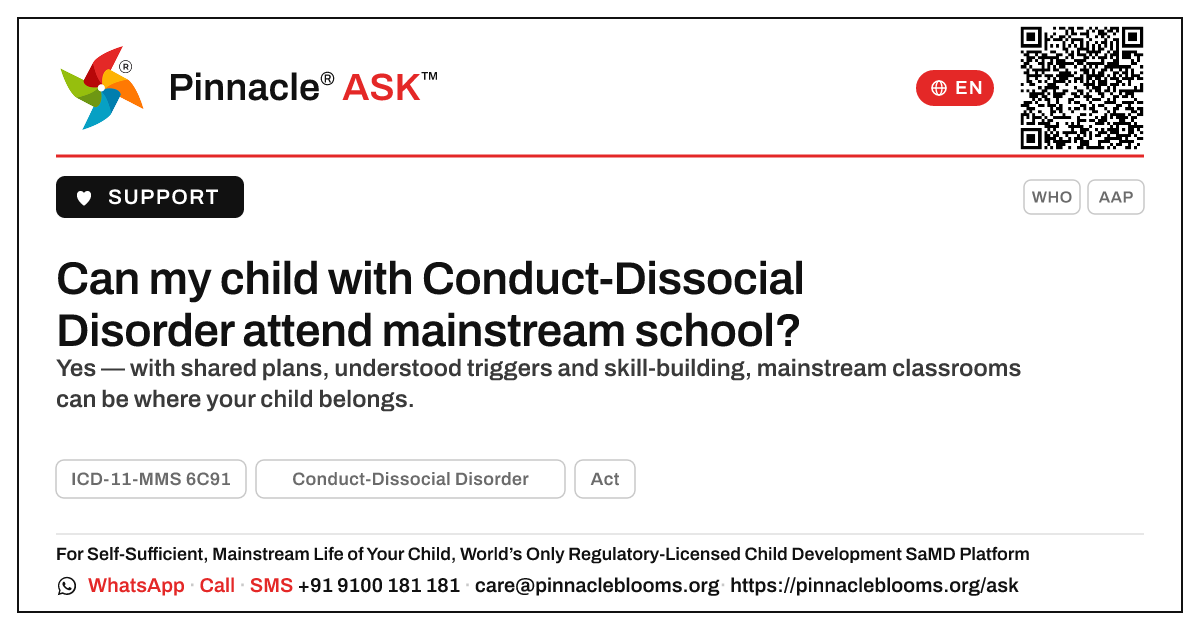
Can a child with Conduct-Dissocial Disorder attend mainstream school?
Most children with Conduct-Dissocial Disorder can attend mainstream school when home, school and therapy share one consistent plan, triggers are understood, regulation skills are taught and strengths are built on. The behaviour is a signal of an unmet need, not a reason for exclusion.
In this answer 4 sections
When your child has been struggling with behaviour, one worry rises above the rest: will school still have a place for them?
In short
Yes — most children with Conduct-Dissocial Disorder can and do attend mainstream school, with the right understanding and support around them. Behaviour that challenges is a signal, not a verdict, and schools across India are increasingly equipped to work alongside families and therapists. The goal is not to exclude your child but to surround them with structure, skills and people who understand what's driving the behaviour.
What helps a child thrive at school
Conduct-Dissocial Disorder (ICD-11 6C91) shows up as a repeated pattern of behaviour that breaks rules or the rights of others — but underneath it there is almost always an unmet need: difficulty with emotional regulation, communication, frustration tolerance or a history of distress. School can work beautifully when:
- There is a shared plan between home, school and the therapy team, so everyone responds consistently.
- Triggers are understood — transitions, unstructured times, or feeling unable to express a need are common ones.
- Skills are taught, not just rules enforced — emotional regulation, social problem-solving and communication grow with support.
- Strengths are named and built on, so your child experiences success, not just correction.
With these in place, mainstream classrooms become a place where your child belongs and grows.
The Pinnacle way
A clinical AbilityScore® and any diagnosis are formed only at a Pinnacle Blooms Network centre, under qualified clinician care — never from an article or app. From there, we help you build the home–school plan that makes mainstream education work. Explore Conduct-Dissocial Disorder support, our behaviour therapy services, and how the AbilityScore is understood.
Trusted sources
WHO ICD-11 classification of conduct-dissocial disorder; American Academy of Pediatrics guidance on disruptive behaviour and school inclusion.
Next step — Want a clear, supportive plan for your child at school? Book an assessment with a Pinnacle clinician.
This is general information, not a diagnosis — individual assessment and diagnosis require an appropriately qualified healthcare professional.
CONNECT THE ANSWER TO YOUR CHILD’S DAY
Something to notice. Something to discuss.
What to notice
Watch for situations that reliably trigger difficult behaviour — transitions, unstructured break times, or moments when your child can't express a need. Noting these patterns helps the school and therapy team plan support that actually works.
In everyday life
Keep one shared note between home and school each week — what went well and what was hard. Consistency between settings is one of the strongest predictors of success.
Bring your observations and questions to your child’s professional. Choose activities that suit your child’s comfort, abilities and agreed plan.
Bring your questions to a first visitQuestions families ask
Will my child be excluded from mainstream school because of their behaviour?
Exclusion is not the default. Most children with Conduct-Dissocial Disorder attend mainstream school successfully when there is a shared plan between home, school and the therapy team, and when triggers are understood and skills are actively taught.
Does the school need a diagnosis to support my child?
Schools can put helpful structure and support in place even before any formal assessment. A clinical AbilityScore® and diagnosis are formed only at a Pinnacle Blooms Network centre under qualified clinician care, and they help everyone respond consistently.
What makes school work well for a child with conduct difficulties?
Consistency across home and school, understanding the triggers behind behaviour, teaching emotional regulation and communication skills rather than only enforcing rules, and building on your child's strengths so they experience success.
FOLLOW THE SOURCE
References behind this answer.
- Source referenceWHO ICD-11: Conduct-Dissocial Disorder (6C91)
- Organisation website · further readingAmerican Academy of Pediatrics — disruptive behaviour guidance
- Organisation website · further readingHealthyChildren.org — supporting behaviour at school
References are supplied with this answer. An organisation homepage offers further reading; it does not establish an independent review of this page.
Content attribution: SETU Consortium · Pinnacle Blooms Network.
PEOPLE, TOPICS & DEVELOPMENT
See the connections.
Browse the wider question collections connected with this answer’s audience, developmental area and stage.
FROM UNDERSTANDING TO PURPOSEFUL SUPPORT
One question. Your child’s whole life.
Your child’s self-sufficient, mainstream-included life is the purpose from the beginning. At Pinnacle, that purpose shapes what we understand, the goals we choose, the people we bring together, everyday practice and review.
Connect this question with the right support.
Explore how the relevant service contributes to everyday abilities, then speak with us about your child.
Make the next conversation useful.
Bring the situations you notice at home or school. We’ll explain a suitable service, centre and first visit, including availability and fees, before you decide.
How PinnacleAI® connects the journeyExplore the seven stages
- 1Understand abilities
A starting picture of your child’s capabilities.
- 2Choose meaningful goals
Readiness and a plan shaped around the child.
- 3Bring the right support together
Suitable therapies and people for those goals.
- 4Carry practice into everyday life
Guidance for family, home and school.
- 5Track and correct
Use observations to adjust the plan.
- 6Reassess and review
Decide what to continue, change or do next.
- 7Grow independence and participation
The child’s life gives each step its purpose.
Explore the whole PinnacleAI® system → · Participation at school and in the community →
PINNACLE’S EVIDENCE, OPEN TO YOU
Look at the evidence behind our work.
Read our research, inspect the original regulatory documents and check what each institutional measure means.
General information supports a conversation with an appropriately qualified professional. Advice, goals and support depend on the individual child.