
YOUR QUESTION. A CLEARER NEXT STEP.
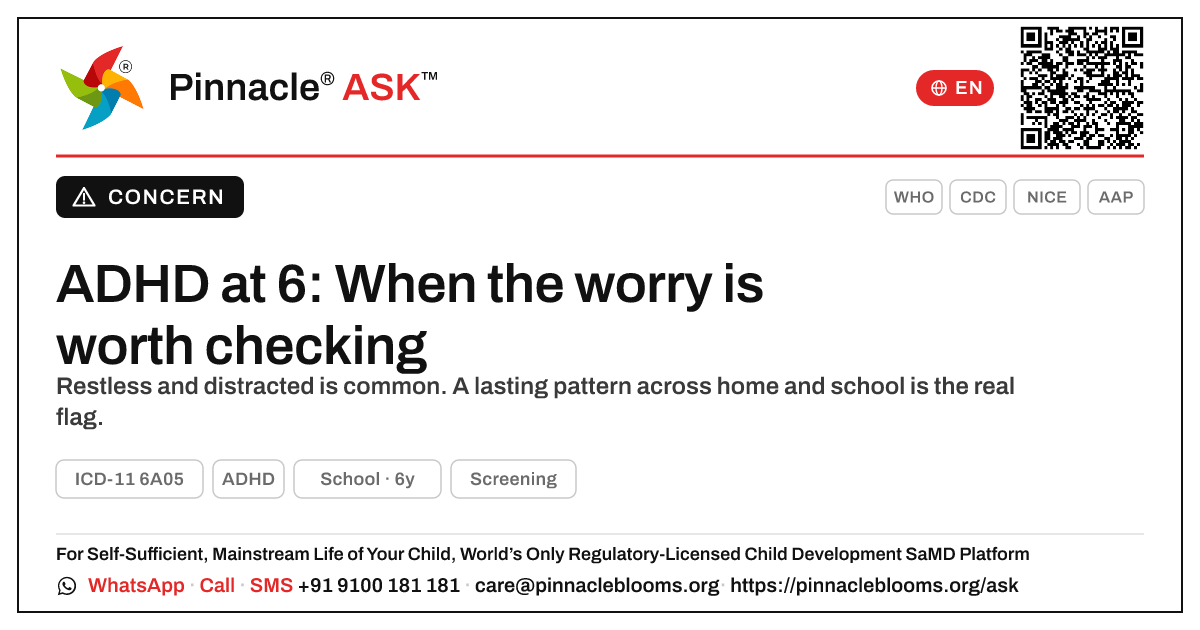
When should I worry that my 6-year-old might have ADHD?
Many six-year-olds are restless and forgetful — that alone isn't ADHD. Worry is warranted when inattention, hyperactivity or impulsivity is stronger than peers, lasts six months or more, and shows up both at home and school, affecting daily life. Only a clinician can confirm it.
In this answer 5 sections
If mornings, homework and "sit still please" feel like daily battles, the worry is real — and it deserves a clear, calm answer, not a label from a checklist.
In short
At six, lots of children are wriggly, forgetful and easily distracted — that alone is not ADHD. The real flag is a pattern of inattention, restlessness or impulsivity that is stronger than other children the same age, lasts six months or more, and shows up in more than one setting — both at home and at school. Worry is a good reason to check; it is not, by itself, a diagnosis.
What to watch
By age six, take a closer look if you consistently see:
- Inattention — can't finish tasks, loses things, seems not to listen, forgets instructions, avoids anything needing sustained focus
- Hyperactivity — can't stay seated, always on the go, fidgets constantly, talks excessively
- Impulsivity — blurts answers, can't wait turns, interrupts, acts before thinking
The key questions are: does it happen across home and school, has it gone on for months, and is it genuinely affecting learning, friendships or family life? One hard week is not a pattern.
The science, briefly
WHO classifies ADHD under ICD-11 6A05. Symptoms usually appear before age 12 and must be present in two or more settings — which is why teacher input matters as much as yours. NICE (NG87) and the Indian Academy of Pediatrics agree: diagnosis is never made from a single questionnaire. Other things — sleep, hearing, vision, anxiety, stress — can look just like ADHD and must be ruled out first. Identified early, children do remarkably well with the right support.
The Pinnacle way
Only a qualified Pinnacle clinician can tell whether this is ADHD or something else — a clinical AbilityScore® and any diagnosis are formed solely at a Pinnacle Blooms Network centre, never from an online form. The clinician gathers home and school observations, rules out other causes, and builds a plan — often behaviour therapy — around your child, not a label.
Trusted sources
WHO ICD-11 (6A05); CDC Learn the Signs; NICE NG87 on ADHD; American Academy of Pediatrics (HealthyChildren.org); Indian Academy of Pediatrics.
Next step — The kindest thing to do with worry is to check. Book a developmental assessment with a Pinnacle clinician.
This is general information, not a diagnosis — individual assessment and diagnosis require an appropriately qualified healthcare professional.
CONNECT THE ANSWER TO YOUR CHILD’S DAY
Something to notice. Something to discuss.
What to notice
Seek assessment sooner if difficulties show up clearly in both home and school, persist beyond six months, and are noticeably affecting learning, friendships or family routines — or if your child seems frustrated, sad or withdrawn alongside the restlessness.
In everyday life
Break instructions into one small step at a time and use a simple visual routine chart for mornings. Catch and praise the moments your child does focus or wait — specific praise ("you waited your turn, well done") builds the very skills ADHD makes harder.
Bring your observations and questions to your child’s professional. Choose activities that suit your child’s comfort, abilities and agreed plan.
Bring your questions to a first visitQuestions families ask
Isn't it normal for a 6-year-old to be restless and distracted?
Yes — most six-year-olds are energetic, forgetful and easily distracted at times. ADHD is considered only when the difficulty is markedly stronger than peers, lasts six months or more, appears in more than one setting, and genuinely affects daily life.
Can my child be diagnosed from an online checklist?
No. A checklist can raise a flag but never confirm ADHD. A qualified clinician gathers home and school observations, rules out other causes such as sleep, hearing or anxiety, and forms any diagnosis in person at a Pinnacle Blooms Network centre.
Why does the school's view matter?
ADHD symptoms must show across more than one setting. Your teacher sees your child in a structured, demanding environment, so their observations are essential to distinguish ADHD from a problem specific to home or school.
What helps a 6-year-old with ADHD?
Behaviour therapy, structured routines, clear expectations and parent and teacher strategies are first-line support for young children. The right plan is built around your individual child after a proper assessment.
FOLLOW THE SOURCE
References behind this answer.
- Source referenceWHO ICD-11 · 6A05 Attention deficit hyperactivity disorder
- Source referenceCDC — Learn the Signs. Act Early.
- Source referenceNICE NG87 — ADHD diagnosis & management
- Organisation website · further readingAmerican Academy of Pediatrics — HealthyChildren.org
References are supplied with this answer. An organisation homepage offers further reading; it does not establish an independent review of this page.
Content attribution: SETU Consortium · Pinnacle Blooms Network.
PEOPLE, TOPICS & DEVELOPMENT
See the connections.
Browse the wider question collections connected with this answer’s audience, developmental area and stage.
FROM UNDERSTANDING TO PURPOSEFUL SUPPORT
One question. Your child’s whole life.
Your child’s self-sufficient, mainstream-included life is the purpose from the beginning. At Pinnacle, that purpose shapes what we understand, the goals we choose, the people we bring together, everyday practice and review.
Connect this question with the right support.
Start with your child’s strengths, your observations and what you want everyday life to become.
Make the next conversation useful.
Bring the situations you notice at home or school. We’ll explain a suitable service, centre and first visit, including availability and fees, before you decide.
How PinnacleAI® connects the journeyExplore the seven stages
- 1Understand abilities
A starting picture of your child’s capabilities.
- 2Choose meaningful goals
Readiness and a plan shaped around the child.
- 3Bring the right support together
Suitable therapies and people for those goals.
- 4Carry practice into everyday life
Guidance for family, home and school.
- 5Track and correct
Use observations to adjust the plan.
- 6Reassess and review
Decide what to continue, change or do next.
- 7Grow independence and participation
The child’s life gives each step its purpose.
Explore the whole PinnacleAI® system → · Participation at school and in the community →
PINNACLE’S EVIDENCE, OPEN TO YOU
Look at the evidence behind our work.
Read our research, inspect the original regulatory documents and check what each institutional measure means.
General information supports a conversation with an appropriately qualified professional. Advice, goals and support depend on the individual child.