
YOUR QUESTION. A CLEARER NEXT STEP.
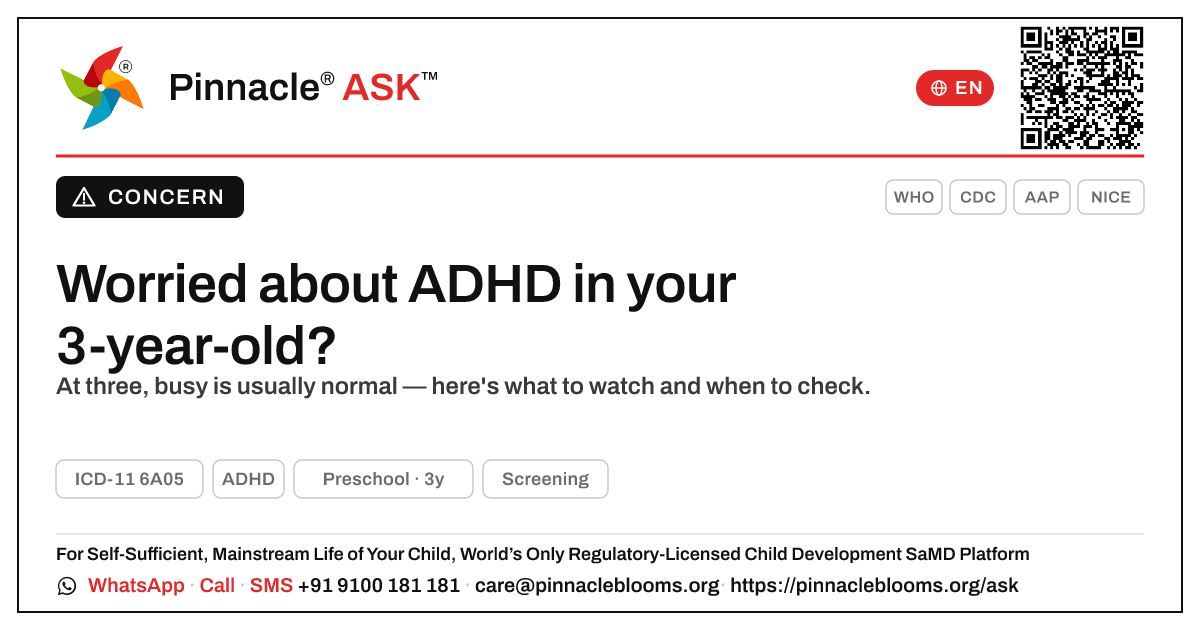
When should I worry my 3-year-old might have ADHD?
At three, being busy, impulsive and easily distracted is usually normal — ADHD is rarely diagnosed reliably this young. Worry is a reason to observe and seek a general developmental check, not to label. Only a clinician can tell the difference.
In this answer 5 sections
If your three-year-old never seems to sit still, the worry is real — but at this age, that liveliness is usually childhood, not a diagnosis.
In short
At three, being constantly on the go, having a short attention span, and acting before thinking are completely typical — preschoolers are meant to be busy. ADHD (ICD-11 6A05) is rarely diagnosed reliably this young, because the behaviours that define it overlap so much with normal toddler development. The honest answer: worry is a reason to observe and check, not to label. A clear pattern — far beyond same-age peers, across home and playgroup, and lasting many months — is what warrants a developmental review.
What to watch (rather than worry over)
At three, gently note whether behaviour is out of step with other children the same age and persists across settings:
- Activity so constant it stops any play from settling, even briefly
- Attention shorter than peers for things the child enjoys
- Impulsivity that repeatedly risks safety despite reminders
- Difficulty that shows up both at home and at crèche or with relatives
Behaviour seen in only one place, or that eases with routine and sleep, usually points to environment, not ADHD.
The science, briefly
Leading guidance (NICE NG87, the AAP and CDC) is cautious about diagnosing ADHD before school age, because attention and self-control are still rapidly maturing at three. When concern is genuine, the first step is a general developmental check — to rule out hearing, sleep, language or anxiety factors that can look similar. Where preschool support is offered, it begins with parent-focused behaviour therapy, never medication first.
The Pinnacle way
No diagnosis is ever made from an online form — Developmental measurement supports care planning; diagnosis requires an appropriately qualified healthcare professional., under a qualified clinician's care. Our clinicians measure your child against their own developmental baseline, look for everyday causes first, and give you clarity and a plan — not a hasty label.
Trusted sources
WHO ICD-11 (6A05); CDC Learn the Signs, Act Early; American Academy of Pediatrics (HealthyChildren.org); NICE NG87 on ADHD; Indian Academy of Pediatrics.
Next step — The kindest thing to do with worry is to check. Book a developmental check with a Pinnacle clinician for calm, clear answers.
CONNECT THE ANSWER TO YOUR CHILD’S DAY
Something to notice. Something to discuss.
What to notice
Seek a developmental check sooner if very high activity and short attention show up across home and crèche, persist for many months beyond same-age peers, repeatedly risk safety, or come with poor sleep, frustration or speech delay.
In everyday life
Build short, predictable routines and give one simple instruction at a time. Praise the calm moments warmly as they happen — "you sat so nicely to finish that puzzle" — so your child learns what focus feels like, in tiny doses.
Bring your observations and questions to your child’s professional. Choose activities that suit your child’s comfort, abilities and agreed plan.
Bring your questions to a first visitQuestions families ask
Can ADHD be diagnosed at age 3?
It is rarely diagnosed reliably this young. Attention and self-control are still maturing at three, so the behaviours overlap heavily with typical toddler development. A general developmental check is the right first step if you are concerned.
How is normal toddler energy different from ADHD?
Typical busyness eases with routine, sleep and growing up, and varies by setting. A possible concern shows as a persistent pattern far beyond same-age peers, present both at home and elsewhere, lasting many months — which is why observation over time matters.
What happens at a developmental check?
A clinician reviews your child against their own developmental baseline, looks first for everyday causes like hearing, sleep, language or anxiety, and offers clarity and a plan. Any support at this age starts with parent-focused behaviour strategies, not medication.
FOLLOW THE SOURCE
References behind this answer.
- Source referenceWHO ICD-11 — Attention deficit hyperactivity disorder
- Source referenceCDC — Learn the Signs. Act Early.
- Organisation website · further readingAmerican Academy of Pediatrics — HealthyChildren.org
- Source referenceNICE NG87 — ADHD diagnosis and management
References are supplied with this answer. An organisation homepage offers further reading; it does not establish an independent review of this page.
Content attribution: SETU Consortium · Pinnacle Blooms Network.
PEOPLE, TOPICS & DEVELOPMENT
See the connections.
Browse the wider question collections connected with this answer’s audience, developmental area and stage.
FROM UNDERSTANDING TO PURPOSEFUL SUPPORT
One question. Your child’s whole life.
Your child’s self-sufficient, mainstream-included life is the purpose from the beginning. At Pinnacle, that purpose shapes what we understand, the goals we choose, the people we bring together, everyday practice and review.
Connect this question with the right support.
Start with your child’s strengths, your observations and what you want everyday life to become.
Make the next conversation useful.
Bring the situations you notice at home or school. We’ll explain a suitable service, centre and first visit, including availability and fees, before you decide.
How PinnacleAI® connects the journeyExplore the seven stages
- 1Understand abilities
A starting picture of your child’s capabilities.
- 2Choose meaningful goals
Readiness and a plan shaped around the child.
- 3Bring the right support together
Suitable therapies and people for those goals.
- 4Carry practice into everyday life
Guidance for family, home and school.
- 5Track and correct
Use observations to adjust the plan.
- 6Reassess and review
Decide what to continue, change or do next.
- 7Grow independence and participation
The child’s life gives each step its purpose.
Explore the whole PinnacleAI® system → · Participation at school and in the community →
PINNACLE’S EVIDENCE, OPEN TO YOU
Look at the evidence behind our work.
Read our research, inspect the original regulatory documents and check what each institutional measure means.
General information supports a conversation with an appropriately qualified professional. Advice, goals and support depend on the individual child.