
YOUR QUESTION. A CLEARER NEXT STEP.
Worrying about dyslexia in a 6–9-month-old
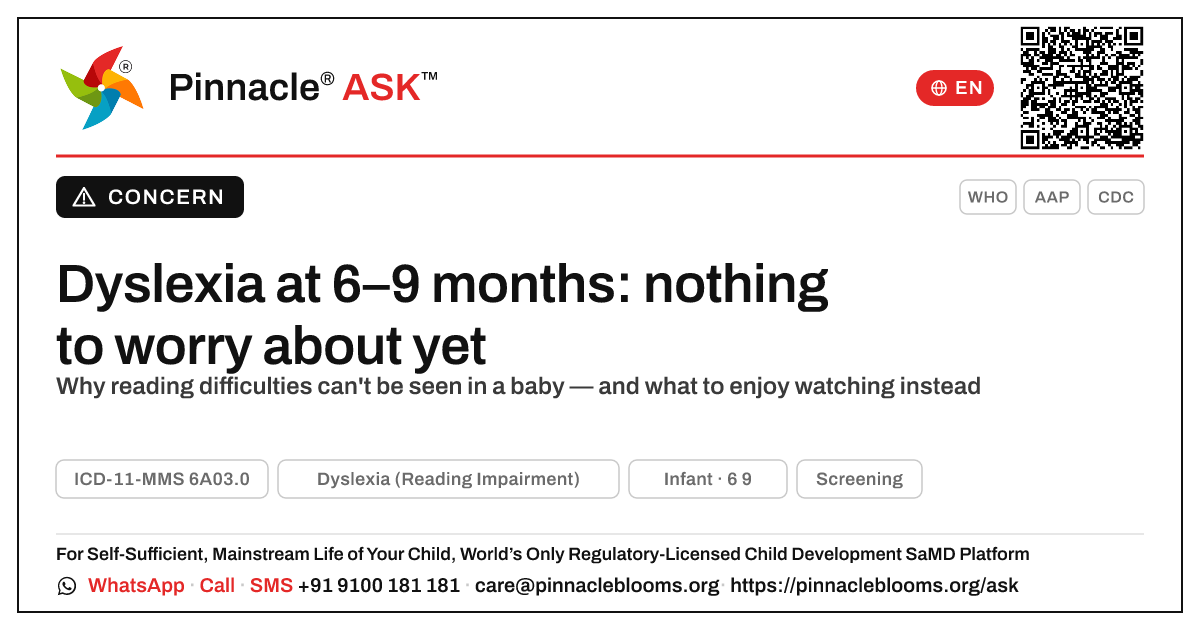
Dyslexia is a reading difficulty that only becomes meaningful once a child is learning to read — usually around age 6 to 8. At 6 to 9 months a baby isn't reading, so dyslexia cannot be identified or ruled out, and there is nothing to worry about now. What helps is observing early communication, hearing and play, and reading aloud daily. Any concern about hearing or babbling deserves a prompt check, separate from dyslexia. Only a Pinnacle clinician can assess, never an online form.
In this answer 5 sections
If you've been wondering whether your baby's babbling, looking at books, or grasping at pages could hint at dyslexia — take a deep breath. At 6 to 9 months, this simply isn't a question that can be answered yet, and that's completely reassuring.
In short
Dyslexia is a reading impairment — a specific difficulty with accurate, fluent reading and spelling that only becomes meaningful once a child is actually learning to read, usually from around age 6 to 8 years. At 6 to 9 months, your baby isn't reading, so dyslexia cannot be identified or ruled out now. There is genuinely nothing to worry about at this age. What is worth gently observing is your baby's early communication, hearing and play — the wide foundations that all later learning rests on.
What's actually appropriate to watch at 6–9 months
Rather than reading, your baby's job right now is to connect, listen and explore. Lovely things to notice — and enjoy — include:
- Responding to sound and voice — turning towards you, quietening to a familiar voice, startling at loud noises (this tells you hearing is working, which matters for later language)
- Babbling — strings like "ba-ba", "da-da", experimenting with sounds
- Eye contact and shared smiles — looking back and forth between you and a toy
- Reaching, grasping and mouthing objects, passing things hand to hand
- Enjoying being read to — not understanding words, but loving your voice, the colours and the closeness
Reading to your baby every day is one of the loveliest, most protective things you can do — not to prevent dyslexia, but to soak them in the rhythm and music of language.
When dyslexia actually becomes a meaningful question
A family history of dyslexia is worth keeping in mind, but the first real clues appear in the pre-school and early-school years (around 4–7) — difficulty rhyming, learning letter sounds, or remembering letter names — and a formal picture only forms once structured reading instruction is underway, generally from age 6–8. If a baby's hearing or early communication ever seems off at any age, that's the thing to check promptly — and it's a separate matter from dyslexia.
The Pinnacle way
A clinical AbilityScore® and any diagnosis are formed only at a Pinnacle Blooms Network centre, under qualified clinician care — never from an online form or a checklist, and never for dyslexia this early. If you have any worry about how your baby hears, babbles or connects, our team is glad to look at the whole picture with you. Gentle, play-based speech therapy and early developmental guidance build the language foundations that serve every child for life.
Trusted sources
WHO ICD-11 (6A03.0, developmental learning disorder with impairment in reading); American Academy of Pediatrics developmental guidance (healthychildren.org); CDC milestone guidance for infants (cdc.gov).
Next step — Keep reading and chatting to your baby daily, and if anything about their hearing or communication ever niggles, book a developmental check with a Pinnacle clinician for calm, expert reassurance.
This is general information, not a diagnosis — individual assessment and diagnosis require an appropriately qualified healthcare professional.
CONNECT THE ANSWER TO YOUR CHILD’S DAY
Something to notice. Something to discuss.
What to notice
Dyslexia can't be seen in a 6–9-month-old. Instead, enjoy watching your baby respond to your voice, babble, make eye contact, reach and grasp, and settle when read to. The things worth a prompt check at this age are hearing and early communication — not reading.
In everyday life
Read aloud to your baby every single day, even for a few minutes. They won't follow the words, but your voice, the rhythm and the cuddle build the language foundations all reading rests on later.
Bring your observations and questions to your child’s professional. Choose activities that suit your child’s comfort, abilities and agreed plan.
Bring your questions to a first visitQuestions families ask
Can a baby be diagnosed with dyslexia?
No. Dyslexia is a reading impairment that can only be identified once a child is learning to read, usually from around age 6 to 8. A baby isn't reading, so there is nothing to diagnose or worry about at 6 to 9 months.
Dyslexia runs in our family — should we test our baby?
A family history is worth keeping in mind, but there is no meaningful test for dyslexia in a baby. The first real clues appear in the pre-school and early-school years. The best thing now is daily reading, talking and singing together.
What should I watch instead at 6 to 9 months?
Notice your baby responding to your voice, babbling, making eye contact, reaching and grasping. These are the foundations of later learning. If anything about hearing or early communication worries you, ask a clinician promptly — that's separate from dyslexia.
FOLLOW THE SOURCE
References behind this answer.
- Organisation website · further readingAAP guidance on early development and reading aloud
- Source referenceCDC developmental milestones for infants
References are supplied with this answer. An organisation homepage offers further reading; it does not establish an independent review of this page.
Content attribution: SETU Consortium · Pinnacle Blooms Network.
PEOPLE, TOPICS & DEVELOPMENT
See the connections.
Browse the wider question collections connected with this answer’s audience, developmental area and stage.
FROM UNDERSTANDING TO PURPOSEFUL SUPPORT
One question. Your child’s whole life.
Your child’s self-sufficient, mainstream-included life is the purpose from the beginning. At Pinnacle, that purpose shapes what we understand, the goals we choose, the people we bring together, everyday practice and review.
Connect this question with the right support.
Start with your child’s strengths, your observations and what you want everyday life to become.
Make the next conversation useful.
Bring the situations you notice at home or school. We’ll explain a suitable service, centre and first visit, including availability and fees, before you decide.
How PinnacleAI® connects the journeyExplore the seven stages
- 1Understand abilities
A starting picture of your child’s capabilities.
- 2Choose meaningful goals
Readiness and a plan shaped around the child.
- 3Bring the right support together
Suitable therapies and people for those goals.
- 4Carry practice into everyday life
Guidance for family, home and school.
- 5Track and correct
Use observations to adjust the plan.
- 6Reassess and review
Decide what to continue, change or do next.
- 7Grow independence and participation
The child’s life gives each step its purpose.
Explore the whole PinnacleAI® system → · Participation at school and in the community →
PINNACLE’S EVIDENCE, OPEN TO YOU
Look at the evidence behind our work.
Read our research, inspect the original regulatory documents and check what each institutional measure means.
General information supports a conversation with an appropriately qualified professional. Advice, goals and support depend on the individual child.