
YOUR QUESTION. A CLEARER NEXT STEP.
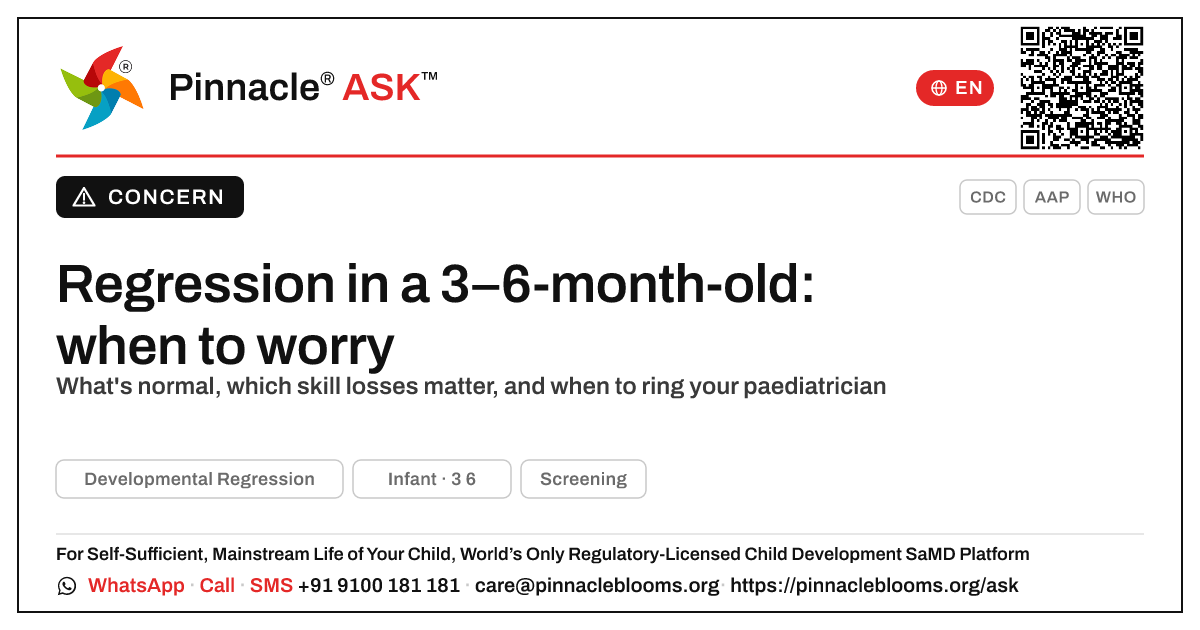
When to worry about regression in a 3–6-month-old
At 3–6 months, true developmental regression is uncommon — babies are mainly gaining skills, not yet showing the complex losses we call regression in older children. Worry promptly if your baby loses something they clearly had: head control, social smiles, tracking, cooing, or normal muscle tone. A real loss of established skills at this age is a medical matter — see your paediatrician promptly so any cause can be checked first.
In this answer 4 sections
If your baby seems to have slipped back on something they were just starting to do, your noticing is exactly the right instinct — let's look at it calmly together.
In short
At 3–6 months, a true loss of skills your baby had clearly gained is uncommon — and when it happens, it deserves a prompt check, not a wait-and-see. At this age the bigger picture is emergence: babies are building skills, not yet showing the complex losses we describe as developmental regression in older children. Worry — and ring your paediatrician promptly — if your baby stops doing something they were reliably doing: losing head control, going quiet after cooing, no longer smiling at you, or stiffening or floppiness that wasn't there before.
What is appropriate to watch at 3–6 months
Between 3 and 6 months, the healthy story is one of gaining skills — social smiles, cooing and babbling, following you with their eyes, reaching for things, holding their head steadily and pushing up on the tummy. Rather than hunting for a frightening label, gently track whether your baby keeps and builds on what they have. Genuine reasons to seek a prompt review are when a skill that was clearly present disappears or goes backwards:
- Movement & tone — losing head control they had, a body that becomes notably stiff or unusually floppy, or hands kept tightly fisted.
- Interaction — stopping social smiles, no longer turning to your voice or face, or eyes that no longer track or that drift inward/outward consistently.
- Sound & feeding — going quiet after cooing, or new difficulty with feeding or swallowing.
A loss of feeding, alertness or muscle tone in a young infant is a medical matter, not a therapy-first one — so the right move is to see your doctor or paediatrician promptly so any underlying cause can be checked first. Most apparent "slips" at this age turn out to be illness, tiredness or an off week — but a real, sustained loss always warrants timely medical attention.
The Pinnacle way
A clinical AbilityScore® and any diagnosis are formed only at a Pinnacle Blooms Network centre, under qualified clinician care — never from an online description or a single worried moment. For an infant this young, our clinicians work alongside your paediatrician: we map your baby's own developmental baseline, look first for any treatable cause, and — if movement or feeding is the worry — our occupational therapy team can offer gentle, early support. The aim is reassurance and a clear path, not a label.
Trusted sources
WHO ICD-11 framework for neurodevelopmental conditions; American Academy of Pediatrics developmental surveillance guidance; CDC milestone and "Learn the Signs, Act Early" resources for infants.
Next step — Trust what you've seen. If your baby has lost a skill they clearly had — in movement, alertness or interaction — speak to your paediatrician promptly, and book a developmental check with a Pinnacle clinician for added clarity.
This is general information, not a diagnosis — individual assessment and diagnosis require an appropriately qualified healthcare professional.
CONNECT THE ANSWER TO YOUR CHILD’S DAY
Something to notice. Something to discuss.
What to notice
Seek a prompt paediatric review if your baby loses a skill they clearly had — head control, social smiles, eye tracking, cooing, or normal muscle tone — or becomes notably stiff, floppy, or less alert. A genuine loss of established skills at this age is a medical matter, not something to wait out.
In everyday life
Jot down what your baby does well this week — a smile back, steady head, a coo when you talk. If anything quietly fades over the next weeks, you'll have a clear record to share with your doctor.
Bring your observations and questions to your child’s professional. Choose activities that suit your child’s comfort, abilities and agreed plan.
Bring your questions to a first visitQuestions families ask
Is developmental regression common in a 3–6-month-old?
No — true regression, the loss of skills a child had clearly gained, is uncommon at this young age. At 3–6 months babies are mainly building new skills. A genuine, sustained loss of an established skill is the signal that warrants a prompt check.
What kind of skill loss should make me call the doctor?
Call your paediatrician promptly if your baby loses head control, stops smiling socially, no longer tracks your face or turns to your voice, goes quiet after cooing, or becomes notably stiff or floppy. Losses of feeding or alertness need prompt medical attention.
Could a quiet or sleepy week mean regression?
Often not. Illness, teething, tiredness or an off week can make a baby seem less responsive briefly. The concern is a real, lasting loss of a skill they reliably had — that is when a prompt review is wise.
Should I start therapy straightaway if I'm worried?
At this age the first step is medical, not therapy-first — your paediatrician can check for any underlying cause. A Pinnacle clinician can then work alongside them to map your baby's baseline and, if needed, begin gentle early support.
FOLLOW THE SOURCE
References behind this answer.
- Source referenceCDC — developmental milestones & Learn the Signs, Act Early
- Source referenceAAP HealthyChildren — infant development guidance
- Organisation website · further readingWHO ICD-11 — neurodevelopmental classification framework
References are supplied with this answer. An organisation homepage offers further reading; it does not establish an independent review of this page.
Content attribution: SETU Consortium · Pinnacle Blooms Network.
PEOPLE, TOPICS & DEVELOPMENT
See the connections.
Browse the wider question collections connected with this answer’s audience, developmental area and stage.
FROM UNDERSTANDING TO PURPOSEFUL SUPPORT
One question. Your child’s whole life.
Your child’s self-sufficient, mainstream-included life is the purpose from the beginning. At Pinnacle, that purpose shapes what we understand, the goals we choose, the people we bring together, everyday practice and review.
Connect this question with the right support.
Explore how the relevant service contributes to everyday abilities, then speak with us about your child.
Make the next conversation useful.
Bring the situations you notice at home or school. We’ll explain a suitable service, centre and first visit, including availability and fees, before you decide.
How PinnacleAI® connects the journeyExplore the seven stages
- 1Understand abilities
A starting picture of your child’s capabilities.
- 2Choose meaningful goals
Readiness and a plan shaped around the child.
- 3Bring the right support together
Suitable therapies and people for those goals.
- 4Carry practice into everyday life
Guidance for family, home and school.
- 5Track and correct
Use observations to adjust the plan.
- 6Reassess and review
Decide what to continue, change or do next.
- 7Grow independence and participation
The child’s life gives each step its purpose.
Explore the whole PinnacleAI® system → · Participation at school and in the community →
PINNACLE’S EVIDENCE, OPEN TO YOU
Look at the evidence behind our work.
Read our research, inspect the original regulatory documents and check what each institutional measure means.
General information supports a conversation with an appropriately qualified professional. Advice, goals and support depend on the individual child.