
YOUR QUESTION. A CLEARER NEXT STEP.
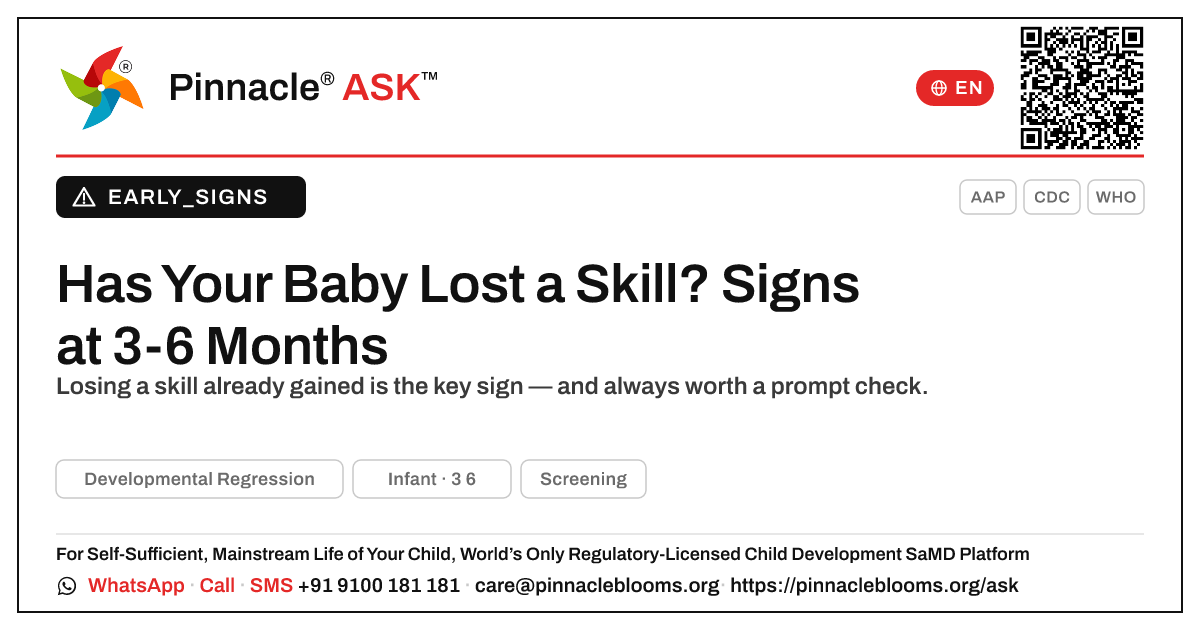
Early Signs of Developmental Regression in a 3-to-6-Month-Old
In a 3-to-6-month-old, the key early sign of developmental regression is losing a skill already gained — such as stopping social smiling, cooing, eye contact or head control. True loss of skills at this age is uncommon and always warrants prompt medical and developmental review rather than waiting. Any unusual jerks, stiffening or a hard-to-rouse baby needs same-day care. Only a clinician can confirm what is happening.
In this answer 5 sections
A baby who was smiling, cooing and reaching — and then seems to slip back — is one of the most frightening things a parent can notice. Trust that instinct: losing skills is always worth a prompt check.
In short
In a 3-to-6-month-old, the most important early sign of developmental regression is losing a skill your baby had already gained — for example, a baby who was smiling socially, cooing or making eye contact who gradually stops. Unlike older children, true loss of skills at this young age is uncommon and is always worth a prompt medical and developmental review rather than waiting. Only a qualified clinician can tell whether what you are seeing is a passing phase, an illness, or a genuine regression that needs support.
Early signs to watch for
Social and communication
- Stopping social smiling, cooing or babbling she had already started
- Less eye contact, or no longer turning towards your face or voice
- Becoming much less responsive, quiet or 'switched off' than before
Movement and tone
- Losing head control she had gained, or suddenly floppy or very stiff limbs
- Stopping reaching or batting at toys she used to enjoy
- New unusual movements, stiffening, or repeated jerks (these need same-day medical attention)
Feeding, alertness and overall pattern
- Feeding much less well or being hard to rouse
- A baby who seems to lose interest in people and the world around her
A single quiet day, a growth spurt, teething, tiredness or a minor illness can briefly change how a baby behaves — that is not regression. Regression means a real, lasting loss of a skill that was clearly present.
When to seek a check — promptly
At this age, do not adopt a long 'wait and see' approach. Any genuine loss of a skill — social smile, head control, movement, alertness — warrants prompt review by your paediatrician, because some causes are medical and time-sensitive. Any unusual jerks, stiffening or staring spells, or a baby who is unusually hard to wake, needs same-day medical care. Acting early protects your baby and gives you answers sooner.
The Pinnacle way
At Pinnacle Blooms Network, we work alongside your paediatrician — medical causes are checked first, then we support each skill your baby is building, drawing on occupational therapy and speech therapy as needed. A clinical AbilityScore® and any diagnosis are formed only at a Pinnacle Blooms Network centre under qualified clinician care — never from an online list. Learn more about developmental regression. With 4.95 lakh+ families served across 70+ centres, our focus stays on what your baby can grow next.
Trusted sources
Aligned with World Health Organization and American Academy of Pediatrics guidance on developmental surveillance, and HealthyChildren.org and CDC milestone resources, which advise prompt review whenever a baby loses skills already gained.
Next step — if your baby seems to have lost a skill she once had, contact your paediatrician promptly and book a gentle developmental screen with the Pinnacle team on WhatsApp: +91 91001 81181.
This is general information, not a diagnosis — individual assessment and diagnosis require an appropriately qualified healthcare professional.
CONNECT THE ANSWER TO YOUR CHILD’S DAY
Something to notice. Something to discuss.
What to notice
Seek same-day medical care for unusual jerks, stiffening, staring spells, or a baby who is unusually hard to wake. Any lasting loss of a skill she once had — social smile, head control, alertness or feeding — needs prompt paediatric review, not waiting.
In everyday life
Keep a simple note or short video of skills your baby shows — first smiles, coos, head lifts. If you ever wonder whether something has changed, this gentle record helps you and your doctor see clearly what is real versus a passing phase.
Bring your observations and questions to your child’s professional. Choose activities that suit your child’s comfort, abilities and agreed plan.
Bring your questions to a first visitQuestions families ask
Is it normal for a 3-to-6-month-old to seem to lose a skill for a day or two?
Brief changes from teething, tiredness, a growth spurt or a minor illness are common and usually pass. True regression means a real, lasting loss of a skill that was clearly present — and that always deserves a prompt check with your paediatrician.
My baby smiled before but seems quieter now — should I worry?
If your baby has clearly stopped social smiling, cooing or making eye contact she had already started, it is worth reviewing promptly with your paediatrician. It may be nothing serious, but losing a social skill at this age is always worth checking early rather than waiting.
What needs same-day medical attention?
Any unusual jerks, stiffening, staring spells or repeated unusual movements, or a baby who is unusually floppy, hard to wake or feeding very poorly, needs same-day medical care. These can have time-sensitive medical causes.
Can Pinnacle Blooms Network diagnose my baby online?
No. Developmental measurement supports care planning; diagnosis requires an appropriately qualified healthcare professional. under qualified clinician care, working alongside your paediatrician. Online information is for guidance only.
FOLLOW THE SOURCE
References behind this answer.
- Organisation website · further readingAAP HealthyChildren — developmental milestones and surveillance
- Source referenceCDC — Learn the Signs. Act Early. milestone guidance
- Organisation website · further readingWHO — child development and nurturing care
References are supplied with this answer. An organisation homepage offers further reading; it does not establish an independent review of this page.
Content attribution: SETU Consortium · Pinnacle Blooms Network.
PEOPLE, TOPICS & DEVELOPMENT
See the connections.
Browse the wider question collections connected with this answer’s audience, developmental area and stage.
FROM UNDERSTANDING TO PURPOSEFUL SUPPORT
One question. Your child’s whole life.
Your child’s self-sufficient, mainstream-included life is the purpose from the beginning. At Pinnacle, that purpose shapes what we understand, the goals we choose, the people we bring together, everyday practice and review.
Connect this question with the right support.
Explore how the relevant service contributes to everyday abilities, then speak with us about your child.
Make the next conversation useful.
Bring the situations you notice at home or school. We’ll explain a suitable service, centre and first visit, including availability and fees, before you decide.
How PinnacleAI® connects the journeyExplore the seven stages
- 1Understand abilities
A starting picture of your child’s capabilities.
- 2Choose meaningful goals
Readiness and a plan shaped around the child.
- 3Bring the right support together
Suitable therapies and people for those goals.
- 4Carry practice into everyday life
Guidance for family, home and school.
- 5Track and correct
Use observations to adjust the plan.
- 6Reassess and review
Decide what to continue, change or do next.
- 7Grow independence and participation
The child’s life gives each step its purpose.
Explore the whole PinnacleAI® system → · Participation at school and in the community →
PINNACLE’S EVIDENCE, OPEN TO YOU
Look at the evidence behind our work.
Read our research, inspect the original regulatory documents and check what each institutional measure means.
General information supports a conversation with an appropriately qualified professional. Advice, goals and support depend on the individual child.