
YOUR QUESTION. A CLEARER NEXT STEP.
Worrying about dysgraphia in a 2-year-old
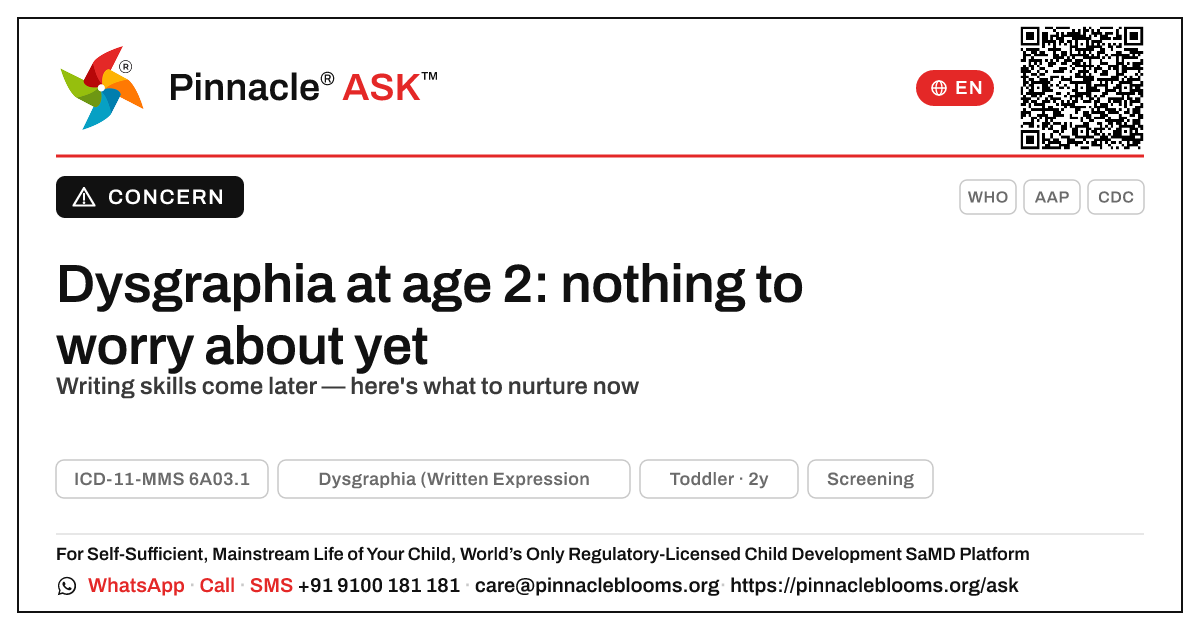
Dysgraphia cannot be identified in a 2-year-old — writing is a skill that develops only after years of language and fine-motor growth, so it's usually recognised from around ages 6–8 when formal writing begins. At two, there is nothing to diagnose; scribbling, fist grips and no shape-drawing are all expected. Support hand strength, language and play, and if you have any broader developmental worry, choose a general developmental check rather than a writing-specific one.
In this answer 5 sections
If you've heard the word 'dysgraphia' and wondered whether your busy, scribbling two-year-old might have it, let this settle your mind gently.
In short
Dysgraphia — a difficulty with the written expression of language — is not something that can be identified in a 2-year-old, and it is not meaningful to worry about it yet. Writing is a skill that develops only after years of language, fine-motor and pre-writing growth, so dysgraphia is usually recognised once formal writing begins, around ages 6–8. At two, there is nothing to diagnose — only wonderful foundations to nurture and watch. What you can do now is support the early building blocks (hand strength, language, play) and keep a general eye on overall development.
Why dysgraphia doesn't apply at age 2
Writing sits at the top of a tall developmental ladder. Before a child can ever write letters, they spend years building grip strength, hand-eye coordination, finger control, spoken language and the ability to hold a crayon. A two-year-old who scribbles, can't draw shapes, or shows no interest in pencils is doing exactly what is expected — these are not signs of dysgraphia.
What is lovely and appropriate to observe at this age:
- Hands & fingers — grasping crayons in a fist, making marks and scribbles, stacking a few blocks, picking up small items with thumb and finger.
- Play & imitation — banging, posting, scribbling back and forth, copying simple actions you make.
- Language — using single words and starting to join two ("more juice"), pointing to share, following simple instructions.
These pre-writing and language skills are the true foundations. If they are growing along, your child is on track for writing in the years ahead.
When writing concerns become meaningful
A genuine look at written expression makes sense only once a child is formally learning to write, typically from age 6 onwards. At that stage, persistent struggles — letters that stay laboured, illegible or reversed long after peers, trouble putting thoughts onto paper, or hand fatigue and avoidance of writing — would be worth a clinician's review.
For now, the right stance is simple: if you have any broader worry about your two-year-old's development — speech, understanding, movement, social connection — a general developmental check is the sensible route, never a writing-specific assessment.
The Pinnacle way
A clinical AbilityScore® and any diagnosis are formed only at a Pinnacle Blooms Network centre, under qualified clinician care — never from an online list, and never for a label that doesn't yet apply at your child's age. If you'd like reassurance about how your two-year-old is growing overall, our clinicians can build a warm developmental baseline; if speech or play is your worry, our occupational therapy team gently strengthens the early hand and play skills that writing will one day rest upon. You can also read more about dysgraphia and when it truly becomes relevant.
Trusted sources
WHO ICD-11 frames developmental learning disorders, including impairment in written expression, as conditions identified once formal academic learning is under way. American Academy of Pediatrics (healthychildren.org) and CDC milestone guidance describe age-appropriate pre-writing and fine-motor skills for toddlers, with formal writing skills expected only in the early school years.
Next step — Set the dysgraphia worry aside for now, and if anything about your child's overall development is on your mind, book a developmental check with a Pinnacle clinician for clarity and reassurance.
This is general information, not a diagnosis — individual assessment and diagnosis require an appropriately qualified healthcare professional.
CONNECT THE ANSWER TO YOUR CHILD’S DAY
Something to notice. Something to discuss.
What to notice
Dysgraphia is not assessable at age 2. Watch instead the building blocks: grasping crayons, scribbling, stacking blocks, using single and two-word phrases, pointing to share, following simple instructions. Writing-specific concerns become meaningful only from about age 6 when formal writing begins. For any broader developmental worry now, choose a general developmental check.
In everyday life
Give your toddler chunky crayons, finger paints and stacking toys — these build the hand strength and coordination that writing will one day rest on. There's no need to teach letters yet; playful scribbling is exactly the right work for now.
Bring your observations and questions to your child’s professional. Choose activities that suit your child’s comfort, abilities and agreed plan.
Bring your questions to a first visitQuestions families ask
Can dysgraphia be diagnosed in a 2-year-old?
No. Dysgraphia is a difficulty with written expression, and writing is a skill that develops only after years of language and fine-motor growth. It is usually recognised once formal writing begins, around ages 6–8, so there is nothing to diagnose at age two.
My 2-year-old can't draw shapes or hold a pencil properly — is that a problem?
Not at all. A fist grip on crayons, scribbling rather than drawing shapes, and little interest in pencils are all completely expected at two. These are normal pre-writing stages, not signs of dysgraphia.
What can I do now to support future writing?
Focus on the foundations: chunky crayons, finger painting, stacking blocks, playdough and lots of talking and shared play. These build hand strength, coordination and language — the true groundwork writing will later rest upon.
When does a writing concern actually become meaningful?
Once a child is formally learning to write, typically from age 6, persistent struggles such as laboured or illegible letters, difficulty getting thoughts on paper, or strong avoidance of writing would be worth a clinician's review.
FOLLOW THE SOURCE
References behind this answer.
- Source referenceWHO ICD-11: developmental learning disorders
- Organisation website · further readingAAP — toddler milestones and fine-motor development
- Source referenceCDC — developmental milestones for toddlers
References are supplied with this answer. An organisation homepage offers further reading; it does not establish an independent review of this page.
Content attribution: SETU Consortium · Pinnacle Blooms Network.
PEOPLE, TOPICS & DEVELOPMENT
See the connections.
Browse the wider question collections connected with this answer’s audience, developmental area and stage.
FROM UNDERSTANDING TO PURPOSEFUL SUPPORT
One question. Your child’s whole life.
Your child’s self-sufficient, mainstream-included life is the purpose from the beginning. At Pinnacle, that purpose shapes what we understand, the goals we choose, the people we bring together, everyday practice and review.
Connect this question with the right support.
Start with your child’s strengths, your observations and what you want everyday life to become.
Make the next conversation useful.
Bring the situations you notice at home or school. We’ll explain a suitable service, centre and first visit, including availability and fees, before you decide.
How PinnacleAI® connects the journeyExplore the seven stages
- 1Understand abilities
A starting picture of your child’s capabilities.
- 2Choose meaningful goals
Readiness and a plan shaped around the child.
- 3Bring the right support together
Suitable therapies and people for those goals.
- 4Carry practice into everyday life
Guidance for family, home and school.
- 5Track and correct
Use observations to adjust the plan.
- 6Reassess and review
Decide what to continue, change or do next.
- 7Grow independence and participation
The child’s life gives each step its purpose.
Explore the whole PinnacleAI® system → · Participation at school and in the community →
PINNACLE’S EVIDENCE, OPEN TO YOU
Look at the evidence behind our work.
Read our research, inspect the original regulatory documents and check what each institutional measure means.
General information supports a conversation with an appropriately qualified professional. Advice, goals and support depend on the individual child.