
YOUR QUESTION. A CLEARER NEXT STEP.
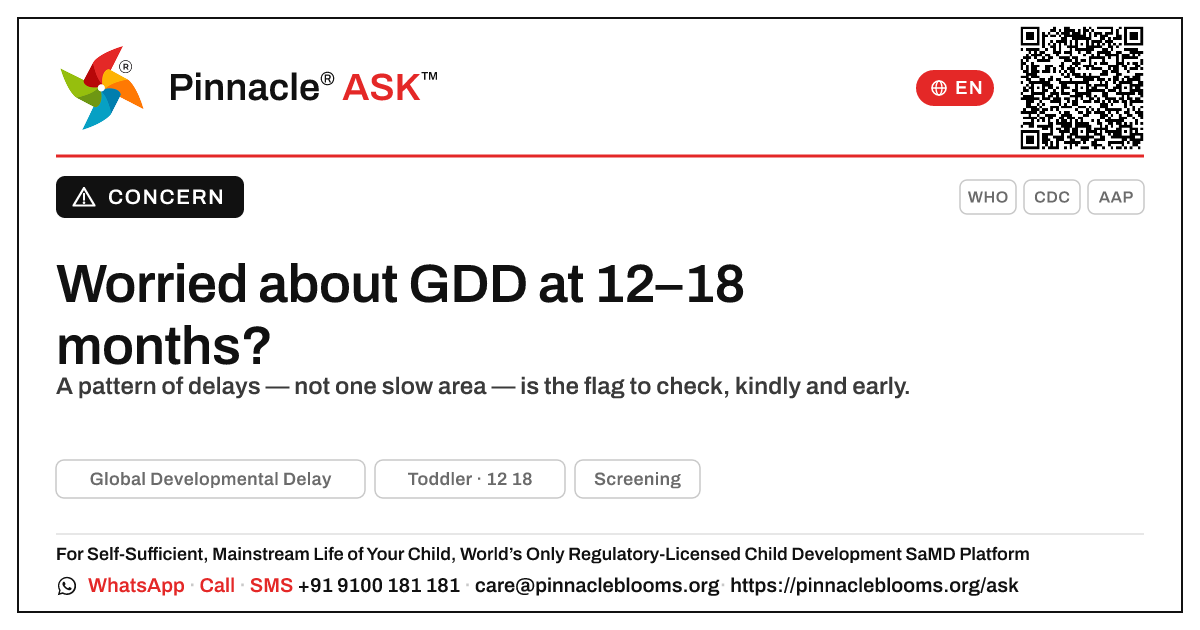
When to worry about Global Developmental Delay at 12–18 months
Worry is reasonable if your 12-to-18-month-old shows delays in two or more areas — movement, speech, social or thinking skills — or loses skills they once had. A single slow area is often normal; a pattern is the flag to check. Only a clinician can confirm GDD.
In this answer 4 sections
If your little one isn't reaching milestones the way you expected, that worry is real — and it deserves a clear, kind answer.
In short
Global Developmental Delay (GDD) means a young child is noticeably behind in two or more areas of development — movement, speech, thinking, social skills or daily self-help — rather than just one. Between 12 and 18 months, worry is reasonable (and worth checking) if you see a pattern of delays such as:
- Not sitting steadily by 9–10 months, or not pulling to stand / cruising by 12–15 months
- No babbling, gestures (waving, pointing), or first words by around 12–15 months
- Little eye contact, social smiling or response to their name
- Loss of skills your child once had — this always warrants a prompt check
One area being a little slow is often a normal variation. A combination of delays, or any skill regression, is the real flag to act on — not to panic over.
The science, briefly
GDD is the recognised term for significant delay across multiple domains in children under five, when full assessment isn't yet possible (WHO ICD-11). Milestones are ranges, not deadlines — many children catch up. But identifying delays early matters enormously: the first two years are when the developing brain is most responsive, so timely support changes outcomes. India's RBSK programme and the CDC's "Learn the Signs" milestones exist precisely so concerns are caught early, not missed.
The Pinnacle way
An online list can raise a question — it cannot answer it. Developmental measurement supports care planning; diagnosis requires an appropriately qualified healthcare professional., under qualified clinician care, where your child is measured against their own developmental baseline. Our early-intervention and special-education team looks for treatable causes first and builds a plan — clarity and a path, never just a label. Backed by 4.95 lakh+ families served across 70+ centres.
Trusted sources
WHO ICD-11 (developmental delay); CDC — Learn the Signs. Act Early. milestones; Indian Academy of Pediatrics; AAP (HealthyChildren.org); RBSK developmental screening (4 Ds).
Next step — The kindest thing to do with worry is check. Book a developmental screening with a Pinnacle clinician.
This is general information, not a diagnosis — individual assessment and diagnosis require an appropriately qualified healthcare professional.
CONNECT THE ANSWER TO YOUR CHILD’S DAY
Something to notice. Something to discuss.
What to notice
Seek assessment sooner if your child loses skills they once had, isn't bearing weight on legs or bringing hands together by 12 months, shows no babbling or gestures, or doesn't respond to their name or familiar faces.
In everyday life
Build short bursts of face-to-face play into your day — point at things together, name them, wave bye-bye, and pause to let your child respond. These tiny back-and-forth moments across movement, sounds and social games are gentle, powerful development practice.
Bring your observations and questions to your child’s professional. Choose activities that suit your child’s comfort, abilities and agreed plan.
Bring your questions to a first visitQuestions families ask
Is being slow in just one area a sign of Global Developmental Delay?
Usually not. GDD describes significant delay across two or more areas — like movement and speech together. A single slower area, especially with no skill loss, is often a normal variation. A persistent pattern across domains is what's worth a clinician's check.
My child was a little late to walk but talks well. Should I worry?
Children develop at their own pace, and one delayed milestone in an otherwise thriving child is often within the normal range. Mention it at your next paediatric visit for reassurance, and watch that other areas — speech, social, play — keep progressing.
Can a child with Global Developmental Delay catch up?
Many children make excellent progress, especially with early support during the highly responsive first years. GDD is a starting point for help, not a fixed outcome. A clinician will look for treatable causes and build a tailored plan.
At what age can Global Developmental Delay be confirmed?
GDD is the term used for under-fives when delays span multiple areas and full testing isn't yet possible. A clinician can assess concerns at any age — the earlier the better — and the picture is reviewed and refined as your child grows.
FOLLOW THE SOURCE
References behind this answer.
- Source referenceWHO ICD-11
- Source referenceCDC — Learn the Signs. Act Early.
- Organisation website · further readingAAP — HealthyChildren.org
References are supplied with this answer. An organisation homepage offers further reading; it does not establish an independent review of this page.
Content attribution: SETU Consortium · Pinnacle Blooms Network.
PEOPLE, TOPICS & DEVELOPMENT
See the connections.
Browse the wider question collections connected with this answer’s audience, developmental area and stage.
FROM UNDERSTANDING TO PURPOSEFUL SUPPORT
One question. Your child’s whole life.
Your child’s self-sufficient, mainstream-included life is the purpose from the beginning. At Pinnacle, that purpose shapes what we understand, the goals we choose, the people we bring together, everyday practice and review.
Connect this question with the right support.
Explore how the relevant service contributes to everyday abilities, then speak with us about your child.
Make the next conversation useful.
Bring the situations you notice at home or school. We’ll explain a suitable service, centre and first visit, including availability and fees, before you decide.
How PinnacleAI® connects the journeyExplore the seven stages
- 1Understand abilities
A starting picture of your child’s capabilities.
- 2Choose meaningful goals
Readiness and a plan shaped around the child.
- 3Bring the right support together
Suitable therapies and people for those goals.
- 4Carry practice into everyday life
Guidance for family, home and school.
- 5Track and correct
Use observations to adjust the plan.
- 6Reassess and review
Decide what to continue, change or do next.
- 7Grow independence and participation
The child’s life gives each step its purpose.
Explore the whole PinnacleAI® system → · Participation at school and in the community →
PINNACLE’S EVIDENCE, OPEN TO YOU
Look at the evidence behind our work.
Read our research, inspect the original regulatory documents and check what each institutional measure means.
General information supports a conversation with an appropriately qualified professional. Advice, goals and support depend on the individual child.