
YOUR QUESTION. A CLEARER NEXT STEP.
SNOMED CT concept for Global Developmental Delay
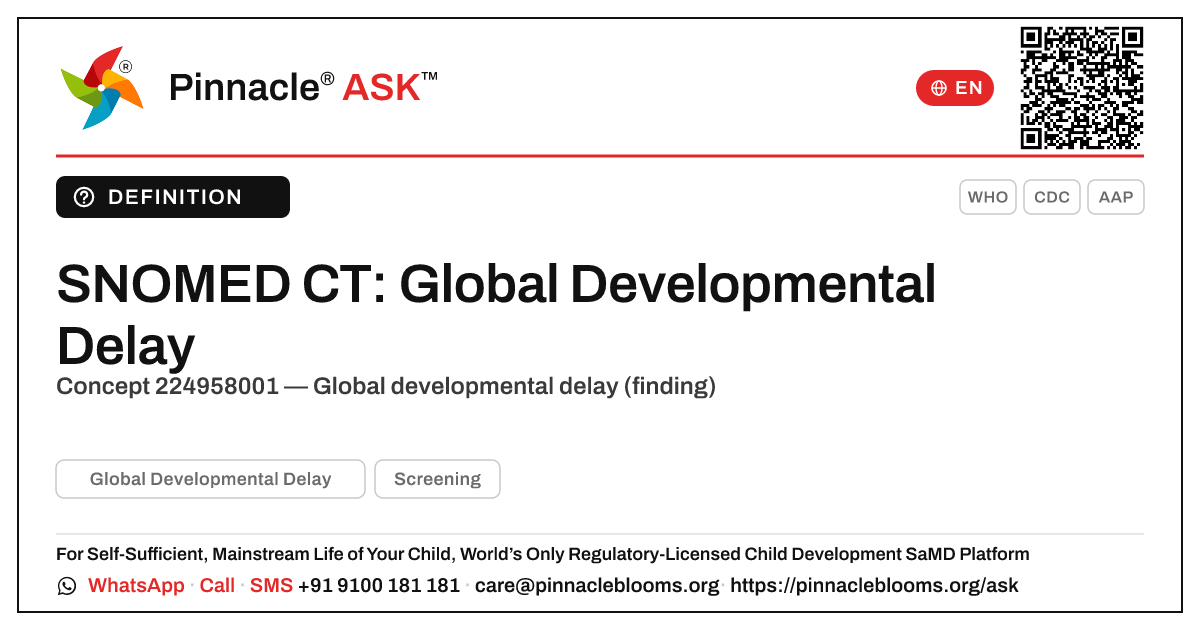
The SNOMED CT International Edition concept for Global Developmental Delay is 224958001 — Global developmental delay (finding). It is a descriptive finding for under-fives, best paired with ICD-11 and re-coded as the clinical picture clarifies. Always verify the active code against your local SNOMED CT release.
In this answer 4 sections
Clean terminology coding starts with the right concept — for Global Developmental Delay, that single SNOMED CT identifier keeps records, referrals and analytics aligned.
In short
The SNOMED CT International Edition concept for Global Developmental Delay is 224958001 — Global developmental delay (finding). It sits within the disorder/finding hierarchy and is the appropriate machine-readable term for documenting GDD in an EHR or referral. Use it as the structured finding while the underlying aetiology remains undetermined; map alongside ICD-11 where billing or epidemiology requires it. As ever, confirm the active code against your local SNOMED CT release, since edition and extension content evolve.
Using the concept correctly
GDD is a descriptive clinical finding, not a permanent diagnosis: it applies to children under roughly five years with significant delay (typically ≥2 domains) where standardised testing of intellectual functioning is not yet reliable. As the child matures, the picture often resolves into a more specific label — intellectual developmental disorder, a specific learning or language disorder, or typical catch-up.
For cross-system interoperability, pair the SNOMED CT finding with the corresponding ICD-11 entry and document the domains affected (gross/fine motor, speech-language, cognition, social, ADL). This supports both clinical clarity and downstream analytics. Re-screen and re-code at follow-up rather than carrying GDD forward indefinitely.
The Pinnacle way
Developmental measurement supports care planning; diagnosis requires an appropriately qualified healthcare professional., under qualified clinician care — coding follows assessment, never the reverse. Across 70+ centres and 25 million+ therapy sessions, we structure GDD documentation so that the AbilityScore® clinician-administered assessment and the child's speech and language therapy plan stay coded consistently from intake through review.
Trusted sources
WHO ICD-11 for the corresponding classification entry; CDC developmental milestones for the clinical context of delay; AAP (HealthyChildren) and the Indian Academy of Pediatrics for surveillance guidance. Always verify the live SNOMED CT concept status in your current national or international release.
Next step — Partner with us to standardise GDD pathways — connect with the Pinnacle clinical team.
This is general information, not a diagnosis — individual assessment and diagnosis require an appropriately qualified healthcare professional.
CONNECT THE ANSWER TO YOUR CHILD’S DAY
Something to notice. Something to discuss.
What to notice
Carrying GDD forward unchanged past age five — re-screen and re-code toward a more specific finding as standardised cognitive testing becomes reliable.
In everyday life
Always confirm the concept status against your current SNOMED CT release, since edition and extension content can change between updates.
Bring your observations and questions to your child’s professional. Choose activities that suit your child’s comfort, abilities and agreed plan.
Bring your questions to a first visitQuestions families ask
What is the SNOMED CT concept ID for Global Developmental Delay?
In the SNOMED CT International Edition, Global Developmental Delay is concept 224958001 — Global developmental delay (finding). Verify it remains active in your current local release.
Is GDD a finding or a disorder in SNOMED CT?
It is recorded as a clinical finding. GDD is descriptive for children under about five, where standardised intellectual testing is not yet reliable, rather than a fixed lifelong diagnosis.
Should I also code an ICD-11 entry?
Yes — pair the SNOMED CT finding with the corresponding ICD-11 entry for billing, epidemiology and interoperability, and document the specific domains affected.
Does the GDD code carry forward indefinitely?
It should not. As the child matures, re-assess and re-code toward a more specific finding such as an intellectual developmental disorder, language disorder, or typical resolution.
FOLLOW THE SOURCE
References behind this answer.
- Source referenceWHO ICD-11 — classification context
- Source referenceCDC — developmental milestones
- Organisation website · further readingAAP — HealthyChildren developmental guidance
References are supplied with this answer. An organisation homepage offers further reading; it does not establish an independent review of this page.
Content attribution: SETU Consortium · Pinnacle Blooms Network.
PEOPLE, TOPICS & DEVELOPMENT
See the connections.
Browse the wider question collections connected with this answer’s audience, developmental area and stage.
FROM UNDERSTANDING TO PURPOSEFUL SUPPORT
One question. Your child’s whole life.
Your child’s self-sufficient, mainstream-included life is the purpose from the beginning. At Pinnacle, that purpose shapes what we understand, the goals we choose, the people we bring together, everyday practice and review.
Connect this question with the right support.
Explore how the relevant service contributes to everyday abilities, then speak with us about your child.
Make the next conversation useful.
Bring the situations you notice at home or school. We’ll explain a suitable service, centre and first visit, including availability and fees, before you decide.
How PinnacleAI® connects the journeyExplore the seven stages
- 1Understand abilities
A starting picture of your child’s capabilities.
- 2Choose meaningful goals
Readiness and a plan shaped around the child.
- 3Bring the right support together
Suitable therapies and people for those goals.
- 4Carry practice into everyday life
Guidance for family, home and school.
- 5Track and correct
Use observations to adjust the plan.
- 6Reassess and review
Decide what to continue, change or do next.
- 7Grow independence and participation
The child’s life gives each step its purpose.
Explore the whole PinnacleAI® system → · Participation at school and in the community →
PINNACLE’S EVIDENCE, OPEN TO YOU
Look at the evidence behind our work.
Read our research, inspect the original regulatory documents and check what each institutional measure means.
General information supports a conversation with an appropriately qualified professional. Advice, goals and support depend on the individual child.