
YOUR QUESTION. A CLEARER NEXT STEP.
When should an ASHA or PHC worker escalate a child showing signs of cerebral palsy?
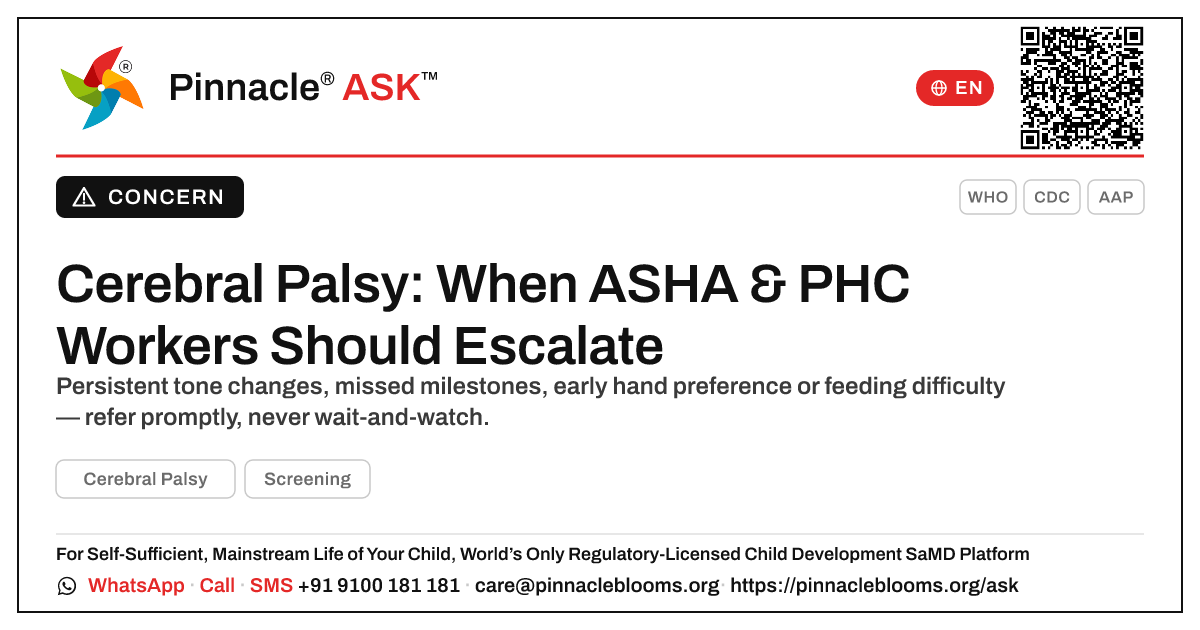
Escalate promptly — do not wait-and-watch — when an infant shows persistent stiff or floppy tone, early hand preference before 12 months, a missed motor milestone, or feeding difficulty, especially with a high-risk birth history. Cerebral palsy is a medical referral; any seizure is an emergency. Early referral is always the safer call.
In this answer 5 sections
A community worker is often the first to notice a baby who isn't moving quite as expected — and that early notice can change a child's whole trajectory.
In short
Escalate to a medical officer or paediatrician promptly — do not wait-and-watch — when an infant shows persistent motor red flags: stiff or unusually floppy tone, asymmetry (consistently favouring one hand before 12 months), a missed gross-motor milestone, or feeding/swallowing difficulty. Cerebral palsy is a medical referral, not a therapy-first or home-monitoring situation. When in doubt, refer up — early referral is always the safer call.
Signs that warrant escalation
For a community health worker, the practical escalation triggers are:
- Tone abnormality — limbs that feel stiff (hypertonia), scissoring of the legs, or a baby who feels persistently floppy (hypotonia).
- Persistent fisting of the hands beyond 4 months, or a strong hand preference before 12 months (true asymmetry is a flag).
- Missed motor milestones — not holding head steady by ~4 months, not sitting by ~9 months, not bearing weight or pulling to stand by ~12 months.
- Feeding or swallowing difficulty, excessive drooling, frequent choking, or poor weight gain.
- Birth-history risk — prematurity, low birth weight, birth asphyxia, neonatal seizures, jaundice needing exchange, or NICU stay — plus any of the above.
- Any seizure activity — escalate immediately as a medical emergency.
A single observation in isolation may be benign; a persistent pattern, or any risk-history child with a motor concern, should be escalated without delay.
How to escalate well
Document what you observed (with dates and the child's age), note the birth and NICU history, and refer to the PHC medical officer or nearest paediatrician for clinical examination and onward developmental assessment. Frame it to the family as a check-up to understand the baby's movements better — never as a diagnosis. Continue routine immunisation, nutrition and growth monitoring in parallel. Early identification under the RBSK pathway connects the family to confirmatory assessment and intervention.
The Pinnacle way
A clinical AbilityScore® and any diagnosis of cerebral palsy are formed only at a Pinnacle Blooms Network centre, under qualified clinician care — never from a screening observation or an online form. Once a child is referred and assessed, a coordinated plan across physiotherapy and developmental therapy supports motor function, feeding and communication. The community worker's role is the most powerful one: noticing early, and routing the family to the right hands.
Trusted sources
WHO ICD-11 (structural classification of cerebral palsy); CDC Learn the Signs. Act Early. milestone guidance; Indian Academy of Pediatrics; American Academy of Pediatrics (HealthyChildren.org); WHO ICF functioning framework.
Next step — Refer the child to the PHC medical officer or paediatrician today, and book a developmental assessment at the nearest Pinnacle centre for confirmatory evaluation.
This is general information, not a diagnosis — individual assessment and diagnosis require an appropriately qualified healthcare professional.
CONNECT THE ANSWER TO YOUR CHILD’S DAY
Something to notice. Something to discuss.
What to notice
Escalate immediately for any seizure, sudden loss of acquired motor skills, severe feeding difficulty with poor weight gain, or breathing concerns. For persistent tone abnormality or strong hand preference before 12 months, refer to the medical officer without delay.
In everyday life
When you visit, watch the baby move on the floor for a minute: does one side lead every time? Does the baby push up, reach with both hands, bear weight on the legs? Note what you see with the date and age — it makes the referral far more useful to the doctor.
Bring your observations and questions to your child’s professional. Choose activities that suit your child’s comfort, abilities and agreed plan.
Bring your questions to a first visitQuestions families ask
Should an ASHA worker wait and watch a baby with stiff or floppy tone?
No. Persistent tone abnormality — stiffness, scissoring or floppiness — in an infant warrants prompt referral to the PHC medical officer or paediatrician. Cerebral palsy is a medical referral, not a wait-and-watch concern, especially in a child with high-risk birth history.
What birth-history factors raise the priority for referral?
Prematurity, low birth weight, birth asphyxia, neonatal seizures, severe jaundice needing exchange transfusion, and NICU admission all raise risk. A child with any of these plus a motor concern should be escalated without delay.
Is early hand preference a real red flag?
Yes. A strong, consistent hand preference before 12 months can indicate weakness or reduced use on the other side and should be referred for clinical examination — true asymmetry in infancy is not typical.
Can a community worker diagnose cerebral palsy?
No. Community workers identify and escalate; diagnosis is made only by a clinician after examination and structured developmental assessment. Frame the referral to families as a check-up to understand the baby's movements, never as a diagnosis.
FOLLOW THE SOURCE
References behind this answer.
- Source referenceWHO ICD-11 classification of cerebral palsy
- Source referenceCDC — Learn the Signs. Act Early. (milestones)
- Organisation website · further readingAmerican Academy of Pediatrics — HealthyChildren.org
- Source referenceWHO ICF — functioning profile
References are supplied with this answer. An organisation homepage offers further reading; it does not establish an independent review of this page.
Content attribution: SETU Consortium · Pinnacle Blooms Network.
PEOPLE, TOPICS & DEVELOPMENT
See the connections.
Browse the wider question collections connected with this answer’s audience, developmental area and stage.
FROM UNDERSTANDING TO PURPOSEFUL SUPPORT
One question. Your child’s whole life.
Your child’s self-sufficient, mainstream-included life is the purpose from the beginning. At Pinnacle, that purpose shapes what we understand, the goals we choose, the people we bring together, everyday practice and review.
Connect this question with the right support.
Start with your child’s strengths, your observations and what you want everyday life to become.
Make the next conversation useful.
Bring the situations you notice at home or school. We’ll explain a suitable service, centre and first visit, including availability and fees, before you decide.
How PinnacleAI® connects the journeyExplore the seven stages
- 1Understand abilities
A starting picture of your child’s capabilities.
- 2Choose meaningful goals
Readiness and a plan shaped around the child.
- 3Bring the right support together
Suitable therapies and people for those goals.
- 4Carry practice into everyday life
Guidance for family, home and school.
- 5Track and correct
Use observations to adjust the plan.
- 6Reassess and review
Decide what to continue, change or do next.
- 7Grow independence and participation
The child’s life gives each step its purpose.
Explore the whole PinnacleAI® system → · Participation at school and in the community →
PINNACLE’S EVIDENCE, OPEN TO YOU
Look at the evidence behind our work.
Read our research, inspect the original regulatory documents and check what each institutional measure means.
General information supports a conversation with an appropriately qualified professional. Advice, goals and support depend on the individual child.