
YOUR QUESTION. A CLEARER NEXT STEP.
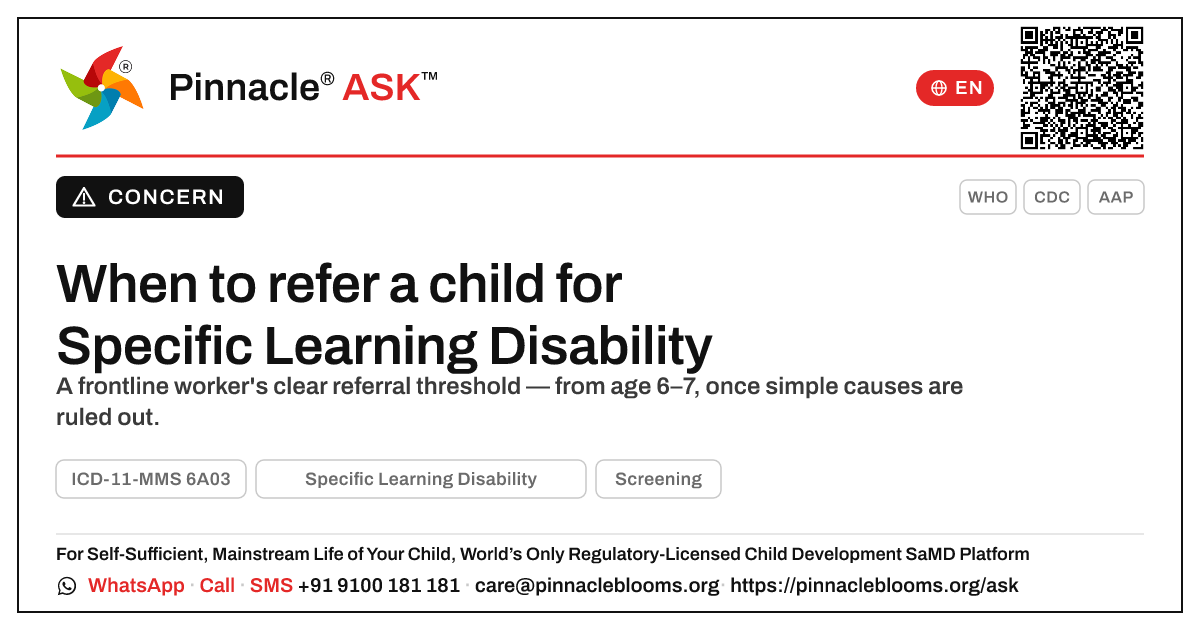
When to refer a child with possible Specific Learning Disability
Refer once academic difficulty is persistent (6+ months despite help), well below age expectation, and not explained by schooling, hearing, vision or another condition — typically from age 6–7 when formal learning has begun. Rule out simple causes first; only a clinician confirms it.
In this answer 5 sections
A frontline worker rarely diagnoses — your gift is noticing early and routing wisely. Here is the clear threshold for referral.
In short
Refer a child to a specialist when academic difficulty is persistent (six months or more despite extra help), is well below what you'd expect for their age, and isn't explained by poor schooling, hearing or vision problems, or another condition — and when the child is at least 6–7 years old, once formal reading, writing and number work has begun. Before that age, watch and support; a true Specific Learning Disability cannot be confirmed earlier because the skills haven't yet been taught.
What to watch — your referral triggers
By primary-school age (Class 1 onward), flag a child who shows a persistent pattern, not a one-off bad term:
- Reading — struggles to link letters and sounds, reads far below classmates, guesses or skips words
- Writing — very poor spelling, reversed or jumbled letters well past the early years, sentences that don't form
- Number — cannot grasp basic quantity, counting or simple arithmetic expected for the grade
- Effort vs. result — bright, capable child who tries hard yet falls behind only in specific academic skills
First rule out the simple, fixable causes: check hearing and vision, and confirm the child has had regular schooling. If difficulty persists despite support, refer.
The science, briefly
The WHO classifies this as Developmental Learning Disorder (ICD-11 6A03) — a specific, persistent difficulty in reading, writing or arithmetic that is not due to intellectual disability, sensory impairment or lack of teaching. It affects a meaningful share of every classroom, and early identification protects a child's confidence and keeps them learning in the mainstream.
The Pinnacle way
No diagnosis is made from a form or a referral note — Developmental measurement supports care planning; diagnosis requires an appropriately qualified healthcare professional., under a qualified clinician, measured against the child's own baseline. Your referral starts that journey. Pinnacle's learning and education-support therapy team then builds a plan with the family and school.
Trusted sources
WHO ICD-11 (6A03, Developmental Learning Disorder); CDC Learn the Signs. Act Early.; Indian Academy of Pediatrics; American Academy of Pediatrics (HealthyChildren.org).
Next step — When the pattern persists past simple causes, don't wait. Refer the family for an assessment at the nearest Pinnacle centre.
This is general information, not a diagnosis — individual assessment and diagnosis require an appropriately qualified healthcare professional.
CONNECT THE ANSWER TO YOUR CHILD’S DAY
Something to notice. Something to discuss.
What to notice
Refer sooner if a school-age child loses confidence, avoids reading or writing, or shows distress about school despite trying hard — and always check hearing and vision first.
In everyday life
When you meet the family, ask one simple question: 'Has anyone checked the child's hearing, vision, and whether they've been in school regularly?' Ruling these out early makes your referral far more useful to the specialist.
Bring your observations and questions to your child’s professional. Choose activities that suit your child’s comfort, abilities and agreed plan.
Bring your questions to a first visitQuestions families ask
At what age can a Specific Learning Disability be confirmed?
Usually from about 6–7 years, once formal reading, writing and arithmetic have been taught. Before that, the skills haven't been learned yet, so the disorder cannot be confirmed — support and monitor instead.
What should a frontline worker rule out before referring?
Check hearing and vision, and confirm the child has had regular, adequate schooling. Difficulty explained by these isn't a learning disability. If difficulty persists despite support, refer.
How long should difficulty persist before referral?
A persistent pattern of around six months or more, despite extra help at home or school, in a specific area like reading, writing or number — not a single bad term.
FOLLOW THE SOURCE
References behind this answer.
- Source referenceWHO ICD-11 · Developmental learning disorder
- Source referenceCDC — Learn the Signs. Act Early.
- Organisation website · further readingAmerican Academy of Pediatrics · HealthyChildren.org
References are supplied with this answer. An organisation homepage offers further reading; it does not establish an independent review of this page.
Content attribution: SETU Consortium · Pinnacle Blooms Network.
PEOPLE, TOPICS & DEVELOPMENT
See the connections.
Browse the wider question collections connected with this answer’s audience, developmental area and stage.
FROM UNDERSTANDING TO PURPOSEFUL SUPPORT
One question. Your child’s whole life.
Your child’s self-sufficient, mainstream-included life is the purpose from the beginning. At Pinnacle, that purpose shapes what we understand, the goals we choose, the people we bring together, everyday practice and review.
Connect this question with the right support.
Explore how the relevant service contributes to everyday abilities, then speak with us about your child.
Make the next conversation useful.
Bring the situations you notice at home or school. We’ll explain a suitable service, centre and first visit, including availability and fees, before you decide.
How PinnacleAI® connects the journeyExplore the seven stages
- 1Understand abilities
A starting picture of your child’s capabilities.
- 2Choose meaningful goals
Readiness and a plan shaped around the child.
- 3Bring the right support together
Suitable therapies and people for those goals.
- 4Carry practice into everyday life
Guidance for family, home and school.
- 5Track and correct
Use observations to adjust the plan.
- 6Reassess and review
Decide what to continue, change or do next.
- 7Grow independence and participation
The child’s life gives each step its purpose.
Explore the whole PinnacleAI® system → · Participation at school and in the community →
PINNACLE’S EVIDENCE, OPEN TO YOU
Look at the evidence behind our work.
Read our research, inspect the original regulatory documents and check what each institutional measure means.
General information supports a conversation with an appropriately qualified professional. Advice, goals and support depend on the individual child.