
YOUR QUESTION. A CLEARER NEXT STEP.
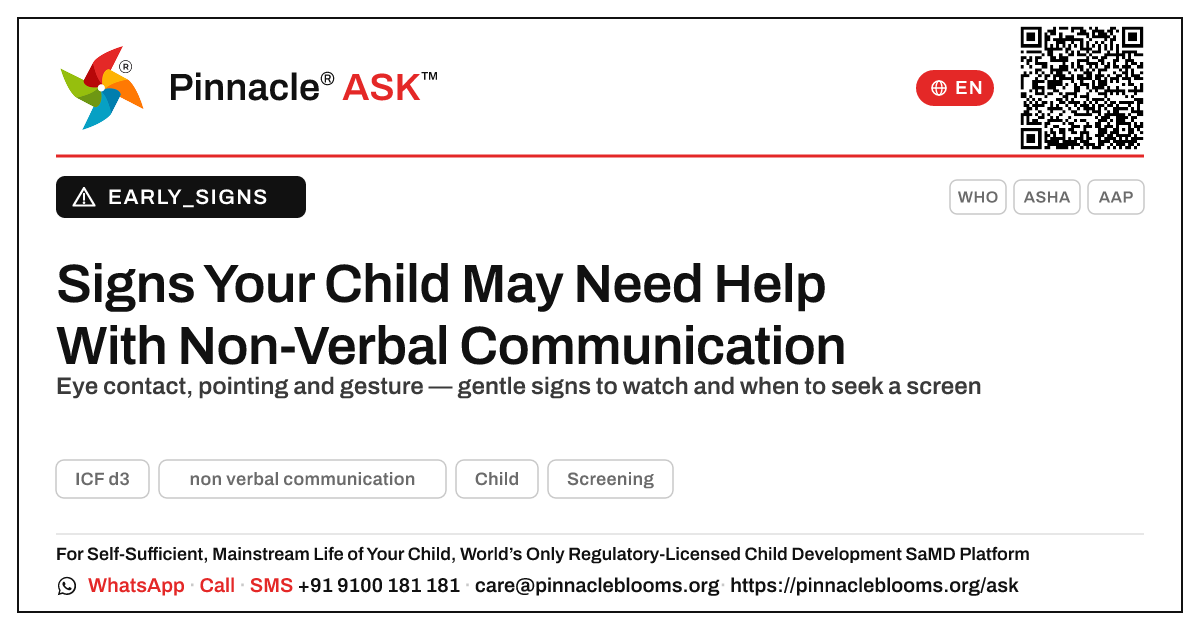
Signs Your Child May Need Support with Non-Verbal Communication
For a child aged 3–7, signs that non-verbal communication may need support include limited eye contact, rarely pointing or showing to share, few gestures (waving, nodding, reaching), limited facial expression, and difficulty reading or using body cues. These are signs to observe and discuss — not to diagnose at home. When several appear together and persist over months, a developmental and speech-language screen is the gentle, useful next step.
In this answer 5 sections
Long before words bloom, children speak with their eyes, hands and faces — so how do you tell ordinary quietness from a pattern worth a gentle, closer look?
In short
For a child between 3 and 7 years, signs that non-verbal communication may need support include little eye contact during play, rarely pointing or showing things to share interest, few gestures (waving, nodding, reaching up), a face that doesn't often light up in response to yours, and difficulty reading or using simple body cues. These are signs to observe and discuss — not to diagnose at home. When several show together and persist, a developmental screen is the kind, useful next step.
Signs to watch
Non-verbal communication is everything we 'say' without words — eye contact, gestures, facial expression, posture and shared attention. Watch gently for:
Eye contact and shared attention
- Rarely looks to your eyes to connect, share joy or check in
- Doesn't follow your point or pointing finger to look where you look
- Seldom points or holds things up just to show you, not only to get them
Gestures and expression
- Few natural gestures — waving bye, nodding, shaking head, reaching to be lifted
- Limited range of facial expression, or expressions that don't match the moment
- Doesn't easily read others' cues (a frown, an open arm, a 'come here')
Using the body to communicate
- Leads you by the hand without looking, rather than gesturing and glancing
- Struggles to take turns in to-and-fro play or simple back-and-forth 'conversation'
What shifts this from ordinary shyness towards worth-assessing is a pattern across several of these, lasting over months, or affecting how your child connects and plays day to day.
When to seek a check
A single quiet trait is rarely cause for worry. But if shared eye contact, pointing and gesture are consistently limited together, a developmental and speech-language screen is wise — earlier support is gentler and works with your child's natural play. Hearing is always checked first, since it shapes communication.
The Pinnacle way
At Pinnacle Blooms Network, we begin with what your child can do and build connection through warm, play-based speech therapy — coaching you as your child's everyday communication partner. You can explore more about non verbal communication and how it grows. A clinical AbilityScore® and any diagnosis are formed only at a Pinnacle Blooms Network centre under qualified clinician care; nothing here is a diagnosis. Across 70+ centres in 4 states and 4.95 lakh+ families served, our aim is steady, strengths-first progress.
Trusted sources
Aligned with WHO ICF guidance on communication functions, American Academy of Pediatrics and HealthyChildren.org developmental monitoring, and ASHA guidance on early social-communication signs.
Next step — if your child shows signs you'd like understood, book a developmental screen with our clinical team on WhatsApp at +91 91001 81181, and let's understand your little one together.
This is general information, not a diagnosis — individual assessment and diagnosis require an appropriately qualified healthcare professional.
CONNECT THE ANSWER TO YOUR CHILD’S DAY
Something to notice. Something to discuss.
What to notice
Limited eye contact to connect or share, not following or making points, few gestures (waving, nodding, reaching up), limited facial expression, leading you by the hand without looking, and difficulty reading others' cues — especially when several persist together over months.
In everyday life
Sit face-to-face during play and pause invitingly — hold a toy near your eyes, point and say 'look!', and wait. These small moments invite eye contact, pointing and shared joy to grow naturally.
Bring your observations and questions to your child’s professional. Choose activities that suit your child’s comfort, abilities and agreed plan.
Bring your questions to a first visitQuestions families ask
Is it normal for a young child to avoid eye contact sometimes?
Yes — brief or shy eye contact happens often, especially with new people or when concentrating. What's worth a closer look is consistently limited eye contact for connecting and sharing joy, combined with few gestures or little pointing, lasting across months.
My child talks but doesn't use many gestures — does that matter?
Gestures, facial expression and eye contact are part of how children connect, even when speech is developing. If non-verbal communication stays limited alongside words, a speech-language screen can help understand the full picture and offer gentle support.
At what age should I seek a screen?
There is no need to wait. Between 3 and 7 years, if pointing, gesture, eye contact and shared attention are consistently limited together, a developmental and speech-language screen is wise. Hearing is always checked first, as it shapes all communication.
FOLLOW THE SOURCE
References behind this answer.
- Organisation website · further readingWHO ICF — communication functions (d3)
- Organisation website · further readingASHA — social and non-verbal communication development
- Organisation website · further readingHealthyChildren.org (AAP) — developmental milestones
References are supplied with this answer. An organisation homepage offers further reading; it does not establish an independent review of this page.
Content attribution: SETU Consortium · Pinnacle Blooms Network.
PEOPLE, TOPICS & DEVELOPMENT
See the connections.
Browse the wider question collections connected with this answer’s audience, developmental area and stage.
FROM UNDERSTANDING TO PURPOSEFUL SUPPORT
One question. Your child’s whole life.
Your child’s self-sufficient, mainstream-included life is the purpose from the beginning. At Pinnacle, that purpose shapes what we understand, the goals we choose, the people we bring together, everyday practice and review.
Connect this question with the right support.
Explore how the relevant service contributes to everyday abilities, then speak with us about your child.
Make the next conversation useful.
Bring the situations you notice at home or school. We’ll explain a suitable service, centre and first visit, including availability and fees, before you decide.
How PinnacleAI® connects the journeyExplore the seven stages
- 1Understand abilities
A starting picture of your child’s capabilities.
- 2Choose meaningful goals
Readiness and a plan shaped around the child.
- 3Bring the right support together
Suitable therapies and people for those goals.
- 4Carry practice into everyday life
Guidance for family, home and school.
- 5Track and correct
Use observations to adjust the plan.
- 6Reassess and review
Decide what to continue, change or do next.
- 7Grow independence and participation
The child’s life gives each step its purpose.
Explore the whole PinnacleAI® system → · Participation at school and in the community →
PINNACLE’S EVIDENCE, OPEN TO YOU
Look at the evidence behind our work.
Read our research, inspect the original regulatory documents and check what each institutional measure means.
General information supports a conversation with an appropriately qualified professional. Advice, goals and support depend on the individual child.