
YOUR QUESTION. A CLEARER NEXT STEP.
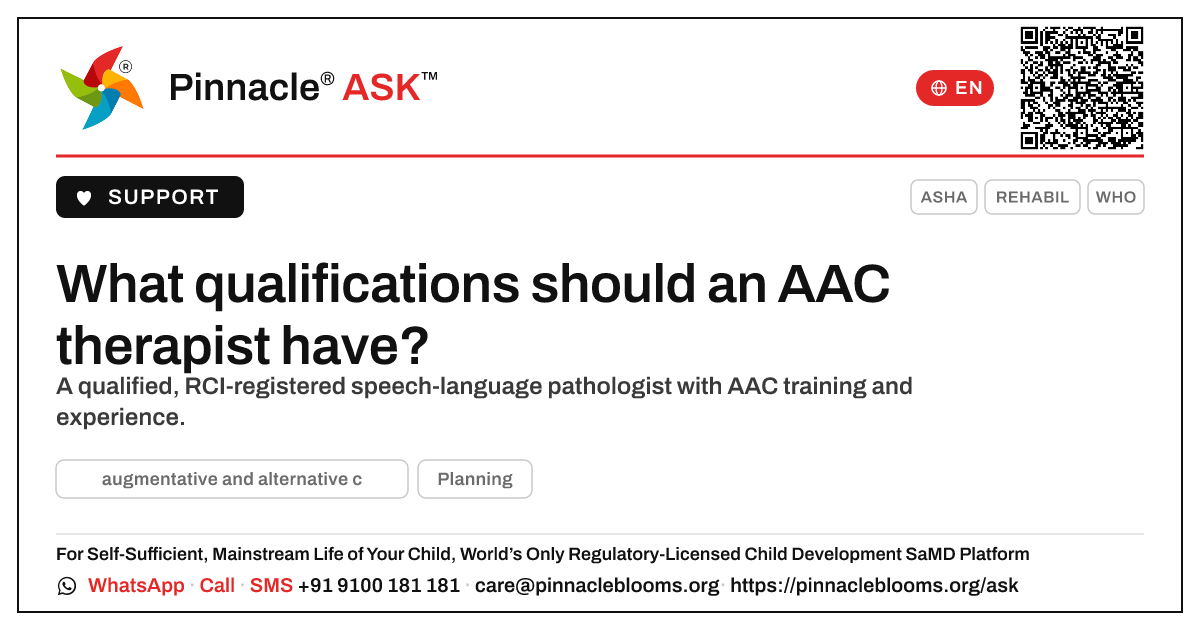
Qualifications an AAC therapist should have
An AAC therapist should be a qualified speech-language pathologist with recognised Rehabilitation Council of India (RCI) registration, plus specific training and hands-on experience in AAC systems and family coaching. AbilityScore® is part of Pinnacle’s developmental assessment. Diagnosis, where needed, requires an appropriately qualified healthcare professional.
In this answer 4 sections
Choosing someone to help your child communicate is a big step — here's exactly what to look for so you can trust the hands your child is in.
In short
A therapist providing augmentative and alternative communication (AAC) should be a qualified speech-language pathologist (speech therapist) with recognised professional registration — in India, that means registration with the Rehabilitation Council of India (RCI). Beyond the core qualification, look for specific training and hands-on experience in AAC: choosing and setting up communication tools (from picture boards to speech-generating apps and devices), and coaching families to use them in everyday life. The right person blends formal credentials with genuine experience supporting children who communicate in different ways.
What to look for
- Core qualification — a degree in speech-language pathology (such as a BASLP or MASLP) from a recognised institution.
- RCI registration — a valid Rehabilitation Council of India registration number, the legal standard for rehabilitation professionals in India. You are always welcome to ask to see it.
- AAC-specific training — additional coursework, workshops or supervised experience in AAC systems, ranging from low-tech (picture cards, communication books) to high-tech (tablet apps and speech-generating devices).
- Hands-on experience — a track record of working with children who use AAC, and comfort selecting the right system for your child rather than a one-size-fits-all tool.
- A family-coaching mindset — AAC works best when it's used at home, at school and in play, so the therapist should actively teach you how to model and support it.
- Team-working — good AAC therapists collaborate with occupational therapists, teachers and your paediatrician so the system fits your child's whole world.
AAC is not a last resort and it does not stop a child from learning to speak — research consistently shows it can support spoken language while giving your child a voice right now.
The Pinnacle way
AbilityScore® is part of Pinnacle’s developmental assessment. Diagnosis, where needed, requires an appropriately qualified healthcare professional — never from an app or online form. Every therapist supporting your child's communication is professionally qualified and works as part of a team, so your child's speech therapy and AAC plan is built around their strengths. You can understand how we map those strengths in the AbilityScore®, and explore more about how we support communication on our home page.
Trusted sources
The American Speech-Language-Hearing Association (ASHA) sets out the speech-language pathologist's central role in AAC assessment and intervention. The Rehabilitation Council of India defines registration standards for rehabilitation professionals in India. WHO guidance recognises AAC within assistive technology and communication support.
Next step — Want to know which communication approach fits your child best? Book an assessment with a qualified Pinnacle clinician.
This is general information, not a diagnosis — individual assessment and diagnosis require an appropriately qualified healthcare professional.
CONNECT THE ANSWER TO YOUR CHILD’S DAY
Something to notice. Something to discuss.
What to notice
Check for a speech-language pathology degree, a valid RCI registration number, specific AAC training, real experience with children who use AAC, and a willingness to coach you as the parent.
In everyday life
Ask any prospective therapist two simple questions: 'Are you RCI-registered?' and 'What AAC systems have you set up for children like mine?' — clear, confident answers are a good sign.
Bring your observations and questions to your child’s professional. Choose activities that suit your child’s comfort, abilities and agreed plan.
Bring your questions to a first visitQuestions families ask
Does my child need a speech therapist specifically for AAC?
Yes — a qualified speech-language pathologist (speech therapist) is the core professional for AAC. They assess your child's communication, select the right tool, and coach your family, often working alongside occupational therapists and teachers.
What is RCI registration and why does it matter?
The Rehabilitation Council of India (RCI) is the body that registers rehabilitation professionals in India, including speech-language pathologists. A valid RCI number means the therapist is formally qualified and accountable. You are always welcome to ask to see it.
Will using AAC stop my child from learning to talk?
No. Research consistently shows AAC does not hinder speech and can actually support spoken language development by reducing frustration and building communication confidence, while giving your child a way to express themselves now.
FOLLOW THE SOURCE
References behind this answer.
- Organisation website · further readingASHA — speech-language pathologists and AAC
- Organisation website · further readingRehabilitation Council of India — professional registration
- Organisation website · further readingWHO — assistive technology and communication support
References are supplied with this answer. An organisation homepage offers further reading; it does not establish an independent review of this page.
Content attribution: SETU Consortium · Pinnacle Blooms Network.
PEOPLE, TOPICS & DEVELOPMENT
See the connections.
Browse the wider question collections connected with this answer’s audience, developmental area and stage.
FROM UNDERSTANDING TO PURPOSEFUL SUPPORT
One question. Your child’s whole life.
Your child’s self-sufficient, mainstream-included life is the purpose from the beginning. At Pinnacle, that purpose shapes what we understand, the goals we choose, the people we bring together, everyday practice and review.
Connect this question with the right support.
Explore how the relevant service contributes to everyday abilities, then speak with us about your child.
Make the next conversation useful.
Bring the situations you notice at home or school. We’ll explain a suitable service, centre and first visit, including availability and fees, before you decide.
How PinnacleAI® connects the journeyExplore the seven stages
- 1Understand abilities
A starting picture of your child’s capabilities.
- 2Choose meaningful goals
Readiness and a plan shaped around the child.
- 3Bring the right support together
Suitable therapies and people for those goals.
- 4Carry practice into everyday life
Guidance for family, home and school.
- 5Track and correct
Use observations to adjust the plan.
- 6Reassess and review
Decide what to continue, change or do next.
- 7Grow independence and participation
The child’s life gives each step its purpose.
Explore the whole PinnacleAI® system → · Participation at school and in the community →
PINNACLE’S EVIDENCE, OPEN TO YOU
Look at the evidence behind our work.
Read our research, inspect the original regulatory documents and check what each institutional measure means.
General information supports a conversation with an appropriately qualified professional. Advice, goals and support depend on the individual child.