
YOUR QUESTION. A CLEARER NEXT STEP.
Qualifications a speech and language therapist should have
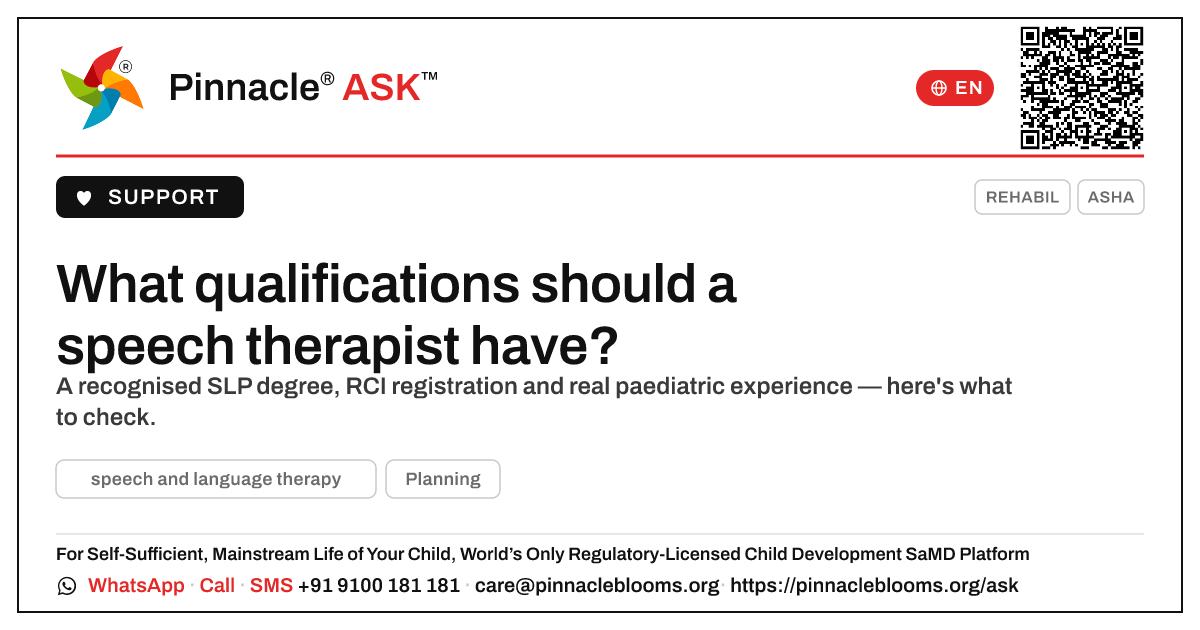
A speech and language therapist supporting your child should hold a recognised Speech-Language Pathology degree (BASLP or MASLP) and be registered with the Rehabilitation Council of India (RCI) with a valid CRR number, alongside genuine experience with children. AbilityScore® is part of Pinnacle’s developmental assessment. Diagnosis, where needed, requires an appropriately qualified healthcare professional.
In this answer 4 sections
Choosing someone to support your child's talking and understanding starts with one simple question — is this person properly qualified?
In short
A speech and language therapist supporting your child should hold a recognised degree in Speech-Language Pathology (such as a BASLP — Bachelor in Audiology and Speech-Language Pathology, or a Master's, MASLP) and be registered with the Rehabilitation Council of India (RCI) with a valid CRR (Central Rehabilitation Register) number. RCI registration is the key legal benchmark in India — it confirms the therapist is trained, accountable and permitted to practise. Experience with children and developmental needs matters just as much as the certificate on the wall.
What to look for
- Recognised qualification — a BASLP, MASLP or equivalent degree from an RCI-approved institution. This is the academic foundation in how speech, language, swallowing and communication develop.
- RCI registration (CRR number) — under Indian law, a qualified speech-language therapist must be registered with the Rehabilitation Council of India. You can politely ask for this; a genuine professional will be happy to share it.
- Paediatric experience — supporting a 3-year-old who is not yet talking is very different from adult therapy. Look for experience with children, developmental delay, autism, stuttering or feeding, as relevant to your child.
- A team around the therapist — the best outcomes come when therapists work alongside occupational therapists, psychologists and developmental clinicians, and coach parents to continue practice at home.
- Ongoing learning — communication science keeps evolving; therapists who attend workshops and update their methods bring your child the most current, evidence-informed support.
A warm, child-friendly manner is not a luxury — children learn to communicate fastest with someone they trust and enjoy being with.
The Pinnacle way
AbilityScore® is part of Pinnacle’s developmental assessment. Diagnosis, where needed, requires an appropriately qualified healthcare professional — never from an app or online form. Every therapist in our speech therapy programme is qualified and registered, and works within a supervised, multidisciplinary team across our 70+ centres. Learn how your child's communication profile is built through our clinician-administered assessment, and explore more about Pinnacle Blooms Network.
Trusted sources
Rehabilitation Council of India (RCI) — statutory body regulating and registering speech-language professionals in India. American Speech-Language-Hearing Association (ASHA) — guidance on the scope and competencies of speech-language pathology.
Next step — Want a qualified, RCI-registered therapist to support your child? Book a developmental assessment with a Pinnacle clinician.
This is general information, not a diagnosis — individual assessment and diagnosis require an appropriately qualified healthcare professional.
CONNECT THE ANSWER TO YOUR CHILD’S DAY
Something to notice. Something to discuss.
What to notice
Check for a recognised Speech-Language Pathology degree, a valid RCI (CRR) registration number, paediatric experience, and a supportive multidisciplinary team around the therapist.
In everyday life
It is completely reasonable to ask a therapist for their qualification and RCI registration number before starting — a genuine professional will share it gladly.
Bring your observations and questions to your child’s professional. Choose activities that suit your child’s comfort, abilities and agreed plan.
Bring your questions to a first visitQuestions families ask
What degree should a speech therapist in India have?
A recognised qualification such as a BASLP (Bachelor in Audiology and Speech-Language Pathology) or MASLP (Master's) from an institution approved by the Rehabilitation Council of India. This gives the therapist a proper grounding in how speech, language, swallowing and communication develop in children.
Why does RCI registration matter?
In India, the Rehabilitation Council of India is the statutory body that regulates rehabilitation professionals, including speech-language therapists. A valid RCI registration with a CRR number confirms the therapist is qualified, accountable and legally permitted to practise. It is reasonable to ask for it.
Is experience with children important?
Yes. Paediatric speech therapy is a distinct skill — supporting a young child who is not yet talking, or a child with autism or stuttering, differs greatly from adult work. Look for genuine experience with children and developmental needs, ideally within a supportive team.
FOLLOW THE SOURCE
References behind this answer.
- Organisation website · further readingRehabilitation Council of India — professional registration
- Organisation website · further readingASHA — scope of speech-language pathology practice
References are supplied with this answer. An organisation homepage offers further reading; it does not establish an independent review of this page.
Content attribution: SETU Consortium · Pinnacle Blooms Network.
PEOPLE, TOPICS & DEVELOPMENT
See the connections.
Browse the wider question collections connected with this answer’s audience, developmental area and stage.
FROM UNDERSTANDING TO PURPOSEFUL SUPPORT
One question. Your child’s whole life.
Your child’s self-sufficient, mainstream-included life is the purpose from the beginning. At Pinnacle, that purpose shapes what we understand, the goals we choose, the people we bring together, everyday practice and review.
Connect this question with the right support.
Explore how the relevant service contributes to everyday abilities, then speak with us about your child.
Make the next conversation useful.
Bring the situations you notice at home or school. We’ll explain a suitable service, centre and first visit, including availability and fees, before you decide.
How PinnacleAI® connects the journeyExplore the seven stages
- 1Understand abilities
A starting picture of your child’s capabilities.
- 2Choose meaningful goals
Readiness and a plan shaped around the child.
- 3Bring the right support together
Suitable therapies and people for those goals.
- 4Carry practice into everyday life
Guidance for family, home and school.
- 5Track and correct
Use observations to adjust the plan.
- 6Reassess and review
Decide what to continue, change or do next.
- 7Grow independence and participation
The child’s life gives each step its purpose.
Explore the whole PinnacleAI® system → · Participation at school and in the community →
PINNACLE’S EVIDENCE, OPEN TO YOU
Look at the evidence behind our work.
Read our research, inspect the original regulatory documents and check what each institutional measure means.
General information supports a conversation with an appropriately qualified professional. Advice, goals and support depend on the individual child.