
YOUR QUESTION. A CLEARER NEXT STEP.
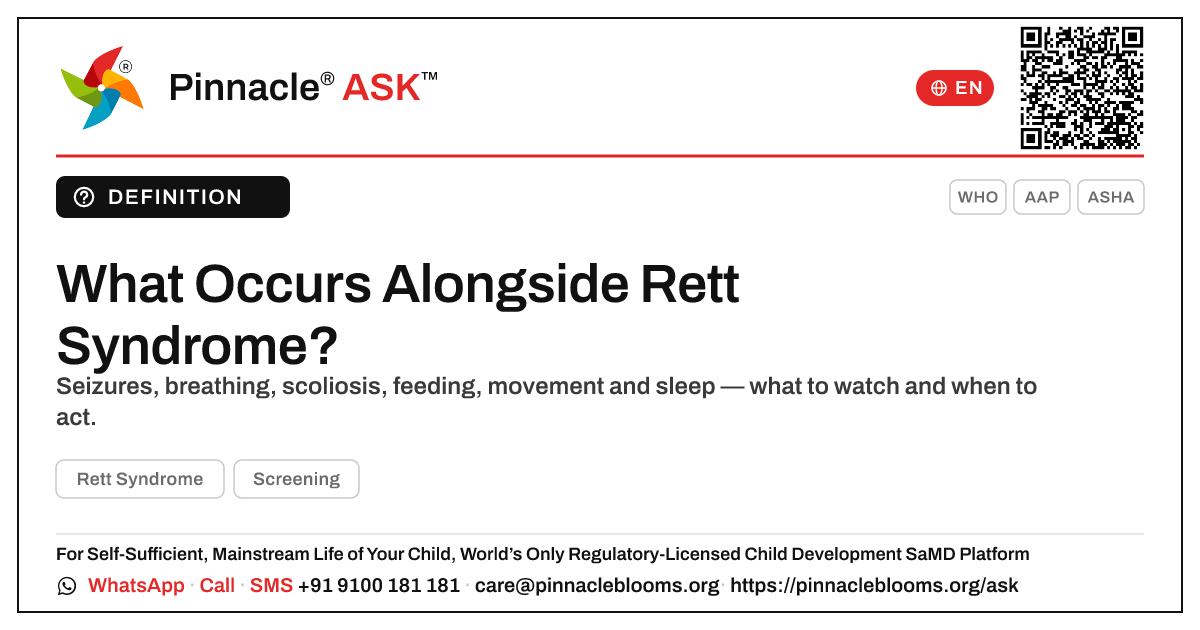
What Other Conditions Often Occur Alongside Rett Syndrome?
Rett Syndrome commonly occurs alongside epilepsy (seizures), breathing irregularities, scoliosis, movement and muscle-tone difficulties, feeding and gut issues, and sleep disturbance. Knowing these can occur lets a coordinated team screen and support early; seizures need prompt medical review.
In this answer 4 sections
When you understand Rett Syndrome, you also want to know what else might travel alongside it — so nothing catches your family off guard.
In short
Rett Syndrome rarely walks alone. Because it affects how the brain and nervous system develop, several conditions commonly occur alongside it — most often epilepsy (seizures), breathing irregularities, scoliosis (spinal curving), movement and muscle-tone difficulties, feeding and gut challenges, and sleep disturbance. Knowing these can occur means a well-planned care team can watch for them early and support your child proactively, not reactively.
What often occurs alongside Rett Syndrome
- Seizures / epilepsy — very common, often appearing in early childhood; any suspected seizure needs prompt medical (neurology) review, not therapy first.
- Breathing irregularities — breath-holding, hyperventilation or air-swallowing, usually while awake.
- Scoliosis — curving of the spine that often progresses with age and needs orthopaedic monitoring.
- Movement and hand differences — loss of purposeful hand use with repetitive hand movements (wringing, mouthing), and changes in muscle tone or walking.
- Feeding, swallowing and gut issues — reflux, constipation, and difficulty chewing or swallowing affecting nutrition and growth.
- Sleep disturbance — irregular sleep patterns, night-time waking or laughing.
- Communication and motor challenges — these shape day-to-day support and are where structured developmental therapy helps most.
Not every child experiences all of these, and their pattern and intensity vary widely. The value of knowing is simple: a coordinated team can screen, anticipate and act early.
The Pinnacle way
Developmental measurement supports care planning; diagnosis requires an appropriately qualified healthcare professional., under qualified clinician care — never from an app, a checklist or online. From there, your family gets a coordinated plan that supports communication, movement and daily living while medical needs like seizures are managed by the right specialists. Learn more about Rett Syndrome, how occupational therapy supports hand use and daily skills, and what the AbilityScore is and how it is formed.
Trusted sources
WHO ICD-11 framing of neurodevelopmental conditions; American Academy of Pediatrics guidance on developmental monitoring; ASHA guidance on supporting communication in complex needs.
Next step — If your child shows any of these signs, or you simply want a clear starting point, book a developmental check with a Pinnacle clinician.
This is general information, not a diagnosis — individual assessment and diagnosis require an appropriately qualified healthcare professional.
CONNECT THE ANSWER TO YOUR CHILD’S DAY
Something to notice. Something to discuss.
What to notice
Watch for suspected seizures, progressive spinal curving, feeding or swallowing difficulty affecting weight, and disrupted sleep — and seek prompt medical review for any seizure activity.
In everyday life
Keep a simple notebook of patterns you notice — breathing, sleep, feeding, any unusual movements — and bring it to appointments. Your observations help the care team act early.
Bring your observations and questions to your child’s professional. Choose activities that suit your child’s comfort, abilities and agreed plan.
Bring your questions to a first visitQuestions families ask
Is epilepsy common in Rett Syndrome?
Yes, seizures are among the most common conditions occurring alongside Rett Syndrome, often appearing in early childhood. Any suspected seizure needs prompt review by a doctor or neurologist — this is a medical referral, not something to manage with therapy alone.
Does every child with Rett Syndrome have all these conditions?
No. The pattern and intensity vary widely from child to child. Knowing which conditions can occur simply allows a coordinated care team to monitor and support early, so families are never caught off guard.
Can therapy help with the difficulties that come with Rett Syndrome?
Yes. Structured developmental therapies support communication, hand use, movement and daily living skills, working alongside the medical specialists who manage needs like seizures, scoliosis and feeding.
FOLLOW THE SOURCE
References behind this answer.
- Organisation website · further readingWHO ICD-11 — neurodevelopmental conditions framework
- Organisation website · further readingAmerican Academy of Pediatrics — developmental monitoring
- Organisation website · further readingASHA — supporting communication in complex needs
References are supplied with this answer. An organisation homepage offers further reading; it does not establish an independent review of this page.
Content attribution: SETU Consortium · Pinnacle Blooms Network.
PEOPLE, TOPICS & DEVELOPMENT
See the connections.
Browse the wider question collections connected with this answer’s audience, developmental area and stage.
FROM UNDERSTANDING TO PURPOSEFUL SUPPORT
One question. Your child’s whole life.
Your child’s self-sufficient, mainstream-included life is the purpose from the beginning. At Pinnacle, that purpose shapes what we understand, the goals we choose, the people we bring together, everyday practice and review.
Connect this question with the right support.
Start with your child’s strengths, your observations and what you want everyday life to become.
Make the next conversation useful.
Bring the situations you notice at home or school. We’ll explain a suitable service, centre and first visit, including availability and fees, before you decide.
How PinnacleAI® connects the journeyExplore the seven stages
- 1Understand abilities
A starting picture of your child’s capabilities.
- 2Choose meaningful goals
Readiness and a plan shaped around the child.
- 3Bring the right support together
Suitable therapies and people for those goals.
- 4Carry practice into everyday life
Guidance for family, home and school.
- 5Track and correct
Use observations to adjust the plan.
- 6Reassess and review
Decide what to continue, change or do next.
- 7Grow independence and participation
The child’s life gives each step its purpose.
Explore the whole PinnacleAI® system → · Participation at school and in the community →
PINNACLE’S EVIDENCE, OPEN TO YOU
Look at the evidence behind our work.
Read our research, inspect the original regulatory documents and check what each institutional measure means.
General information supports a conversation with an appropriately qualified professional. Advice, goals and support depend on the individual child.