
YOUR QUESTION. A CLEARER NEXT STEP.
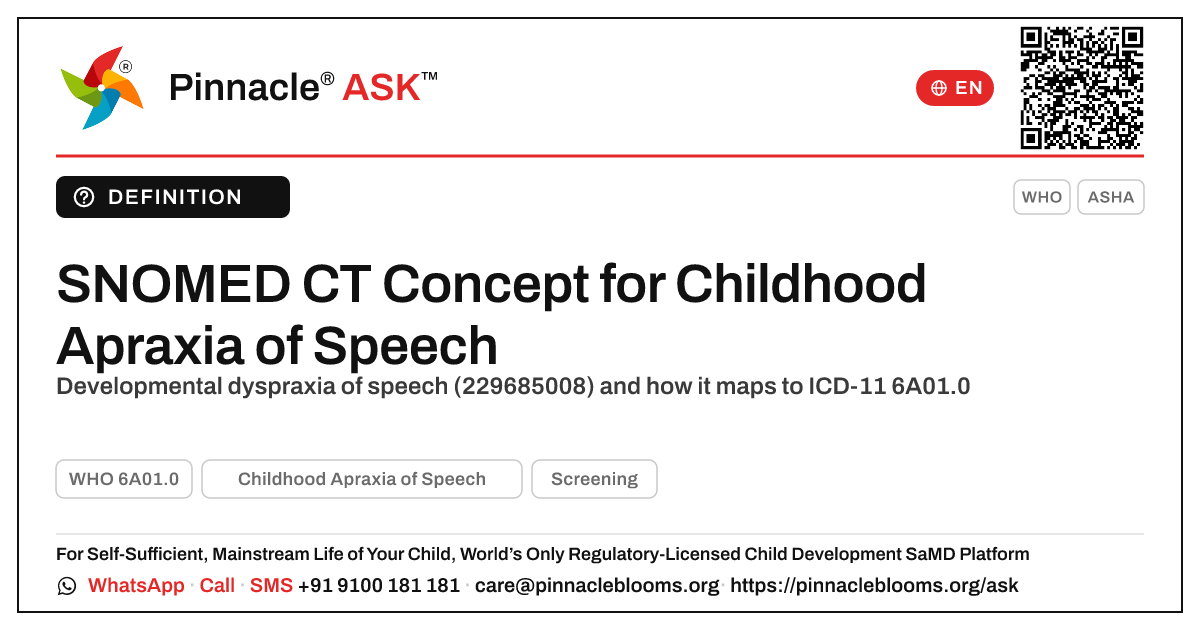
SNOMED CT Concept for Childhood Apraxia of Speech
In SNOMED CT, Childhood Apraxia of Speech maps to 'Developmental dyspraxia of speech' (SCTID 229685008); in ICD-11 the closest diagnostic category is 6A01.0, Developmental speech sound disorder. Use SNOMED for the EHR problem list and ICD-11 for diagnostic coding, confirming the SCTID against your local release.
In this answer 4 sections
Clean coding starts with the right concept — and Childhood Apraxia of Speech sits across two classification systems that clinicians use side by side.
In short
In SNOMED CT, Childhood Apraxia of Speech maps to the concept Developmental dyspraxia of speech (SCTID 229685008), a child-development finding under disorders of articulation/motor speech. This is distinct from the ICD-11 classification, where the closest construct is 6A01.0 — Developmental speech sound disorder, the diagnostic category an Indian clinician would code for billing and records. SNOMED CT gives you the granular concept for the EHR problem list; ICD-11 gives you the diagnostic code — use both deliberately.
The science, briefly
Childhood Apraxia of Speech (CAS) is a neurological motor-speech disorder: the difficulty lies in planning and sequencing the movements for speech, not in muscle weakness (dysarthria) or in phonological rule acquisition alone. Hallmark features — inconsistent errors on repeated productions, disrupted prosody, and difficulty with smooth transitions between sounds and syllables — distinguish it from a typical phonological disorder.
Mapping notes that matter in practice:
- SNOMED CT 229685008 — Developmental dyspraxia of speech is the recommended terminology concept for the active problem list; Childhood apraxia of speech is widely used clinically as the contemporary descriptor for the same construct.
- ICD-11 6A01.0 — Developmental speech sound disorder is the parent diagnostic code; CAS is recorded here as it has no separate stem code in ICD-11.
- Confirm the current SCTID against your local SNOMED CT release before encoding, as terminology refsets are versioned.
The Pinnacle way
Coding is a record-keeping act; a clinical diagnosis and any AbilityScore® are established only at a Pinnacle Blooms Network centre, under qualified clinician care — never from a terminology lookup or an app. Our motor-speech pathway pairs accurate classification with structured speech therapy, an AbilityScore® baseline tracked over time, and clinician governance across 70+ centres. For peers, we welcome referral and clinical partnership.
Trusted sources
WHO ICD-11 for Mortality and Morbidity Statistics, category 6A01.0 (developmental speech sound disorder); ASHA practice resources on Childhood Apraxia of Speech; SNOMED CT International Edition terminology concepts.
Next step — Referring a child with suspected CAS? Partner with a Pinnacle motor-speech clinician for assessment and a shared management plan.
This is general information, not a diagnosis — individual assessment and diagnosis require an appropriately qualified healthcare professional.
CONNECT THE ANSWER TO YOUR CHILD’S DAY
Something to notice. Something to discuss.
What to notice
Inconsistent speech-sound errors on repeated attempts at the same word, disrupted prosody, and difficulty sequencing sounds and syllables — features distinguishing CAS from phonological disorder or dysarthria.
In everyday life
On the EHR problem list, encode the SNOMED CT concept for granularity and the ICD-11 6A01.0 code for diagnosis and reporting — and verify the SCTID against your current SNOMED release before finalising.
Bring your observations and questions to your child’s professional. Choose activities that suit your child’s comfort, abilities and agreed plan.
Bring your questions to a first visitQuestions families ask
What is the SNOMED CT concept ID for Childhood Apraxia of Speech?
Childhood Apraxia of Speech maps to the SNOMED CT concept 'Developmental dyspraxia of speech', SCTID 229685008. Confirm the identifier against your local SNOMED CT release, as terminology refsets are versioned.
How does this differ from the ICD-11 code 6A01.0?
ICD-11 6A01.0 is 'Developmental speech sound disorder', the parent diagnostic category used for clinical coding and reporting. CAS has no separate ICD-11 stem code, so it is recorded here. SNOMED CT provides the more granular concept for the EHR problem list.
How is CAS distinguished from dysarthria or phonological disorder?
CAS is a motor-speech planning and sequencing disorder, not muscle weakness (dysarthria) or rule-based phonology alone. Hallmarks include inconsistent errors on repeated productions, disrupted prosody and difficulty transitioning between sounds and syllables.
Where is a clinical diagnosis of CAS established?
A clinical diagnosis and any AbilityScore® are established only at a Pinnacle Blooms Network centre under qualified clinician care, never from a terminology lookup or an app.
FOLLOW THE SOURCE
References behind this answer.
- Organisation website · further readingWHO ICD-11 — Developmental speech sound disorder
- Organisation website · further readingASHA — Childhood Apraxia of Speech practice resources
References are supplied with this answer. An organisation homepage offers further reading; it does not establish an independent review of this page.
Content attribution: SETU Consortium · Pinnacle Blooms Network.
PEOPLE, TOPICS & DEVELOPMENT
See the connections.
Browse the wider question collections connected with this answer’s audience, developmental area and stage.
FROM UNDERSTANDING TO PURPOSEFUL SUPPORT
One question. Your child’s whole life.
Your child’s self-sufficient, mainstream-included life is the purpose from the beginning. At Pinnacle, that purpose shapes what we understand, the goals we choose, the people we bring together, everyday practice and review.
Connect this question with the right support.
Explore how the relevant service contributes to everyday abilities, then speak with us about your child.
Make the next conversation useful.
Bring the situations you notice at home or school. We’ll explain a suitable service, centre and first visit, including availability and fees, before you decide.
How PinnacleAI® connects the journeyExplore the seven stages
- 1Understand abilities
A starting picture of your child’s capabilities.
- 2Choose meaningful goals
Readiness and a plan shaped around the child.
- 3Bring the right support together
Suitable therapies and people for those goals.
- 4Carry practice into everyday life
Guidance for family, home and school.
- 5Track and correct
Use observations to adjust the plan.
- 6Reassess and review
Decide what to continue, change or do next.
- 7Grow independence and participation
The child’s life gives each step its purpose.
Explore the whole PinnacleAI® system → · Participation at school and in the community →
PINNACLE’S EVIDENCE, OPEN TO YOU
Look at the evidence behind our work.
Read our research, inspect the original regulatory documents and check what each institutional measure means.
General information supports a conversation with an appropriately qualified professional. Advice, goals and support depend on the individual child.