
YOUR QUESTION. A CLEARER NEXT STEP.
ICD-11 Classification of Oppositional Defiant Disorder (6C90)
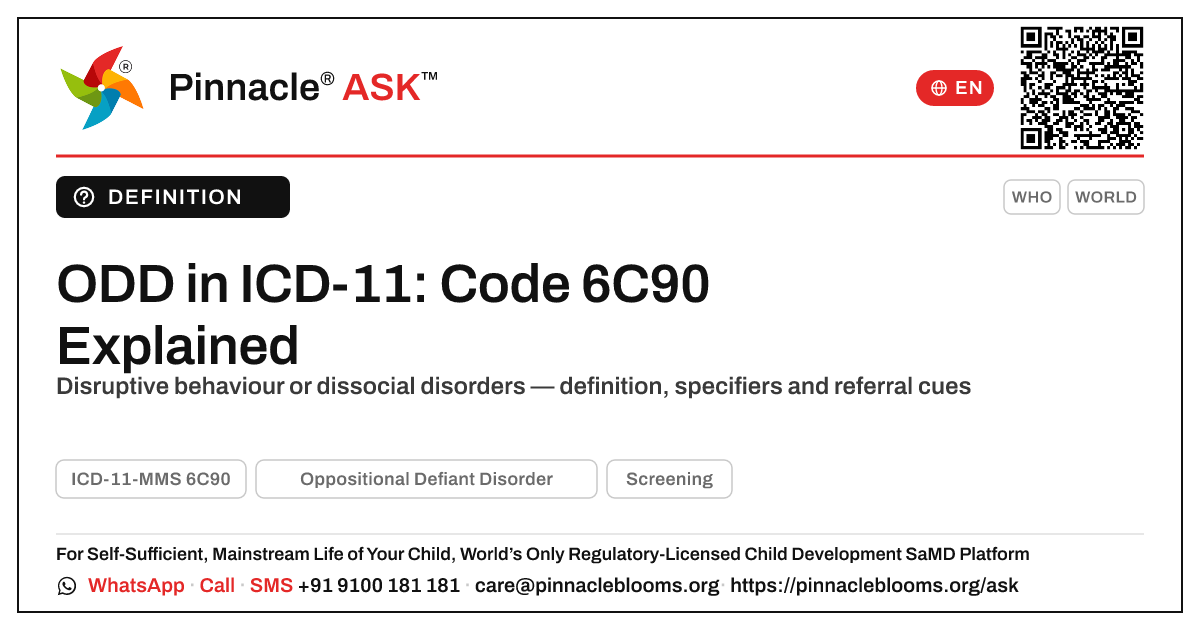
In ICD-11-MMS, Oppositional Defiant Disorder is coded 6C90 within disruptive behaviour or dissocial disorders, defined as a persistent (~6-month) pattern of markedly defiant, disobedient or spiteful behaviour beyond age-typical limits, with a specifier for chronic irritability and anger.
In this answer 5 sections
Clinicians reaching for the right ICD-11 code for ODD need it precise, parent-explicable, and correctly placed in the disruptive-behaviour group — here it is.
In short
In ICD-11-MMS, Oppositional Defiant Disorder is classified under code 6C90, within the grouping Disruptive behaviour or dissocial disorders. ICD-11 defines it as a persistent pattern (≈6 months or more) of markedly defiant, disobedient, provocative or spiteful behaviour, occurring more frequently than expected for age and developmental level, and not restricted to a single relationship or setting. It is distinguished from age-typical oppositionality by frequency, persistence, severity and functional impairment.
The classification, in clinical terms
ICD-11 sits 6C90 alongside Conduct-dissocial disorder (6C91) under disruptive behaviour or dissocial disorders. Two features sharpen diagnosis:
- Specifier for chronic irritability–anger (with chronic irritability and anger): captures the predominantly angry/irritable mood presentation, the construct that broadly overlaps with disruptive mood dysregulation in DSM-5.
- Headstrong/oppositional and spiteful/vindictive behaviours are recognised dimensions of the presentation.
The pattern must exceed normative limits for the child's age, sex and culture, persist over time, and cause distress or impairment in personal, family, social or educational functioning. Diagnosis below early childhood requires caution — transient oppositionality is developmentally normal, so persistence across settings and clear impairment are the discriminating thresholds.
When to refer
Refer for structured assessment where defiant, hostile or spiteful behaviour is pervasive across home and school, persists beyond ~6 months, and impairs relationships or learning. Screen for co-occurring ADHD, anxiety, language disorder and learning difficulties, which frequently coexist and reshape the management plan.
The Pinnacle way
Developmental measurement supports care planning; diagnosis requires an appropriately qualified healthcare professional., under qualified clinician care — never from an online form, app or code lookup. Coding orients the conversation; clinician-led, multi-domain assessment defines the plan. Explore our developmental approach, the behavioural and emotional-regulation support pathway, and what the AbilityScore is and how it is calculated.
Trusted sources
WHO ICD-11 for Mortality and Morbidity Statistics, disruptive behaviour or dissocial disorders chapter; WHO clinical descriptions and diagnostic requirements for mental disorders.
Next step — Refer a child with persistent oppositional patterns for structured, clinician-led assessment.
This is general information, not a diagnosis — individual assessment and diagnosis require an appropriately qualified healthcare professional.
CONNECT THE ANSWER TO YOUR CHILD’S DAY
Something to notice. Something to discuss.
What to notice
Defiant, hostile or spiteful behaviour that is pervasive across home and school, persists beyond ~6 months, exceeds age-typical limits, and impairs relationships or learning — with screening for co-occurring ADHD, anxiety and learning difficulties.
In everyday life
When coding, check whether the chronic irritability-and-anger specifier applies — it materially changes how the presentation maps to mood-related management.
Bring your observations and questions to your child’s professional. Choose activities that suit your child’s comfort, abilities and agreed plan.
Bring your questions to a first visitQuestions families ask
What is the ICD-11 code for Oppositional Defiant Disorder?
Oppositional Defiant Disorder is classified under code 6C90 in ICD-11-MMS, within the grouping disruptive behaviour or dissocial disorders.
How does ICD-11 distinguish ODD from age-typical oppositionality?
By the frequency, persistence (~6 months or more), severity and pervasiveness across settings of the defiant or spiteful behaviour, together with associated distress or functional impairment beyond what is expected for the child's age and developmental level.
Does ICD-11 include a specifier for ODD?
Yes. ICD-11 recognises a presentation with chronic irritability and anger, capturing the predominantly angry or irritable mood form of the disorder, alongside headstrong/oppositional and spiteful/vindictive dimensions.
Can ODD be diagnosed in very young children?
Caution is required, as transient oppositionality is developmentally normal in early childhood. Diagnosis rests on persistence across settings, clear excess beyond age norms, and demonstrable functional impairment — assessed by a qualified clinician.
FOLLOW THE SOURCE
References behind this answer.
- Organisation website · further readingWHO ICD-11 for Mortality and Morbidity Statistics
- Organisation website · further readingWorld Health Organization — mental and behavioural disorders resources
References are supplied with this answer. An organisation homepage offers further reading; it does not establish an independent review of this page.
Content attribution: SETU Consortium · Pinnacle Blooms Network.
PEOPLE, TOPICS & DEVELOPMENT
See the connections.
Browse the wider question collections connected with this answer’s audience, developmental area and stage.
FROM UNDERSTANDING TO PURPOSEFUL SUPPORT
One question. Your child’s whole life.
Your child’s self-sufficient, mainstream-included life is the purpose from the beginning. At Pinnacle, that purpose shapes what we understand, the goals we choose, the people we bring together, everyday practice and review.
Connect this question with the right support.
Start with your child’s strengths, your observations and what you want everyday life to become.
Make the next conversation useful.
Bring the situations you notice at home or school. We’ll explain a suitable service, centre and first visit, including availability and fees, before you decide.
How PinnacleAI® connects the journeyExplore the seven stages
- 1Understand abilities
A starting picture of your child’s capabilities.
- 2Choose meaningful goals
Readiness and a plan shaped around the child.
- 3Bring the right support together
Suitable therapies and people for those goals.
- 4Carry practice into everyday life
Guidance for family, home and school.
- 5Track and correct
Use observations to adjust the plan.
- 6Reassess and review
Decide what to continue, change or do next.
- 7Grow independence and participation
The child’s life gives each step its purpose.
Explore the whole PinnacleAI® system → · Participation at school and in the community →
PINNACLE’S EVIDENCE, OPEN TO YOU
Look at the evidence behind our work.
Read our research, inspect the original regulatory documents and check what each institutional measure means.
General information supports a conversation with an appropriately qualified professional. Advice, goals and support depend on the individual child.