
YOUR QUESTION. A CLEARER NEXT STEP.
ICD-11 Classification of Hypotonia (Low Muscle Tone)
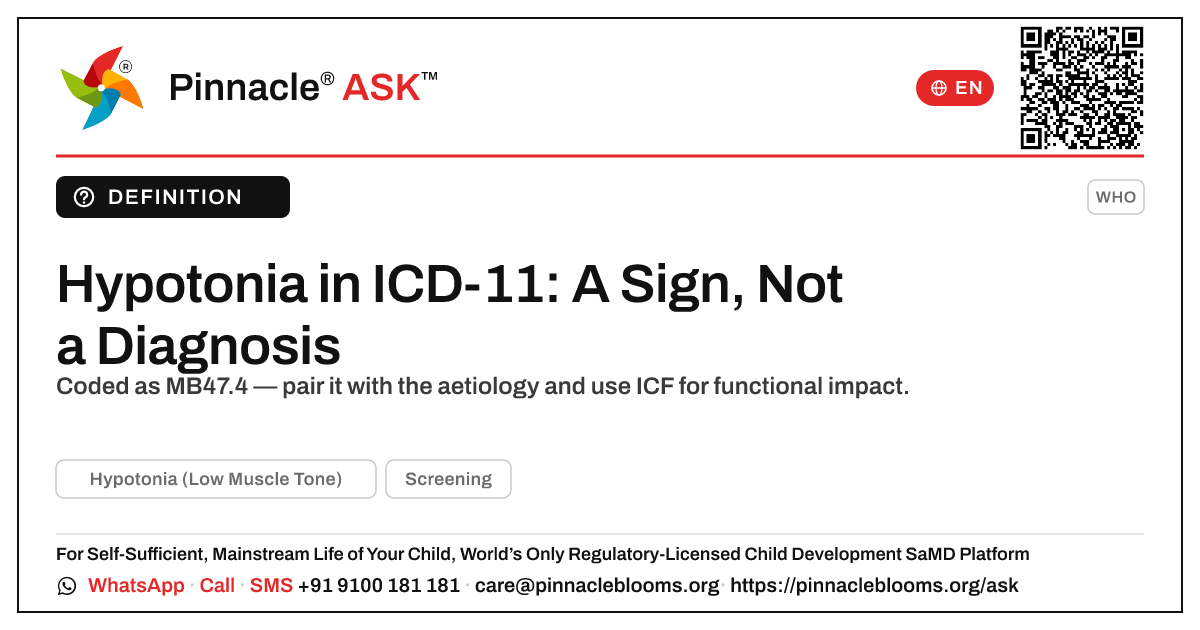
In ICD-11, hypotonia is classified as a clinical sign (MB47.4 Hypotonia) under symptoms and signs of the musculoskeletal system — a manifestation, not a diagnosis. The underlying central, peripheral, genetic or metabolic cause must be coded separately, and ICF describes its functional impact on posture, feeding and motor milestones.
In this answer 5 sections
Hypotonia is a clinical sign, not a diagnosis in itself — and ICD-11 codes it accordingly.
In short
In ICD-11, hypotonia (low muscle tone) is classified under the chapter on symptoms, signs or clinical findings of the musculoskeletal system, coded as MB47.4 Hypotonia within the broader "Symptoms, signs or clinical findings, not elsewhere classified" structure. Crucially, ICD-11 treats it as a manifestation, not an aetiological diagnosis — the underlying cause (central, peripheral, genetic, metabolic or syndromic) must be coded separately. Where hypotonia is congenital and benign, the descriptor "benign congenital hypotonia" is used clinically, but the coding still points to the sign plus its established cause.
The classification, in practice
ICD-11 deliberately separates the sign of reduced muscle tone from its origin, which keeps coding precise:
- The sign — code the hypotonia (MB47.4) when low tone is the presenting finding under evaluation.
- The cause — add the relevant aetiological code: e.g. neuromuscular disorders, central nervous system conditions, chromosomal or genetic syndromes (Down syndrome, Prader-Willi), or metabolic disease.
- Functioning — ICD-11 pairs naturally with the WHO ICF framework to describe the functional impact of hypotonia on posture, feeding, gross-motor milestones and self-care, which is what therapy actually targets.
This matters clinically because hypotonia in an infant is a gateway sign: the coding hierarchy nudges the clinician toward localising the lesion (central versus peripheral) and pursuing the cause rather than stopping at the descriptive label.
When to escalate
Acute or rapidly progressive hypotonia, hypotonia with respiratory or feeding compromise, loss of previously acquired tone or milestones, or a floppy neonate all warrant prompt paediatric neurology referral, not a therapy-first pathway. Stable, longstanding low tone with preserved strength is appropriately managed with developmental therapy alongside aetiological work-up.
The Pinnacle way
A clinical AbilityScore® and any diagnosis are established only at a Pinnacle Blooms Network centre, under qualified clinician care — never from an online form. For a child with low tone, our clinicians map the functional impact across motor, feeding and self-care domains and build a graded plan through occupational therapy and physiotherapy, with the AbilityScore® as the shared baseline for measuring progress. Explore the full network.
Trusted sources
WHO ICD-11 for Mortality and Morbidity Statistics (symptoms and signs of the musculoskeletal system); WHO International Classification of Functioning, Disability and Health (ICF) for the functional framing of muscle-tone disorders.
Next step — Reviewing a child with persistent low tone? Partner with a Pinnacle clinician to baseline functional impact and co-ordinate the aetiological pathway.
CONNECT THE ANSWER TO YOUR CHILD’S DAY
Something to notice. Something to discuss.
What to notice
Acute or progressive hypotonia, a floppy neonate, loss of previously acquired tone or milestones, or hypotonia with feeding or respiratory compromise — all warrant prompt paediatric neurology referral rather than a therapy-first approach.
In everyday life
When coding hypotonia, always pair the sign with its aetiology and use the ICF framing to capture functional impact on posture, feeding and motor milestones — that combination drives the therapy plan, not the label alone.
Bring your observations and questions to your child’s professional. Choose activities that suit your child’s comfort, abilities and agreed plan.
Bring your questions to a first visitQuestions families ask
Is hypotonia a diagnosis or a sign in ICD-11?
ICD-11 classifies hypotonia as a clinical sign or manifestation (MB47.4), not an aetiological diagnosis. The underlying cause — neuromuscular, central, genetic, metabolic or syndromic — must always be identified and coded separately.
How should the underlying cause be coded alongside hypotonia?
Add the relevant aetiological ICD-11 code — for example a neuromuscular disorder, a central nervous system condition, or a chromosomal syndrome such as Down syndrome or Prader-Willi. The hypotonia code captures the sign; the aetiology code captures the diagnosis.
When does low muscle tone need urgent referral?
Refer promptly to paediatric neurology for acute or progressive hypotonia, a floppy neonate, hypotonia with feeding or respiratory compromise, or any loss of previously acquired tone or milestones. Stable longstanding low tone is appropriate for developmental therapy alongside work-up.
FOLLOW THE SOURCE
References behind this answer.
- Organisation website · further readingWHO ICD-11 for Mortality and Morbidity Statistics
- Source referenceWHO ICF framework for functioning and disability
References are supplied with this answer. An organisation homepage offers further reading; it does not establish an independent review of this page.
Content attribution: SETU Consortium · Pinnacle Blooms Network.
PEOPLE, TOPICS & DEVELOPMENT
See the connections.
Browse the wider question collections connected with this answer’s audience, developmental area and stage.
FROM UNDERSTANDING TO PURPOSEFUL SUPPORT
One question. Your child’s whole life.
Your child’s self-sufficient, mainstream-included life is the purpose from the beginning. At Pinnacle, that purpose shapes what we understand, the goals we choose, the people we bring together, everyday practice and review.
Connect this question with the right support.
Start with your child’s strengths, your observations and what you want everyday life to become.
Make the next conversation useful.
Bring the situations you notice at home or school. We’ll explain a suitable service, centre and first visit, including availability and fees, before you decide.
How PinnacleAI® connects the journeyExplore the seven stages
- 1Understand abilities
A starting picture of your child’s capabilities.
- 2Choose meaningful goals
Readiness and a plan shaped around the child.
- 3Bring the right support together
Suitable therapies and people for those goals.
- 4Carry practice into everyday life
Guidance for family, home and school.
- 5Track and correct
Use observations to adjust the plan.
- 6Reassess and review
Decide what to continue, change or do next.
- 7Grow independence and participation
The child’s life gives each step its purpose.
Explore the whole PinnacleAI® system → · Participation at school and in the community →
PINNACLE’S EVIDENCE, OPEN TO YOU
Look at the evidence behind our work.
Read our research, inspect the original regulatory documents and check what each institutional measure means.
General information supports a conversation with an appropriately qualified professional. Advice, goals and support depend on the individual child.