
YOUR QUESTION. A CLEARER NEXT STEP.
Fetal Alcohol Spectrum Disorder vs Hypotonia in Young Children
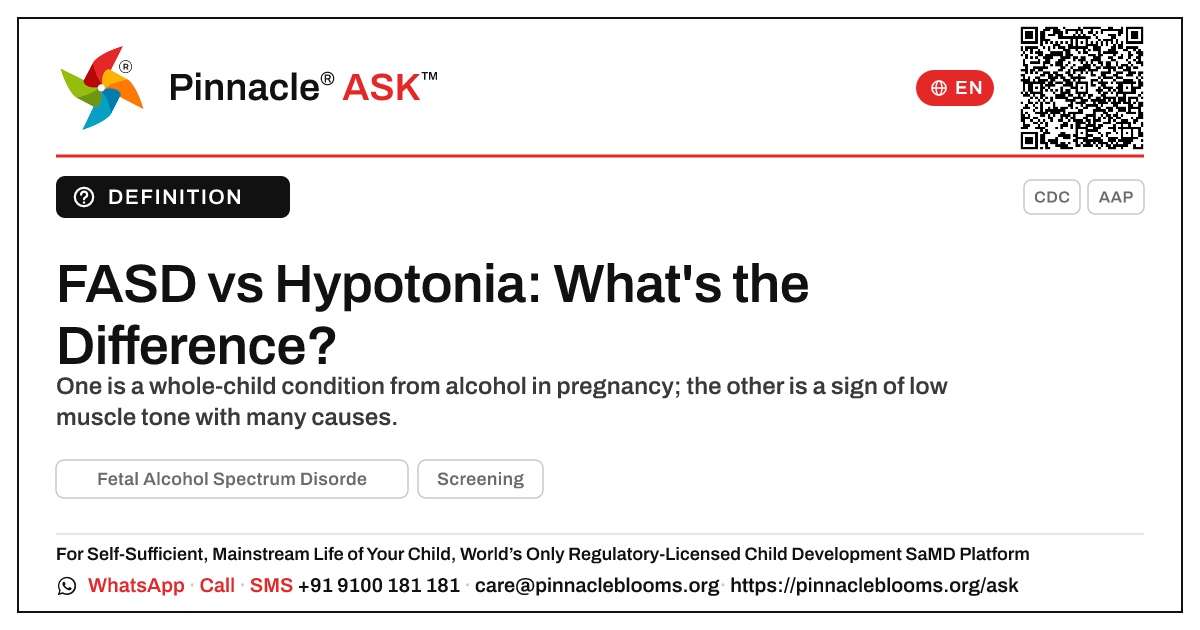
Fetal Alcohol Spectrum Disorder (FASD) and hypotonia are very different. FASD is a condition caused by alcohol exposure during pregnancy, affecting the whole child — growth, facial features, learning, behaviour and sometimes muscle tone. Hypotonia (low muscle tone) is not a diagnosis but a sign — a description of muscles that feel softer or floppier than expected — and it can have many causes, of which FASD is just one. In short: FASD is a whole-child condition with a prenatal cause; hypotonia is a physical sign that needs assessment to understand why.
In this answer 5 sections
Two very different things that can both make a baby seem floppy or slow to reach milestones — but one starts before birth and one is a description of muscle tone.
In short
Fetal Alcohol Spectrum Disorder (FASD) is a condition caused by a baby being exposed to alcohol during pregnancy. It can affect the whole of development — growth, facial features, learning, behaviour, attention and movement — and it is preventable, but lifelong once present. Hypotonia (low muscle tone) is not a diagnosis on its own; it is a description of muscles that feel softer or floppier than expected, so a baby may feel loose when held or be slower to hold their head, sit or stand. In short: FASD is a cause with many effects across the child; hypotonia is a sign that can have many different causes — and FASD is sometimes one of them.
How they differ in everyday life
A child with FASD has a story that begins before birth — alcohol exposure during pregnancy. Over time you may notice a mix of things together: slower growth, certain facial features, difficulties with attention, memory, learning, emotions and sometimes low muscle tone too. Because it touches many areas, support is usually broad and brings several therapies together.
Hypotonia is something a clinician feels and sees, not a label of why. A baby with low tone may feel floppy when picked up, slip through your hands, rest in a frog-legged position, or be late to roll, sit or walk. The crucial point is that hypotonia is a finding — it points the clinician to ask why. The reasons range widely, from benign and improving with time, to genetic, neurological or, indeed, FASD.
The key contrast: FASD is a whole-child condition with a known prenatal cause; hypotonia is a physical sign of softer muscle tone that needs careful assessment to understand its origin. A child can have hypotonia without FASD, and a child with FASD may or may not show hypotonia.
When to seek a look
If your baby feels unusually floppy, tires quickly during feeds, or is noticeably slow to gain head control, sit or stand, that is worth a gentle developmental check — not a cause for panic, but a reason to look closely. If alcohol was used during pregnancy and you have concerns about your child's growth, learning or behaviour, an early developmental review helps map strengths and shape the right support. Trust your instincts and ask early — early support works.
The Pinnacle way
This is general information, not a diagnosis — a clinical AbilityScore® and any diagnosis are formed only at a Pinnacle Blooms Network centre, under qualified clinician care, never from an app or form. Our team observes how your child moves, feeds, plays and learns, then shapes the right plan — drawing on physiotherapy to build strength and motor milestones, and occupational therapy for daily skills and play. Learn more about Fetal Alcohol Spectrum Disorder support.
Trusted sources
The Centers for Disease Control and Prevention on FASD and the effects of alcohol exposure in pregnancy; the American Academy of Pediatrics and HealthyChildren on muscle tone, developmental milestones and when to seek a review.
Next step — Noticed your little one feels floppy or is reaching milestones late? Book a developmental screening and let a clinician gently map your child's strengths and needs.
CONNECT THE ANSWER TO YOUR CHILD’S DAY
Something to notice. Something to discuss.
What to notice
A baby who feels floppy or slips through your hands, rests in a frog-legged position, tires quickly during feeds, or is slow to gain head control, sit or stand — and, separately, slower growth, distinctive facial features or learning and attention difficulties where alcohol was used in pregnancy.
In everyday life
During play and cuddles, notice how your baby holds themselves — does their head bob, do they feel loose when lifted, do they push against you when held upright? Sharing these everyday observations with a clinician gives a clearer picture than any single test.
Bring your observations and questions to your child’s professional. Choose activities that suit your child’s comfort, abilities and agreed plan.
Bring your questions to a first visitQuestions families ask
Is hypotonia the same as Fetal Alcohol Spectrum Disorder?
No. Hypotonia (low muscle tone) is a sign — a description of muscles that feel softer or floppier than expected. FASD is a condition caused by alcohol exposure during pregnancy that affects the whole child. A child with FASD may show hypotonia, but most children with low tone do not have FASD.
Can a child have both FASD and hypotonia?
Yes. Low muscle tone can be one of the features seen in some children with FASD. A clinician assesses the whole picture to understand the cause and shape the right support.
Will low muscle tone go away on its own?
It depends on the cause. Some babies have mild, benign hypotonia that improves with time and support; others have an underlying reason that needs ongoing care. A developmental review helps a clinician understand why — and physiotherapy can build strength and motor skills.
When should I seek help?
If your baby feels unusually floppy, tires during feeds, or is noticeably slow to gain head control, sit or stand, ask for a gentle developmental check. Early support works best, so it is always reasonable to ask early.
FOLLOW THE SOURCE
References behind this answer.
- Source referenceCDC — About Fetal Alcohol Spectrum Disorders
- Source referenceHealthyChildren (AAP) — Milestones & muscle tone
- Source referenceCDC — Developmental Milestones
References are supplied with this answer. An organisation homepage offers further reading; it does not establish an independent review of this page.
Content attribution: SETU Consortium · Pinnacle Blooms Network.
PEOPLE, TOPICS & DEVELOPMENT
See the connections.
Browse the wider question collections connected with this answer’s audience, developmental area and stage.
FROM UNDERSTANDING TO PURPOSEFUL SUPPORT
One question. Your child’s whole life.
Your child’s self-sufficient, mainstream-included life is the purpose from the beginning. At Pinnacle, that purpose shapes what we understand, the goals we choose, the people we bring together, everyday practice and review.
Connect this question with the right support.
Start with your child’s strengths, your observations and what you want everyday life to become.
Make the next conversation useful.
Bring the situations you notice at home or school. We’ll explain a suitable service, centre and first visit, including availability and fees, before you decide.
How PinnacleAI® connects the journeyExplore the seven stages
- 1Understand abilities
A starting picture of your child’s capabilities.
- 2Choose meaningful goals
Readiness and a plan shaped around the child.
- 3Bring the right support together
Suitable therapies and people for those goals.
- 4Carry practice into everyday life
Guidance for family, home and school.
- 5Track and correct
Use observations to adjust the plan.
- 6Reassess and review
Decide what to continue, change or do next.
- 7Grow independence and participation
The child’s life gives each step its purpose.
Explore the whole PinnacleAI® system → · Participation at school and in the community →
PINNACLE’S EVIDENCE, OPEN TO YOU
Look at the evidence behind our work.
Read our research, inspect the original regulatory documents and check what each institutional measure means.
General information supports a conversation with an appropriately qualified professional. Advice, goals and support depend on the individual child.