
YOUR QUESTION. A CLEARER NEXT STEP.
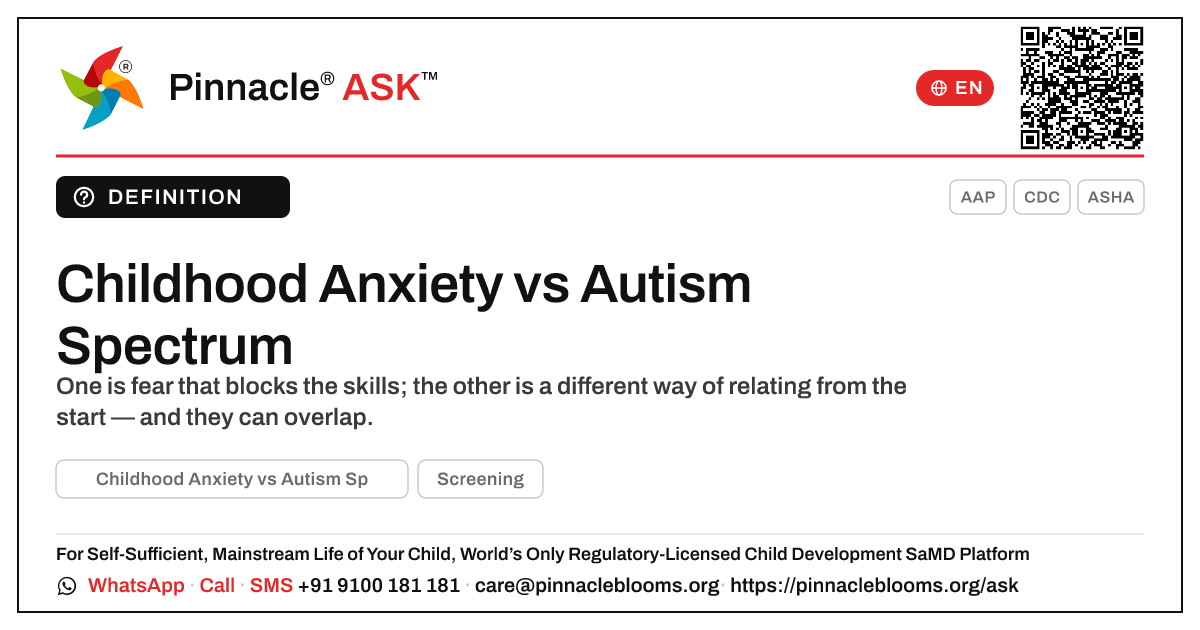
Childhood Anxiety vs Autism Spectrum in Young Children
Childhood anxiety is about fear and worry — a child who has social skills but feels too frightened to use them, often varying a lot by setting. Autism spectrum is a consistent, early difference in communication, social connection and sensory experience, not driven mainly by fear. An anxious child usually wants to join in but feels scared; an autistic child relates and communicates differently from the start. The two often overlap, so a careful clinical assessment matters rather than guessing.
In this answer 5 sections
Two very different things can look alike in a small child — a quiet, clingy worrier and a child wired for a different social world — and telling them apart gently changes everything.
In short
Childhood anxiety is about fear and worry — a child who has the social skills but feels too frightened, nervous or overwhelmed to use them comfortably. Autism spectrum is a different way of experiencing communication, social connection and sensory input — present from early on, woven into how a child relates to the world. The simplest way to picture it: an anxious child usually wants to join in but feels too scared; an autistic child may relate and communicate differently from the start, whether or not fear is present. The two can also overlap, which is exactly why a careful clinical look matters.
How they look different day to day
With anxiety, you tend to see a child who can chat, play and make eye contact happily when relaxed — at home with family, say — but freezes, clings, cries or refuses in new or social situations. The behaviour shifts a lot with the setting and the level of comfort. Worry often centres on separation, new faces, performance, or specific fears, and a settled, familiar environment usually brings the warmer, more confident child back out.
With autism, the differences are more consistent across settings and present from very early childhood. You might notice differences in back-and-forth conversation, in eye contact and gesture, a deep love of routine and sameness, intense focused interests, or strong reactions to sounds, textures or lights. These are not driven mainly by fear — they reflect a genuinely different communication and sensory style.
Here is the honest part: anxiety and autism often travel together. Many autistic children also feel real anxiety, and an anxious child can look socially withdrawn. So overlapping signs are common — and that is a reason to assess thoughtfully, not to guess.
When to seek a look
If your child's worry, clinginess or social differences are getting in the way of everyday life — play, sleep, nursery, family outings — it is worth a developmental check, whatever the eventual picture. Earlier understanding means earlier, gentler support, and there is real reassurance in simply knowing.
The Pinnacle way
This is general information, not a diagnosis — a clinical AbilityScore® and any diagnosis are formed only at a Pinnacle Blooms Network centre, under qualified clinician care, never from an app or a checklist. Our clinicians observe how your child communicates, connects, copes with change and handles worry, then tell apart anxiety, autism, or both — and shape support drawn from behavioural therapy and, where social communication is part of the picture, speech therapy. Learn more about childhood anxiety.
Trusted sources
The American Academy of Pediatrics and HealthyChildren on early social-emotional development and anxiety in young children; the CDC on developmental milestones and monitoring; ASHA on social communication.
Next step — Unsure whether it is worry, a different way of relating, or both? Book a developmental screening and let a clinician gently tell the difference and guide your next step.
CONNECT THE ANSWER TO YOUR CHILD’S DAY
Something to notice. Something to discuss.
What to notice
Notice whether the differences shift with comfort and setting (more likely anxiety — a child who is warm at home but freezes in new places) or stay consistent across settings from early on, with routines, intense interests and sensory sensitivities (more suggestive of autism). Remember the two can co-occur, so overlapping signs are common.
In everyday life
Watch your child in their most relaxed setting — at home with familiar people. A child whose chat, play and connection flow easily when comfortable but vanish in new situations is showing the shifting pattern of anxiety; differences that stay steady everywhere are worth a developmental look.
Bring your observations and questions to your child’s professional. Choose activities that suit your child’s comfort, abilities and agreed plan.
Bring your questions to a first visitQuestions families ask
Can a child have both anxiety and autism?
Yes, and it is common. Many autistic children also experience real anxiety, and anxiety can make social differences look larger. This overlap is exactly why a careful clinical assessment is better than trying to decide between the two yourself.
My child is shy and clingy — is that autism?
Not necessarily. Shyness and clinginess that ease in familiar, comfortable settings point more towards anxiety than autism. If your child connects warmly at home but freezes elsewhere, that shifting pattern is typical of worry. A developmental check can reassure you either way.
At what age can these be told apart?
Both can be considered in early childhood, but the picture becomes clearer as a child grows and their communication and worries can be observed across settings. If everyday life, play or sleep are affected, it is worth a developmental screening regardless of age.
FOLLOW THE SOURCE
References behind this answer.
- Organisation website · further readingAAP HealthyChildren — childhood anxiety and social-emotional development
- Source referenceCDC — developmental milestones and monitoring
- Organisation website · further readingASHA — social communication in children
References are supplied with this answer. An organisation homepage offers further reading; it does not establish an independent review of this page.
Content attribution: SETU Consortium · Pinnacle Blooms Network.
PEOPLE, TOPICS & DEVELOPMENT
See the connections.
Browse the wider question collections connected with this answer’s audience, developmental area and stage.
FROM UNDERSTANDING TO PURPOSEFUL SUPPORT
One question. Your child’s whole life.
Your child’s self-sufficient, mainstream-included life is the purpose from the beginning. At Pinnacle, that purpose shapes what we understand, the goals we choose, the people we bring together, everyday practice and review.
Connect this question with the right support.
Explore how the relevant service contributes to everyday abilities, then speak with us about your child.
Make the next conversation useful.
Bring the situations you notice at home or school. We’ll explain a suitable service, centre and first visit, including availability and fees, before you decide.
How PinnacleAI® connects the journeyExplore the seven stages
- 1Understand abilities
A starting picture of your child’s capabilities.
- 2Choose meaningful goals
Readiness and a plan shaped around the child.
- 3Bring the right support together
Suitable therapies and people for those goals.
- 4Carry practice into everyday life
Guidance for family, home and school.
- 5Track and correct
Use observations to adjust the plan.
- 6Reassess and review
Decide what to continue, change or do next.
- 7Grow independence and participation
The child’s life gives each step its purpose.
Explore the whole PinnacleAI® system → · Participation at school and in the community →
PINNACLE’S EVIDENCE, OPEN TO YOU
Look at the evidence behind our work.
Read our research, inspect the original regulatory documents and check what each institutional measure means.
General information supports a conversation with an appropriately qualified professional. Advice, goals and support depend on the individual child.