
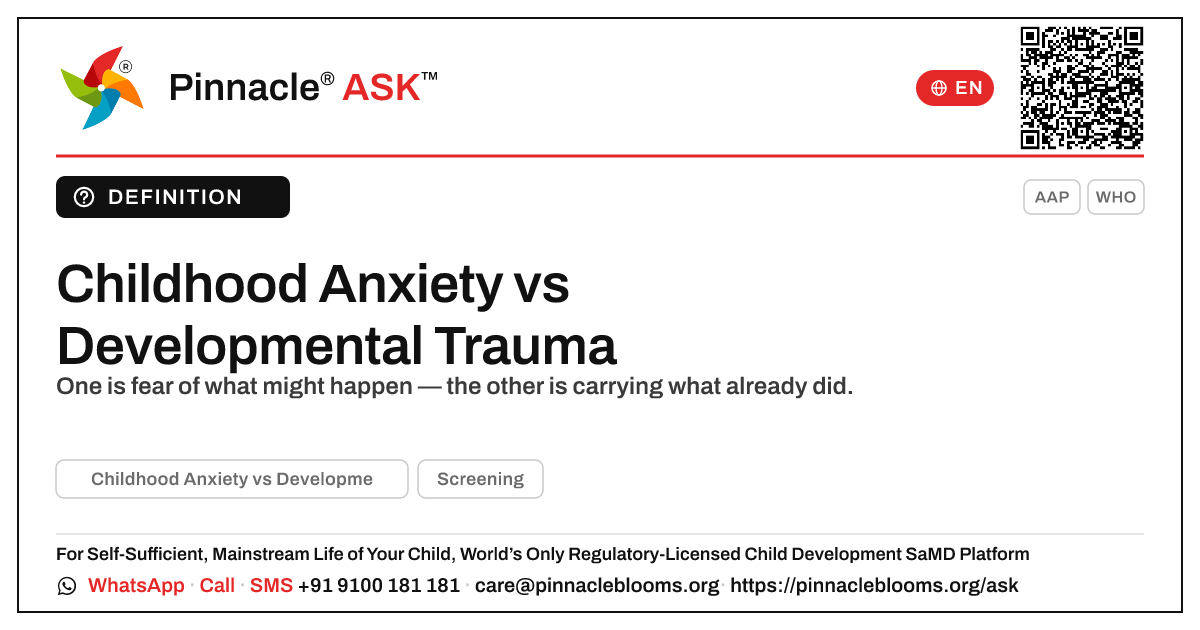
YOUR QUESTION. A CLEARER NEXT STEP.
Childhood Anxiety vs Developmental Trauma in Young Children
Childhood anxiety and developmental trauma can both leave a young child fearful, clingy or unsettled, but they differ in origin. Anxiety is an over-active alarm system — fear about what might happen — and often appears even in safe, stable homes. Developmental trauma is the lasting imprint of overwhelming or repeated frightening experiences on a young child's growing brain and sense of trust, often tied to feeling unsafe with caregivers. Trauma frequently produces anxiety, and the two overlap, so only a qualified clinician can tell them apart and match the right relationship-first or confidence-building support.
In this answer 5 sections
Both can make a small child seem fearful, clingy or unsettled — but one grows from inside the child's wiring, and the other grows from what has happened to the child.
In short
Childhood anxiety is when a child's natural alarm system fires too often or too strongly — worry, fear and physical unease that may appear even when life feels safe and stable. Developmental trauma is the lasting imprint of overwhelming or repeated frightening experiences — neglect, loss, frightening separations, or living without a steady, safe caregiver — on a young child's growing brain and sense of trust. Put simply: anxiety is often about fear of what might happen; developmental trauma is the body and brain still carrying what already happened. They can look alike, they can overlap, and only a qualified clinician can tell them apart.
How they differ in everyday life
With childhood anxiety, you might see a child who worries about new places, clings at drop-off, fears the dark, asks 'what if' questions, or has tummy aches before school — often in a child whose home life has been steady and loving. The fear tends to be about future or imagined events, and the child can usually be soothed and reassured, even if it takes time.
With developmental trauma, the unsettledness is rooted in past experiences that overwhelmed the child's ability to cope. You might see big swings between being switched-off (withdrawn, frozen, 'spaced out') and switched-on (sudden rage, panic, fight-or-flight) over things that seem small. Trust and feeling safe with adults can be hard. Sleep, eating and toileting may be affected, and ordinary reassurance may not settle the child as quickly, because the alarm is tied to a sense of safety itself.
The overlap is real: trauma frequently produces anxiety, and an anxious child under chronic stress can show trauma-like responses. This is exactly why a careful history — gentle, non-judgemental, and led by a clinician — matters so much. The right support differs: anxiety often responds well to graded, confidence-building approaches, while developmental trauma needs relationship-first, safety-first care that rebuilds trust before anything else.
When to seek a developmental check
If fear, clinginess or distress is intense, lasts for weeks, gets in the way of play, sleep, eating or nursery, or if you know your child has lived through frightening or disruptive experiences, it is worth a gentle look. You are not labelling your child — you are giving a clinician the chance to understand what your child is carrying and how best to help.
The Pinnacle way
This is general information, not a diagnosis — a clinical AbilityScore® and any diagnosis are formed only at a Pinnacle Blooms Network centre, under qualified clinician care, never from an app or form. Our clinicians listen to your child's story and observe how they cope, connect and calm, then shape relationship-first support — drawing on behavioural therapy and, where worry shapes everyday life, gentle guidance for childhood anxiety.
Trusted sources
The American Academy of Pediatrics and HealthyChildren on toxic stress, early adversity and children's emotional development; the World Health Organization on nurturing care and early childhood wellbeing.
Next step — Unsure whether it's worry or something deeper? Book a developmental screening and let a Pinnacle clinician understand your child with warmth and care.
CONNECT THE ANSWER TO YOUR CHILD’S DAY
Something to notice. Something to discuss.
What to notice
Watch for intense fear, clinginess or distress lasting weeks that disrupts play, sleep, eating or nursery. With anxiety, worry is often about future or imagined events and the child can usually be soothed. With developmental trauma, you may see big swings between withdrawn 'frozen' states and sudden panic or rage over small things, difficulty trusting adults, and reassurance that doesn't settle the child easily — especially after frightening or disruptive experiences.
In everyday life
Build felt-safety with predictable, calm routines and a steady 'I'm here, you're safe' presence. Name feelings simply ('you look scared, I'll stay with you') rather than rushing to fix or dismiss them — for both anxious and trauma-affected children, a calm, reliable adult is the most powerful regulator.
Bring your observations and questions to your child’s professional. Choose activities that suit your child’s comfort, abilities and agreed plan.
Bring your questions to a first visitQuestions families ask
Can a child have both childhood anxiety and developmental trauma?
Yes, and it is common. Frightening or overwhelming experiences can make a child's alarm system more reactive, so trauma often produces anxiety. An anxious child under prolonged stress can also show trauma-like responses. A clinician untangles the picture through a gentle history and observation, then shapes the right support.
How can I tell if my child's fear is anxiety or something deeper?
A simple rule of thumb: anxiety usually centres on worry about what might happen, and the child can often be soothed with reassurance over time. Trauma responses tend to be tied to feeling unsafe, may include withdrawn 'frozen' states or sudden panic, and ordinary reassurance settles the child less easily. Only a qualified clinician can confirm — a developmental check is the safe next step.
Will my child grow out of it on their own?
Some short-lived worry is a normal part of growing up and eases with time and steady, loving support. But if fear or distress is intense, lasts weeks, disrupts daily life, or follows frightening experiences, it is worth a gentle look. Early, relationship-first support helps children feel safe again and protects their development.
FOLLOW THE SOURCE
References behind this answer.
- Organisation website · further readingAAP HealthyChildren — early adversity and children's emotional development
- Organisation website · further readingWHO — nurturing care for early childhood development
References are supplied with this answer. An organisation homepage offers further reading; it does not establish an independent review of this page.
Content attribution: SETU Consortium · Pinnacle Blooms Network.
PEOPLE, TOPICS & DEVELOPMENT
See the connections.
Browse the wider question collections connected with this answer’s audience, developmental area and stage.
FROM UNDERSTANDING TO PURPOSEFUL SUPPORT
One question. Your child’s whole life.
Your child’s self-sufficient, mainstream-included life is the purpose from the beginning. At Pinnacle, that purpose shapes what we understand, the goals we choose, the people we bring together, everyday practice and review.
Connect this question with the right support.
Explore how the relevant service contributes to everyday abilities, then speak with us about your child.
Make the next conversation useful.
Bring the situations you notice at home or school. We’ll explain a suitable service, centre and first visit, including availability and fees, before you decide.
How PinnacleAI® connects the journeyExplore the seven stages
- 1Understand abilities
A starting picture of your child’s capabilities.
- 2Choose meaningful goals
Readiness and a plan shaped around the child.
- 3Bring the right support together
Suitable therapies and people for those goals.
- 4Carry practice into everyday life
Guidance for family, home and school.
- 5Track and correct
Use observations to adjust the plan.
- 6Reassess and review
Decide what to continue, change or do next.
- 7Grow independence and participation
The child’s life gives each step its purpose.
Explore the whole PinnacleAI® system → · Participation at school and in the community →
PINNACLE’S EVIDENCE, OPEN TO YOU
Look at the evidence behind our work.
Read our research, inspect the original regulatory documents and check what each institutional measure means.
General information supports a conversation with an appropriately qualified professional. Advice, goals and support depend on the individual child.