
YOUR QUESTION. A CLEARER NEXT STEP.
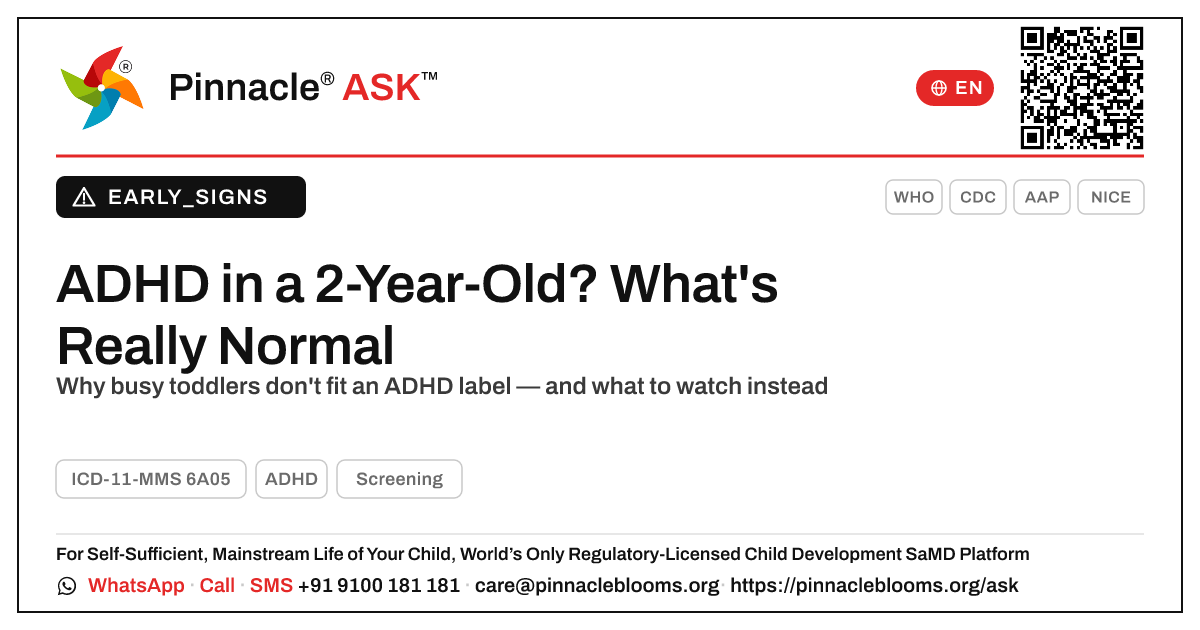
Early Signs of ADHD in a 2-Year-Old Boy: What Parents Should Know
ADHD cannot be meaningfully diagnosed or screened in a two-year-old — high activity, short attention and big feelings are normal at this age. ADHD is recognised later, usually from around 4–6 years. For now, watch overall development (communication, social warmth, play) and book a routine developmental check rather than looking for ADHD signs.
In this answer 5 sections
A worried parent of a busy, fast-moving two-year-old often asks the same question: is this just toddler energy, or something more? Here is the reassuring truth.
In short
At two years old, it is not clinically meaningful to diagnose — or even reliably screen for — ADHD. High activity, short attention and big emotions are completely normal at this age; in fact, they are how healthy two-year-olds learn. ADHD (ICD-11 6A05) is recognised only later, usually from around school age, when attention and self-control can be fairly compared to peers across different settings. What matters now is watching your son's overall development and enjoying his curiosity.
What is normal — and what to watch at two
A typical two-year-old is meant to be on the move. The following are normal and not signs of ADHD:
- Running, climbing and rarely sitting still for long
- A very short attention span — a few minutes on one toy is plenty
- Big feelings, tantrums and difficulty waiting or sharing
- Boundless energy and constant exploration
Instead of looking for "ADHD signs," gently keep an eye on the broader developmental picture — these are the things worth mentioning to your paediatrician:
- Communication — using single words by around 16 months and two-word phrases by 24 months
- Social warmth — sharing smiles, pointing to show you things, responding to his name
- Play — beginning pretend play and copying what you do
- Any loss of skills he previously had — always worth a prompt check
These tell us far more at this age than activity level ever could.
When ADHD assessment becomes meaningful
A reliable conversation about attention and impulsivity usually begins from around 4 to 6 years, when behaviour can be observed consistently at home and at preschool or school. If by then you notice difficulties with focus, impulsivity and over-activity that are greater than other children's and are affecting daily life across settings, that is the right time for a structured developmental review — never before. For now, a routine developmental check is the perfect, no-pressure next step.
The Pinnacle way
Developmental measurement supports care planning; diagnosis requires an appropriately qualified healthcare professional., under the care of a qualified clinician — never from an online list or a single observation. For a two-year-old, our team focuses on celebrating and supporting overall development. You can begin with a gentle developmental check at any of our centres, explore early child-development support, or learn how our clinician-administered AbilityScore® builds an objective, whole-child baseline. With 2.5 billion+ data points and 25 million+ therapy sessions across 70+ centres, our work is to reassure first and act only when it truly helps.
Trusted sources
Guided by WHO ICD-11 (6A05 Attention deficit hyperactivity disorder), the CDC's "Learn the Signs. Act Early." milestone guidance, the American Academy of Pediatrics (HealthyChildren.org), NICE NG87 on ADHD, and the Indian Academy of Pediatrics — all of which recognise ADHD beyond the toddler years.
Next step — if you'd simply like reassurance about your son's development, book a friendly developmental check with the Pinnacle team on WhatsApp: +91 91001 81181.
This is general information, not a diagnosis — individual assessment and diagnosis require an appropriately qualified healthcare professional.
CONNECT THE ANSWER TO YOUR CHILD’S DAY
Something to notice. Something to discuss.
What to notice
Rather than activity level, watch overall development: two-word phrases by 24 months, sharing smiles and pointing, responding to his name, and beginning pretend play. Book a prompt check for any loss of skills or persistent parental concern.
In everyday life
Channel your son's energy with short, active play and simple turn-taking games — they build attention naturally and there's no need to compare him to ADHD checklists at this age.
Bring your observations and questions to your child’s professional. Choose activities that suit your child’s comfort, abilities and agreed plan.
Bring your questions to a first visitQuestions families ask
Can a 2-year-old be diagnosed with ADHD?
No. At two, high activity and short attention are normal developmental traits, not signs of ADHD. A reliable assessment usually becomes meaningful from around 4 to 6 years, when behaviour can be compared across home and preschool. A diagnosis is always a clinical decision made at a centre, never from a list.
My 2-year-old never sits still — should I worry?
Being on the move is exactly what healthy two-year-olds do; it's how they learn. Rather than focusing on energy, watch his communication, social warmth and play. If you'd like reassurance, a routine developmental check is a calm, no-pressure way forward.
What should I watch instead of ADHD signs at this age?
Watch the broader picture: using two-word phrases by 24 months, pointing to show you things, responding to his name, beginning pretend play, and not losing skills he already had. Mention any concerns to your paediatrician.
When is the right time to assess for ADHD?
Usually from around 4 to 6 years, when over-activity, impulsivity and attention difficulties can be observed consistently across settings and are affecting daily life. Before then, a watch-and-support approach is the right one.
FOLLOW THE SOURCE
References behind this answer.
- Source referenceWHO ICD-11 · 6A05 Attention deficit hyperactivity disorder
- Source referenceCDC — Learn the Signs. Act Early.
- Organisation website · further readingAmerican Academy of Pediatrics — HealthyChildren.org
- Source referenceNICE NG87 — ADHD diagnosis and management
References are supplied with this answer. An organisation homepage offers further reading; it does not establish an independent review of this page.
Content attribution: SETU Consortium · Pinnacle Blooms Network.
PEOPLE, TOPICS & DEVELOPMENT
See the connections.
Browse the wider question collections connected with this answer’s audience, developmental area and stage.
FROM UNDERSTANDING TO PURPOSEFUL SUPPORT
One question. Your child’s whole life.
Your child’s self-sufficient, mainstream-included life is the purpose from the beginning. At Pinnacle, that purpose shapes what we understand, the goals we choose, the people we bring together, everyday practice and review.
Connect this question with the right support.
Start with your child’s strengths, your observations and what you want everyday life to become.
Make the next conversation useful.
Bring the situations you notice at home or school. We’ll explain a suitable service, centre and first visit, including availability and fees, before you decide.
How PinnacleAI® connects the journeyExplore the seven stages
- 1Understand abilities
A starting picture of your child’s capabilities.
- 2Choose meaningful goals
Readiness and a plan shaped around the child.
- 3Bring the right support together
Suitable therapies and people for those goals.
- 4Carry practice into everyday life
Guidance for family, home and school.
- 5Track and correct
Use observations to adjust the plan.
- 6Reassess and review
Decide what to continue, change or do next.
- 7Grow independence and participation
The child’s life gives each step its purpose.
Explore the whole PinnacleAI® system → · Participation at school and in the community →
PINNACLE’S EVIDENCE, OPEN TO YOU
Look at the evidence behind our work.
Read our research, inspect the original regulatory documents and check what each institutional measure means.
General information supports a conversation with an appropriately qualified professional. Advice, goals and support depend on the individual child.