
YOUR QUESTION. A CLEARER NEXT STEP.
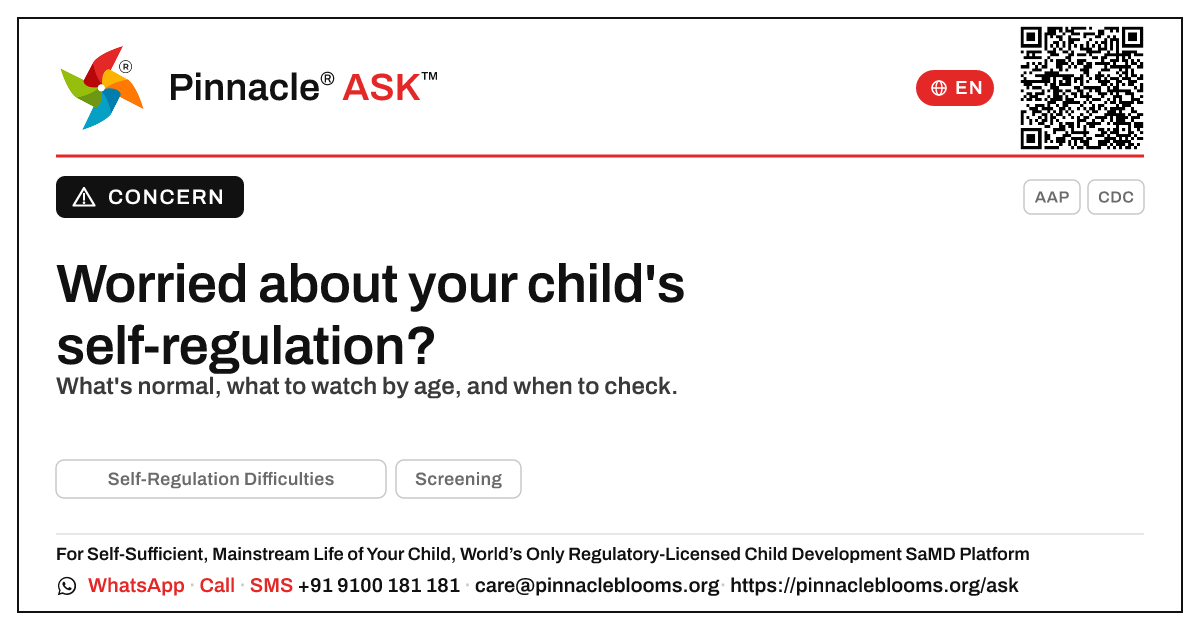
Should I be worried about my child's self-regulation?
Some meltdowns and big feelings are normal — self-regulation is still being built through childhood. A persistent, intense pattern that disrupts daily life is worth checking. Worry is a reason to assess, not a diagnosis. Only a Pinnacle clinician can confirm.
In this answer 4 sections
If your child melts down hard, struggles to calm, or swings from zero to overwhelmed in seconds — the worry is real, and it's worth understanding gently.
In short
Self-regulation difficulties mean a child finds it harder than expected — for their age — to manage big feelings, calm down after upset, wait, or shift between activities. Some unevenness is completely normal: every toddler has meltdowns, and self-control is still being built well into the school years. The flag is a persistent pattern that's intense, frequent, and getting in the way of daily life at home, in play, or at preschool. Worry is a good reason to check — it is not, by itself, a diagnosis.
What's worth watching
Self-regulation grows step by step, so what's typical depends on age:
- Toddlers (1–3 years) — frequent meltdowns are normal; watch if your child cannot be soothed even with your help, or distress is extreme and prolonged.
- Preschoolers (3–5 years) — gradually managing waiting, sharing, and transitions; watch if upset is far bigger than the trigger, or recovery takes very long.
- Any age — sleep, hunger, sensory overload or a hard day make regulation harder for everyone. Look at the overall pattern, not one bad afternoon.
Remember: young children borrow your calm to build their own. Co-regulation comes before self-regulation.
The Pinnacle way
Only a qualified Pinnacle clinician can tell whether this is a passing developmental phase or something that needs support — and that is exactly what an assessment is for. The clinician measures your child against their own AbilityScore baseline, looks at the whole picture, and gives you a plan, not a label. No diagnosis is ever made from an online form. Occupational therapy and parent-coaching approaches often help children build calmer, steadier days.
Trusted sources
American Academy of Pediatrics (HealthyChildren.org) on emotional development; CDC developmental milestones; Pinnacle Blooms Network clinical practice.
Next step — The kindest thing you can do with worry is check. Book a developmental assessment with a Pinnacle clinician.
This is general information, not a diagnosis — individual assessment and diagnosis require an appropriately qualified healthcare professional.
CONNECT THE ANSWER TO YOUR CHILD’S DAY
Something to notice. Something to discuss.
What to notice
Seek assessment sooner if your child cannot be soothed even with your help, if distress is extreme and prolonged for their age, or if meltdowns are so frequent they disrupt sleep, play, or preschool.
In everyday life
Be your child's calm. When they're overwhelmed, lower your voice, get down to their level, and name the feeling: "You're so frustrated — I'm here." Children borrow your steadiness before they grow their own.
Bring your observations and questions to your child’s professional. Choose activities that suit your child’s comfort, abilities and agreed plan.
Bring your questions to a first visitQuestions families ask
Are meltdowns a sign of self-regulation difficulties?
Not on their own. Meltdowns are completely normal in toddlers and young children whose self-control is still developing. The flag is a persistent pattern that's unusually intense or frequent for your child's age and disrupts daily life.
At what age should children manage their emotions better?
Self-regulation builds gradually across the early years and into the school years — there's no single switch. Preschoolers slowly get better at waiting and recovering from upset, but they still rely heavily on a calm adult to co-regulate.
What helps a child with self-regulation difficulties?
Co-regulation comes first — your calm helps build theirs. Predictable routines, naming feelings, and gentle support during transitions all help. A clinician may suggest occupational therapy or parent-coaching after assessing your child's own baseline.
FOLLOW THE SOURCE
References behind this answer.
- Organisation website · further readingAAP HealthyChildren — emotional development
- Source referenceCDC — child development & positive parenting
References are supplied with this answer. An organisation homepage offers further reading; it does not establish an independent review of this page.
Content attribution: SETU Consortium · Pinnacle Blooms Network.
PEOPLE, TOPICS & DEVELOPMENT
See the connections.
Browse the wider question collections connected with this answer’s audience, developmental area and stage.
FROM UNDERSTANDING TO PURPOSEFUL SUPPORT
One question. Your child’s whole life.
Your child’s self-sufficient, mainstream-included life is the purpose from the beginning. At Pinnacle, that purpose shapes what we understand, the goals we choose, the people we bring together, everyday practice and review.
Connect this question with the right support.
Start with your child’s strengths, your observations and what you want everyday life to become.
Make the next conversation useful.
Bring the situations you notice at home or school. We’ll explain a suitable service, centre and first visit, including availability and fees, before you decide.
How PinnacleAI® connects the journeyExplore the seven stages
- 1Understand abilities
A starting picture of your child’s capabilities.
- 2Choose meaningful goals
Readiness and a plan shaped around the child.
- 3Bring the right support together
Suitable therapies and people for those goals.
- 4Carry practice into everyday life
Guidance for family, home and school.
- 5Track and correct
Use observations to adjust the plan.
- 6Reassess and review
Decide what to continue, change or do next.
- 7Grow independence and participation
The child’s life gives each step its purpose.
Explore the whole PinnacleAI® system → · Participation at school and in the community →
PINNACLE’S EVIDENCE, OPEN TO YOU
Look at the evidence behind our work.
Read our research, inspect the original regulatory documents and check what each institutional measure means.
General information supports a conversation with an appropriately qualified professional. Advice, goals and support depend on the individual child.