
YOUR QUESTION. A CLEARER NEXT STEP.
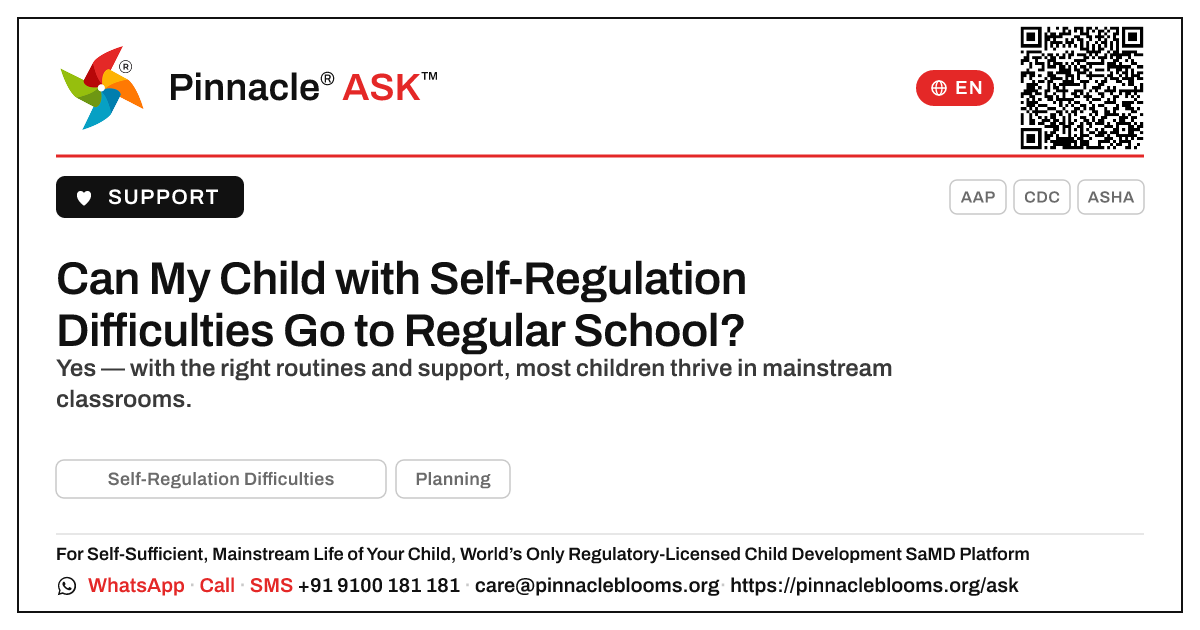
Can a Child with Self-Regulation Difficulties Attend a Regular School?
Yes — most children with self-regulation difficulties attend regular school successfully. With predictable routines, calm-down spaces, sensory breaks and a teacher partnership, these children thrive alongside peers. Targeted therapy strengthens regulation skills; only a clinician can shape the right plan.
In this answer 5 sections
Yes — and the question itself shows how much you want your child to belong. Here's the honest, hopeful answer.
In short
Yes, most children with self-regulation difficulties can attend a regular school. Trouble managing big feelings, impulses, attention or transitions is something a child learns to do better with time and the right support — not a barrier to mainstream education. With understanding teachers, a few simple classroom strategies and targeted therapy where needed, these children very often thrive alongside their peers.
What helps a child settle and succeed
Self-regulation is a skill that grows — and a regular classroom is one of the best places for it to grow, with the right scaffolding:
- Predictable routines — visual schedules and gentle warnings before transitions reduce overwhelm.
- A calm-down space — a quiet corner the child can use before a meltdown, not as punishment.
- Movement and sensory breaks — short, planned breaks help an unsettled nervous system reset.
- Clear, kind expectations — short instructions, one step at a time, with warm acknowledgement of effort.
- A teacher partnership — sharing what calms your child means home and school speak the same language.
Many children need this support only for a season. Self-regulation strengthens markedly through the early school years as the brain matures.
When extra support is wise
If difficulties are intense, persistent, or stopping your child from learning or making friends, an assessment helps clarify why — and what specific support will help. Sometimes self-regulation difficulties sit alongside attention, language or sensory needs, and naming that early opens the right doors, including reasonable accommodations the school can offer.
The Pinnacle way
Developmental measurement supports care planning; diagnosis requires an appropriately qualified healthcare professional., under qualified clinician care — never from an online form. At Pinnacle, the clinician measures your child against their own AbilityScore baseline, works with you on a plan, and where helpful, occupational therapy builds practical regulation skills your child can carry straight into the classroom. The goal is always belonging and confidence in mainstream school.
Trusted sources
American Academy of Pediatrics guidance on emotional and behavioural development; CDC milestones on managing feelings and behaviour; ASHA on supporting children in educational settings.
Next step — Want to know exactly what support your child needs to flourish at school? Book an assessment with a Pinnacle clinician.
This is general information, not a diagnosis — individual assessment and diagnosis require an appropriately qualified healthcare professional.
CONNECT THE ANSWER TO YOUR CHILD’S DAY
Something to notice. Something to discuss.
What to notice
Seek assessment sooner if meltdowns are intense and frequent, if your child cannot stay safe or settle even with support, or if difficulties are stopping them learning or making friends at school.
In everyday life
Practise a simple 'calm down' routine at home before school needs it — three slow belly breaths and a count to five. Name feelings out loud together ('you're feeling cross') so your child learns the words before the big moment arrives.
Bring your observations and questions to your child’s professional. Choose activities that suit your child’s comfort, abilities and agreed plan.
Bring your questions to a first visitQuestions families ask
Does my child need a special school for self-regulation difficulties?
Usually not. Most children with self-regulation difficulties attend regular school well, especially with simple classroom strategies like routines, calm-down spaces and movement breaks. A special setting is only considered in rare, more complex situations, and that decision is made with clinicians and the school together.
Should I tell my child's teacher?
Yes — a warm partnership with the teacher is one of the most powerful supports. Sharing what calms your child and which transitions are tricky helps home and school use the same approach, so your child feels understood in both places.
Will self-regulation get better as my child grows?
Very often, yes. Self-regulation is a skill that strengthens as the brain matures through the early school years, and supportive routines plus targeted therapy can speed that growth. Many children need extra support only for a season.
FOLLOW THE SOURCE
References behind this answer.
- Organisation website · further readingAAP HealthyChildren — emotional and behavioural development
- Organisation website · further readingCDC — milestones for managing feelings and behaviour
- Organisation website · further readingASHA — supporting children in school settings
References are supplied with this answer. An organisation homepage offers further reading; it does not establish an independent review of this page.
Content attribution: SETU Consortium · Pinnacle Blooms Network.
PEOPLE, TOPICS & DEVELOPMENT
See the connections.
Browse the wider question collections connected with this answer’s audience, developmental area and stage.
FROM UNDERSTANDING TO PURPOSEFUL SUPPORT
One question. Your child’s whole life.
Your child’s self-sufficient, mainstream-included life is the purpose from the beginning. At Pinnacle, that purpose shapes what we understand, the goals we choose, the people we bring together, everyday practice and review.
Connect this question with the right support.
Explore how the relevant service contributes to everyday abilities, then speak with us about your child.
Make the next conversation useful.
Bring the situations you notice at home or school. We’ll explain a suitable service, centre and first visit, including availability and fees, before you decide.
How PinnacleAI® connects the journeyExplore the seven stages
- 1Understand abilities
A starting picture of your child’s capabilities.
- 2Choose meaningful goals
Readiness and a plan shaped around the child.
- 3Bring the right support together
Suitable therapies and people for those goals.
- 4Carry practice into everyday life
Guidance for family, home and school.
- 5Track and correct
Use observations to adjust the plan.
- 6Reassess and review
Decide what to continue, change or do next.
- 7Grow independence and participation
The child’s life gives each step its purpose.
Explore the whole PinnacleAI® system → · Participation at school and in the community →
PINNACLE’S EVIDENCE, OPEN TO YOU
Look at the evidence behind our work.
Read our research, inspect the original regulatory documents and check what each institutional measure means.
General information supports a conversation with an appropriately qualified professional. Advice, goals and support depend on the individual child.