
YOUR QUESTION. A CLEARER NEXT STEP.
How therapy supports self-regulation difficulties
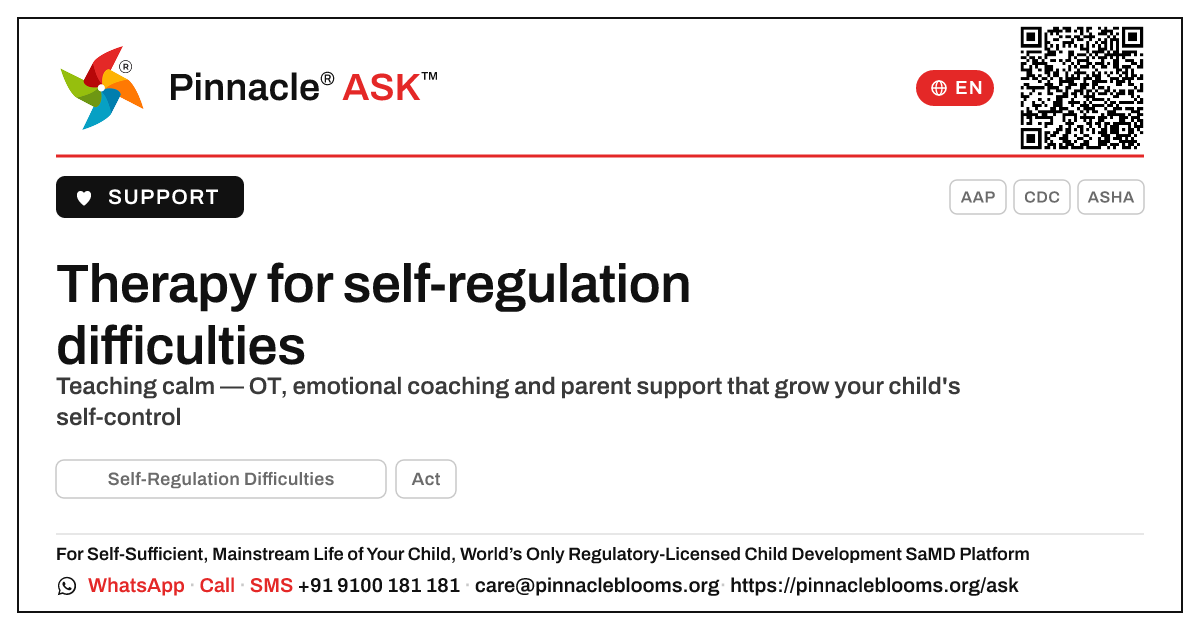
Self-regulation difficulties are supported through occupational therapy, emotional-regulation coaching, speech and language therapy and parent coaching — teaching the child to return to calm while you co-regulate at home. A clinical plan and AbilityScore® are formed only at a Pinnacle centre under clinician care.
In this answer 4 sections
When big feelings spill over fast, your child isn't being difficult — their brain is still building the controls, and therapy gives them the tools to find calm.
In short
Self-regulation difficulties — trouble managing emotions, impulses, attention and energy levels — are supported through occupational therapy (especially sensory and arousal-regulation strategies), behavioural and emotional-coaching approaches, and speech and language therapy that builds the words a child needs to name and manage feelings. The goal is to teach the child how to return to calm, while coaching you to support that at home. With consistent, playful practice, regulation is a skill that grows beautifully over time.
The therapies that help
- Occupational therapy (OT) — the cornerstone for many children. Therapists identify what tips your child into overwhelm or shutdown and build a personalised "toolkit" of sensory and movement strategies (deep pressure, heavy work, calming spaces, breathing) that settle the nervous system.
- Emotional-regulation coaching — structured, playful programmes that teach children to recognise their body signals, name feelings, and choose a calming step before the meltdown peaks.
- Speech and language therapy — gives the child the vocabulary to express "I'm frustrated" or "I need a break" instead of acting it out; language is one of the strongest tools for self-control.
- Parent coaching — predictable routines, co-regulation (staying calm with your child), and clear, kind boundaries that the home and centre share, so the skill transfers everywhere.
Regulation develops through co-regulation first — a calm adult borrowing their steadiness to your child — long before a child can self-regulate alone. That is normal and exactly how the brain learns.
The Pinnacle way
AbilityScore® is part of Pinnacle’s developmental assessment. Diagnosis, where needed, requires an appropriately qualified healthcare professional — never from an app or online form. A clinician maps your child's regulation profile through a structured clinician-led assessment and shapes a plan, often anchored in occupational therapy. Learn more about self-regulation difficulties and how everyday support is built around your child.
Trusted sources
American Academy of Pediatrics (HealthyChildren.org) on emotional development and co-regulation; CDC guidance on social-emotional milestones; American Speech-Language-Hearing Association on language and self-expression.
Next step — Want to understand what calms and what overwhelms your child? Book a developmental assessment with a Pinnacle clinician.
This is general information, not a diagnosis — individual assessment and diagnosis require an appropriately qualified healthcare professional.
CONNECT THE ANSWER TO YOUR CHILD’S DAY
Something to notice. Something to discuss.
What to notice
Watch for frequent, intense meltdowns that outlast the child's age, trouble switching tasks or calming after upset, sensory over- or under-reactions, and difficulty waiting or managing impulses compared with peers.
In everyday life
Build a simple "calm-down corner" with a soft cushion and a favourite quiet activity — and stay calm yourself; your steadiness teaches their brain how to settle.
Bring your observations and questions to your child’s professional. Choose activities that suit your child’s comfort, abilities and agreed plan.
Bring your questions to a first visitQuestions families ask
At what age should my child be able to self-regulate?
Self-regulation develops slowly through childhood and relies on co-regulation — a calm adult helping the child settle — first. Toddlers and preschoolers naturally need a lot of adult support; the ability to calm independently grows over years. If meltdowns are very frequent or intense for the age, a developmental check helps.
Is occupational therapy or behaviour therapy better for self-regulation?
They often work together. Occupational therapy addresses the sensory and arousal side of regulation, while emotional-coaching approaches teach recognising and managing feelings. A clinician decides the right mix after assessing your child's specific profile.
Can I support my child's regulation at home?
Yes — predictable routines, staying calm during upsets (co-regulation), naming feelings out loud, and a quiet calming space all help. Parent coaching at a centre shows you strategies that match your child and keep home and therapy consistent.
FOLLOW THE SOURCE
References behind this answer.
- Organisation website · further readingAAP HealthyChildren.org — emotional development and co-regulation
- Source referenceCDC — social-emotional developmental milestones
- Organisation website · further readingASHA — language and self-expression
References are supplied with this answer. An organisation homepage offers further reading; it does not establish an independent review of this page.
Content attribution: SETU Consortium · Pinnacle Blooms Network.
PEOPLE, TOPICS & DEVELOPMENT
See the connections.
Browse the wider question collections connected with this answer’s audience, developmental area and stage.
FROM UNDERSTANDING TO PURPOSEFUL SUPPORT
One question. Your child’s whole life.
Your child’s self-sufficient, mainstream-included life is the purpose from the beginning. At Pinnacle, that purpose shapes what we understand, the goals we choose, the people we bring together, everyday practice and review.
Connect this question with the right support.
Start with your child’s strengths, your observations and what you want everyday life to become.
Make the next conversation useful.
Bring the situations you notice at home or school. We’ll explain a suitable service, centre and first visit, including availability and fees, before you decide.
How PinnacleAI® connects the journeyExplore the seven stages
- 1Understand abilities
A starting picture of your child’s capabilities.
- 2Choose meaningful goals
Readiness and a plan shaped around the child.
- 3Bring the right support together
Suitable therapies and people for those goals.
- 4Carry practice into everyday life
Guidance for family, home and school.
- 5Track and correct
Use observations to adjust the plan.
- 6Reassess and review
Decide what to continue, change or do next.
- 7Grow independence and participation
The child’s life gives each step its purpose.
Explore the whole PinnacleAI® system → · Participation at school and in the community →
PINNACLE’S EVIDENCE, OPEN TO YOU
Look at the evidence behind our work.
Read our research, inspect the original regulatory documents and check what each institutional measure means.
General information supports a conversation with an appropriately qualified professional. Advice, goals and support depend on the individual child.