
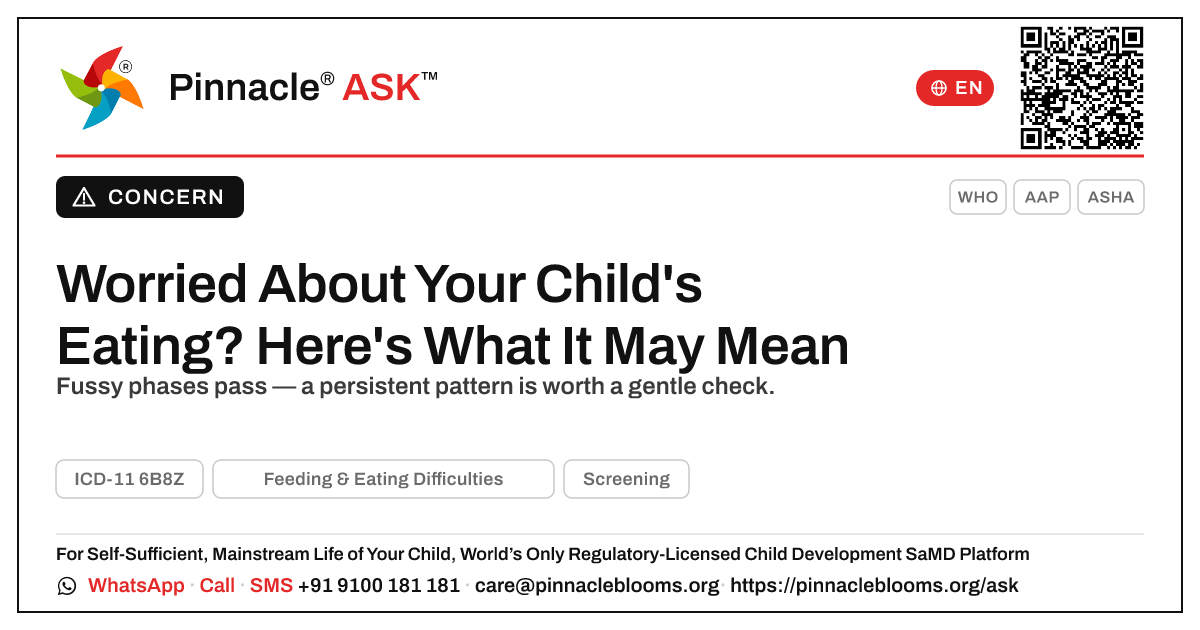
YOUR QUESTION. A CLEARER NEXT STEP.
Should I worry about my child's feeding and eating difficulties?
Fussy phases are common and often pass. A persistent pattern — a shrinking food list, distress at textures, choking, or faltering weight — is worth a gentle professional check. Worry is a reason to assess, not a diagnosis. Only a Pinnacle clinician can confirm.
In this answer 5 sections
If mealtimes have become a battle, or your child eats so little or so narrowly that you worry — the worry is real, and worth listening to.
In short
Feeding & Eating Difficulties cover a range of patterns — refusing whole food groups, gagging or distress at certain textures, very slow or messy eating, or eating so little that weight and energy suffer. Many children go through fussy phases that pass on their own. A pattern that persists, narrows further over time, or affects growth, weight or family life is the real flag worth checking. Worry is a reason to assess — it is not, by itself, a diagnosis.
Signs worth attention
- Eating fewer than 10–15 foods, with the list shrinking rather than growing
- Strong distress, gagging or vomiting at certain textures, smells or colours
- Coughing, choking or breathlessness during feeds
- Mealtimes that regularly take over 30 minutes or end in tears
- Faltering weight, low energy, or feeds that disrupt the whole household
One or two of these in a passing phase is common. Several, persisting, deserve a gentle professional look.
The science, briefly
Feeding difficulties sit within the WHO ICD-11 family of feeding and eating disorders (6B8Z). They can stem from sensory sensitivities, oral-motor coordination, medical factors such as reflux, or learned mealtime stress — often a mix. This is why a careful assessment that looks at why feeding is hard matters more than any single label. Identified early, most children make real, steady progress.
The Pinnacle way
Only a qualified clinician at a Pinnacle Blooms Network centre can tell whether this is a passing phase or a difficulty that needs support — your child is measured against their own AbilityScore baseline, never a label from an online form. Our feeding and oral-motor therapy team builds a gentle, child-led plan. No diagnosis is ever made online.
Trusted sources
WHO ICD-11 (6B8Z); American Academy of Pediatrics (healthychildren.org); ASHA guidance on paediatric feeding; Pinnacle Blooms Network clinical studies.
Next step — The kindest thing to do with worry is check. Book a feeding assessment with a Pinnacle clinician.
This is general information, not a diagnosis — individual assessment and diagnosis require an appropriately qualified healthcare professional.
CONNECT THE ANSWER TO YOUR CHILD’S DAY
Something to notice. Something to discuss.
What to notice
Seek assessment sooner if your child coughs, chokes or turns breathless during feeds, loses weight, drops foods they once accepted, or shows real distress at every meal.
In everyday life
Offer new foods alongside a trusted favourite, with zero pressure to eat — just let your child touch, smell or lick it. Repeated, calm exposure with no battle is how trust with food slowly grows.
Bring your observations and questions to your child’s professional. Choose activities that suit your child’s comfort, abilities and agreed plan.
Bring your questions to a first visitQuestions families ask
Is my child just a fussy eater or is it a real difficulty?
Many children go through fussy phases that pass. The difference is pattern and impact: a food list that shrinks rather than grows, strong distress at textures, choking, or effects on weight and family life suggest it's worth a professional check rather than a passing phase.
At what age should I get feeding difficulties assessed?
There's no single cut-off. If feeding difficulties persist, narrow over time, involve coughing or choking, or affect your child's weight and energy, it's reasonable to seek an assessment at any age — earlier support tends to bring steadier progress.
Can feeding difficulties be helped?
Yes. With a gentle, child-led plan that addresses why feeding is hard — whether sensory, oral-motor, medical or mealtime stress — most children make real, steady progress. A clinician identifies the cause first, then builds support around it.
FOLLOW THE SOURCE
References behind this answer.
- Organisation website · further readingWHO ICD-11: Feeding & eating disorders
- Organisation website · further readingAAP HealthyChildren: feeding and nutrition
- Organisation website · further readingASHA: paediatric feeding and swallowing
References are supplied with this answer. An organisation homepage offers further reading; it does not establish an independent review of this page.
Content attribution: SETU Consortium · Pinnacle Blooms Network.
PEOPLE, TOPICS & DEVELOPMENT
See the connections.
Browse the wider question collections connected with this answer’s audience, developmental area and stage.
FROM UNDERSTANDING TO PURPOSEFUL SUPPORT
One question. Your child’s whole life.
Your child’s self-sufficient, mainstream-included life is the purpose from the beginning. At Pinnacle, that purpose shapes what we understand, the goals we choose, the people we bring together, everyday practice and review.
Connect this question with the right support.
Explore how the relevant service contributes to everyday abilities, then speak with us about your child.
Make the next conversation useful.
Bring the situations you notice at home or school. We’ll explain a suitable service, centre and first visit, including availability and fees, before you decide.
How PinnacleAI® connects the journeyExplore the seven stages
- 1Understand abilities
A starting picture of your child’s capabilities.
- 2Choose meaningful goals
Readiness and a plan shaped around the child.
- 3Bring the right support together
Suitable therapies and people for those goals.
- 4Carry practice into everyday life
Guidance for family, home and school.
- 5Track and correct
Use observations to adjust the plan.
- 6Reassess and review
Decide what to continue, change or do next.
- 7Grow independence and participation
The child’s life gives each step its purpose.
Explore the whole PinnacleAI® system → · Participation at school and in the community →
PINNACLE’S EVIDENCE, OPEN TO YOU
Look at the evidence behind our work.
Read our research, inspect the original regulatory documents and check what each institutional measure means.
General information supports a conversation with an appropriately qualified professional. Advice, goals and support depend on the individual child.