
YOUR QUESTION. A CLEARER NEXT STEP.
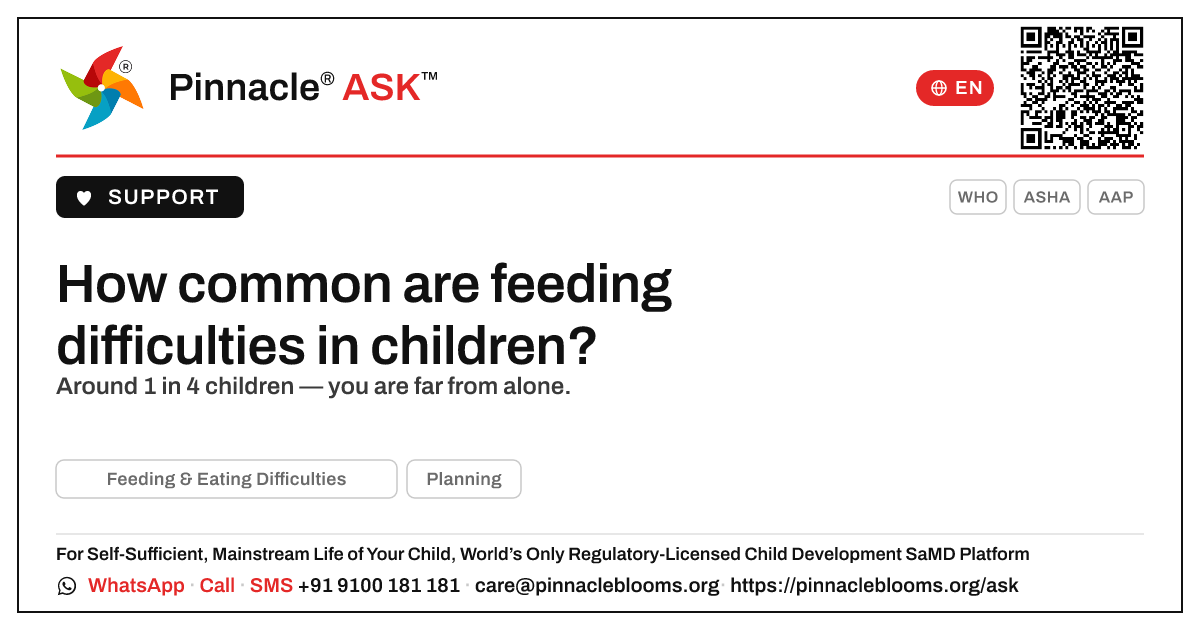
How common are feeding and eating difficulties in children?
Feeding and eating difficulties are very common in childhood — affecting around 1 in 4 typically developing children and up to 8 in 10 children with developmental or medical conditions. Most mild fussiness settles, but persistent difficulties affecting growth, swallowing safety or wellbeing benefit from skilled support. AbilityScore® is part of Pinnacle’s developmental assessment. Diagnosis, where needed, requires an appropriately qualified healthcare professional.
In this answer 5 sections
If mealtimes in your home feel like a daily struggle, take heart — you are far from alone, and feeding difficulties are one of the most common reasons families seek a little extra support.
In short
Feeding and eating difficulties are very common in childhood. Around 1 in 4 typically developing children experience some degree of feeding difficulty in their early years, and this rises to as many as 8 in 10 children with developmental differences such as autism, prematurity or other medical conditions. Most mild, short-lived fussiness settles on its own — but when difficulties are persistent, affect growth, or cause real distress, gentle, skilled support helps enormously.
What the numbers tell us
- In the general population — roughly 25–45% of otherwise healthy children show some feeding difficulty (picky eating, slow feeding, food refusal) at some stage, most often between toddlerhood and the early school years.
- Picky eating is a normal developmental phase for many toddlers and usually eases with time and patient, low-pressure exposure.
- In children with developmental or medical conditions — rates are much higher, reported in 70–90% of children with autism, and commonly among children born prematurely or with conditions affecting the mouth, gut or sensory processing.
- Persistent, clinically significant difficulties — where eating affects nutrition, growth, safe swallowing or family wellbeing — are far less common but very real, and these are the ones that most benefit from a proper assessment.
In short: a little fussiness is ordinary; difficulty that worries you, lingers, or affects your child's growth and joy around food is worth checking.
When to seek a check
Seek a check sooner if your child gags, chokes or coughs during feeds, eats only a very narrow range of foods, is not growing or gaining weight well, takes very long over meals, or if eating causes real distress. Any sign of unsafe swallowing — coughing, a wet or gurgly voice, or breathing changes while eating — needs prompt medical review first.
The Pinnacle way
AbilityScore® is part of Pinnacle’s developmental assessment. Diagnosis, where needed, requires an appropriately qualified healthcare professional — never from an app or online form. Across 70+ centres, 700+ therapists and 4.95 lakh+ families served, we help families understand whether a feeding difficulty is ordinary fussiness or something that benefits from skilled support. Explore feeding and oral-motor therapy, learn how a structured developmental profile is built, or start at our home page to find your nearest centre.
Trusted sources
WHO ICD-11 (Feeding or eating disorders); American Speech-Language-Hearing Association guidance on paediatric feeding and swallowing; American Academy of Pediatrics (HealthyChildren.org) feeding and picky-eating guidance.
Next step — Wondering whether your child's eating needs a closer look? Book a feeding assessment with a Pinnacle clinician.
This is general information, not a diagnosis — individual assessment and diagnosis require an appropriately qualified healthcare professional.
CONNECT THE ANSWER TO YOUR CHILD’S DAY
Something to notice. Something to discuss.
What to notice
Watch for gagging, choking or coughing during feeds, a very narrow range of accepted foods, slow or distressing mealtimes, poor weight gain or growth, and any wet voice or breathing change while eating — which needs prompt medical review.
In everyday life
If your toddler is fussy, relax — offer one tiny portion of a new food beside foods they already trust, and let them touch or smell it with no pressure to eat. Repeated calm exposure works better than coaxing.
Bring your observations and questions to your child’s professional. Choose activities that suit your child’s comfort, abilities and agreed plan.
Bring your questions to a first visitQuestions families ask
Is picky eating the same as a feeding difficulty?
Not always. Picky eating is a very common and usually passing toddler phase. It becomes a feeding difficulty worth checking when it persists, narrows your child's diet severely, affects growth, or causes real distress at mealtimes.
Are feeding difficulties more common in children with autism?
Yes. Feeding difficulties are reported in around 70–90% of children with autism, often linked to sensory sensitivities to textures, smells or appearance of food. Gentle, sensory-friendly feeding support helps.
When should I see someone about my child's eating?
Seek a check if your child gags, chokes or coughs during feeds, eats only a few foods, is not growing well, takes very long over meals, or if eating causes distress. Any sign of unsafe swallowing needs prompt medical review first.
FOLLOW THE SOURCE
References behind this answer.
- Organisation website · further readingWHO ICD-11 — Feeding or eating disorders
- Organisation website · further readingASHA — Paediatric feeding and swallowing
- Organisation website · further readingAAP HealthyChildren.org — Feeding and picky eating
References are supplied with this answer. An organisation homepage offers further reading; it does not establish an independent review of this page.
Content attribution: SETU Consortium · Pinnacle Blooms Network.
PEOPLE, TOPICS & DEVELOPMENT
See the connections.
Browse the wider question collections connected with this answer’s audience, developmental area and stage.
FROM UNDERSTANDING TO PURPOSEFUL SUPPORT
One question. Your child’s whole life.
Your child’s self-sufficient, mainstream-included life is the purpose from the beginning. At Pinnacle, that purpose shapes what we understand, the goals we choose, the people we bring together, everyday practice and review.
Connect this question with the right support.
Explore how the relevant service contributes to everyday abilities, then speak with us about your child.
Make the next conversation useful.
Bring the situations you notice at home or school. We’ll explain a suitable service, centre and first visit, including availability and fees, before you decide.
How PinnacleAI® connects the journeyExplore the seven stages
- 1Understand abilities
A starting picture of your child’s capabilities.
- 2Choose meaningful goals
Readiness and a plan shaped around the child.
- 3Bring the right support together
Suitable therapies and people for those goals.
- 4Carry practice into everyday life
Guidance for family, home and school.
- 5Track and correct
Use observations to adjust the plan.
- 6Reassess and review
Decide what to continue, change or do next.
- 7Grow independence and participation
The child’s life gives each step its purpose.
Explore the whole PinnacleAI® system → · Participation at school and in the community →
PINNACLE’S EVIDENCE, OPEN TO YOU
Look at the evidence behind our work.
Read our research, inspect the original regulatory documents and check what each institutional measure means.
General information supports a conversation with an appropriately qualified professional. Advice, goals and support depend on the individual child.