
YOUR QUESTION. A CLEARER NEXT STEP.
Green zone for rotational control: what to do next
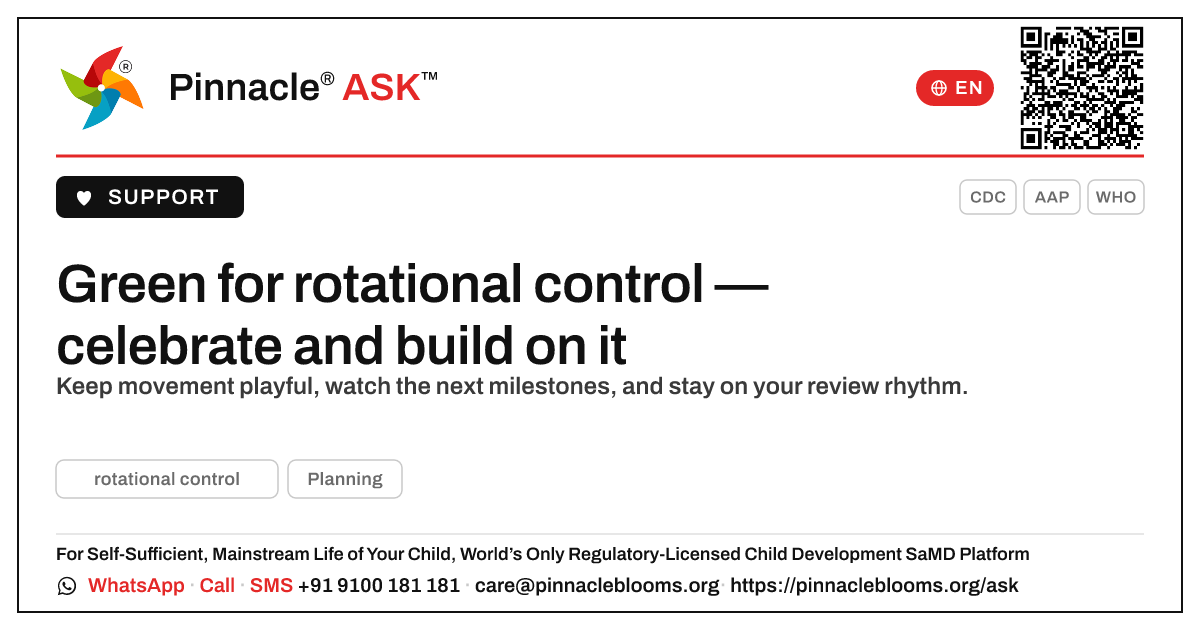
A green zone for rotational control means your child's turning, twisting and rolling are developing on track, so no therapy is needed — keep enriching movement through varied floor play, watch for the connected skills of crawling and sitting transitions, and stay on your routine review schedule. AbilityScore® is part of Pinnacle’s developmental assessment. Diagnosis, where needed, requires an appropriately qualified healthcare professional.
In this answer 5 sections
A green zone for rotational control is wonderful news — it means your child's turning, twisting and rolling skills are developing beautifully, and now we get to build on that momentum.
In short
Green for rotational control means your child is moving on track for the way they turn, twist and rotate their body — rolling over, segmental rolling, and the trunk rotation that underpins crawling, sitting transitions and later balance. Your next step is simple: keep nurturing it through everyday play, and stay on your routine review schedule so we can watch the next milestones emerge naturally. No therapy is needed when a skill is green — just rich, joyful movement opportunities and a gentle eye on what comes next.
What "green" means and what to do next
Rotational control is a foundation skill — it feeds directly into crawling, moving in and out of sitting, pivoting to reach a toy, and eventually walking and protective balance. A green result tells us this foundation is strong, so the goal now is to enrich and consolidate, not to intervene.
- Keep movement varied and playful — encourage rolling for toys, reaching across the midline, twisting to look behind, and changing positions freely on the floor.
- Give plenty of floor time — open, safe spaces let your child practise turning and transitioning in every direction.
- Watch the connected skills — as rotation matures, look for confident sitting transitions, crawling and pivoting. These often blossom next.
- Stay on your review rhythm — green today is best protected by gentle, periodic re-checks so progress is confirmed over time, not assumed.
Green is a green light to celebrate and keep playing — children consolidate skills through repetition that feels like fun, never drill.
When to check in sooner
Most green-zone children simply continue to thrive. Do bring a review forward if you notice your child suddenly avoiding rolling or rotation they had mastered, strong differences between one side of the body and the other, or stiffness or floppiness that wasn't there before. A quick check lets a clinician confirm all is well and adjust the plan if anything has shifted.
The Pinnacle way
AbilityScore® is part of Pinnacle’s developmental assessment. Diagnosis, where needed, requires an appropriately qualified healthcare professional — never from an app, a colour zone alone, or an online form. Your green result is a snapshot of strength; a clinician can map your child's full movement profile and confirm the next milestones to nurture, drawing on our physiotherapy expertise. Explore more developmental guidance across our knowledge engine.
Trusted sources
WHO developmental milestone guidance; CDC "Learn the Signs. Act Early." milestone resources; American Academy of Pediatrics family guidance via HealthyChildren.org.
Next step — Want to confirm your child's progress and plan the next milestones with confidence? Book a developmental review with a Pinnacle clinician.
This is general information, not a diagnosis — individual assessment and diagnosis require an appropriately qualified healthcare professional.
CONNECT THE ANSWER TO YOUR CHILD’S DAY
Something to notice. Something to discuss.
What to notice
Watch for suddenly avoiding rolling or rotation they once managed, clear differences between one side of the body and the other, or new stiffness or floppiness.
In everyday life
Place a favourite toy just to one side so your child twists and rolls to reach it — playful reaching across the midline keeps rotational control strong and joyful.
Bring your observations and questions to your child’s professional. Choose activities that suit your child’s comfort, abilities and agreed plan.
Bring your questions to a first visitQuestions families ask
Does a green zone mean my child needs no therapy?
Yes — a green result for rotational control means this skill is developing on track, so targeted therapy isn't needed. The best next step is rich, varied movement play and staying on your routine review schedule so progress is confirmed over time.
What skills come after rotational control?
Rotation underpins crawling, moving in and out of sitting, pivoting to reach, and later balance and walking. As rotation matures you'll often see these connected skills blossom next.
When should I bring a review forward?
Check in sooner if your child suddenly avoids rolling they had mastered, shows strong differences between the two sides of the body, or develops new stiffness or floppiness. A clinician can confirm all is well.
FOLLOW THE SOURCE
References behind this answer.
- Source referenceCDC: Developmental milestones
- Organisation website · further readingAAP: HealthyChildren.org family guidance
- Organisation website · further readingWHO: Child development and milestones
References are supplied with this answer. An organisation homepage offers further reading; it does not establish an independent review of this page.
Content attribution: SETU Consortium · Pinnacle Blooms Network.
PEOPLE, TOPICS & DEVELOPMENT
See the connections.
Browse the wider question collections connected with this answer’s audience, developmental area and stage.
FROM UNDERSTANDING TO PURPOSEFUL SUPPORT
One question. Your child’s whole life.
Your child’s self-sufficient, mainstream-included life is the purpose from the beginning. At Pinnacle, that purpose shapes what we understand, the goals we choose, the people we bring together, everyday practice and review.
Connect this question with the right support.
Start with your child’s strengths, your observations and what you want everyday life to become.
Make the next conversation useful.
Bring the situations you notice at home or school. We’ll explain a suitable service, centre and first visit, including availability and fees, before you decide.
How PinnacleAI® connects the journeyExplore the seven stages
- 1Understand abilities
A starting picture of your child’s capabilities.
- 2Choose meaningful goals
Readiness and a plan shaped around the child.
- 3Bring the right support together
Suitable therapies and people for those goals.
- 4Carry practice into everyday life
Guidance for family, home and school.
- 5Track and correct
Use observations to adjust the plan.
- 6Reassess and review
Decide what to continue, change or do next.
- 7Grow independence and participation
The child’s life gives each step its purpose.
Explore the whole PinnacleAI® system → · Participation at school and in the community →
PINNACLE’S EVIDENCE, OPEN TO YOU
Look at the evidence behind our work.
Read our research, inspect the original regulatory documents and check what each institutional measure means.
General information supports a conversation with an appropriately qualified professional. Advice, goals and support depend on the individual child.