
YOUR QUESTION. A CLEARER NEXT STEP.
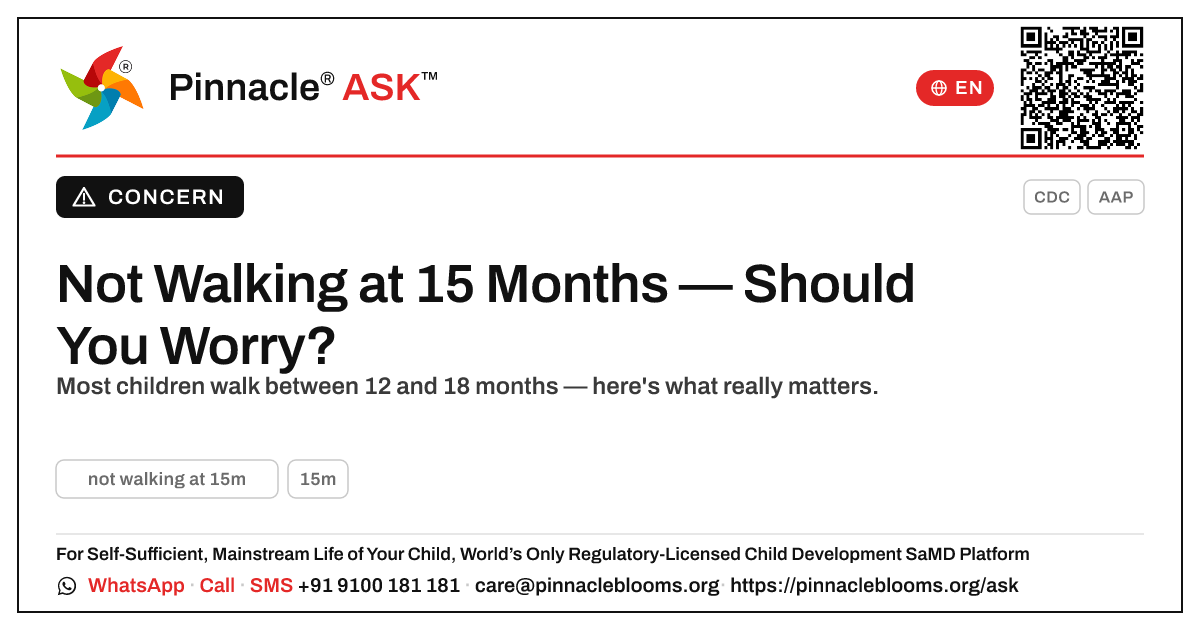
Not Walking at 15 Months — Should You Worry?
Many healthy children are not walking independently at 15 months — most start between 12 and 18 months. What matters more is the whole picture: pulling to stand, cruising, bearing weight and moving about. A developmental check brings certainty; only a Pinnacle clinician can assess and confirm.
In this answer 4 sections
Most 15-month-olds toddle, but a good number are still cruising the furniture — and that single fact tells you less than you might fear.
In short
Many healthy children are not yet walking independently at 15 months, and most begin somewhere between 12 and 18 months. So no, walking at 15 months is not, on its own, a reason to panic. What matters more is the whole picture: is your child pulling to stand, cruising along furniture, bearing weight on the legs, and moving about happily by crawling, bottom-shuffling or cruising? If yes, this is usually a child taking their own timeline. A simple developmental check brings certainty and peace of mind.
What to watch
Reassuring signs of steady motor progress at this age include:
- Pulling to stand at furniture and cruising sideways while holding on
- Bearing weight comfortably through both legs when held to stand
- Getting around the room some way — crawling, rolling or bottom-shuffling
- Using both hands and both legs evenly, not strongly favouring one side
Worth a prompt check with your doctor if you notice your child is not bearing any weight on the legs, has stiff or very floppy legs, is not pulling to stand by 12 months, has lost a skill they once had, or seems uneven (one side much weaker). These are not diagnoses — they are simply reasons to be seen sooner rather than later.
The Pinnacle way
A clinical AbilityScore® and any diagnosis are formed only at a Pinnacle Blooms Network centre, under qualified clinician care — never from an online checklist or a worried late-night search. If you'd like clarity, a structured developmental check can confirm whether your child's motor progress is simply their own pace or could benefit from gentle support such as paediatric physiotherapy.
Trusted sources
US Centers for Disease Control and Prevention developmental milestone guidance; American Academy of Pediatrics parent resources on gross-motor development.
Next step — Want certainty rather than worry? Book a developmental check with a Pinnacle clinician.
This is general information, not a diagnosis — individual assessment and diagnosis require an appropriately qualified healthcare professional.
CONNECT THE ANSWER TO YOUR CHILD’S DAY
Something to notice. Something to discuss.
What to notice
Reassuring: pulling to stand, cruising furniture, bearing weight on both legs, moving about by crawling. Check sooner if no weight-bearing on the legs, very stiff or floppy legs, not pulling to stand by 12 months, a lost skill, or one side clearly weaker.
In everyday life
Give plenty of barefoot floor time and let your child cruise along low, stable furniture. Soft shoes are best kept for outdoors — bare feet help little ones learn balance and build strength faster than walkers do.
Bring your observations and questions to your child’s professional. Choose activities that suit your child’s comfort, abilities and agreed plan.
Bring your questions to a first visitQuestions families ask
Is it normal for a 15-month-old not to walk yet?
Often, yes. Most children take their first independent steps between 12 and 18 months, so 15 months is well within the typical range. As long as your child is pulling to stand, cruising furniture and bearing weight on both legs, this is usually simply their own pace.
When should I see a doctor about late walking?
Have a prompt check if your child is not bearing any weight on the legs, has stiff or very floppy legs, was not pulling to stand by 12 months, has lost a skill they once had, or strongly favours one side. These are reasons to be seen sooner, not diagnoses.
Will using a baby walker help my child walk earlier?
No — research does not support walkers for earlier walking, and they can be unsafe. Floor time, barefoot cruising along low furniture and plenty of supported standing practice help your child build the strength and balance they need naturally.
FOLLOW THE SOURCE
References behind this answer.
- Source referenceCDC developmental milestones
- Organisation website · further readingAAP HealthyChildren — gross motor development
References are supplied with this answer. An organisation homepage offers further reading; it does not establish an independent review of this page.
Content attribution: SETU Consortium · Pinnacle Blooms Network.
PEOPLE, TOPICS & DEVELOPMENT
See the connections.
Browse the wider question collections connected with this answer’s audience, developmental area and stage.
FROM UNDERSTANDING TO PURPOSEFUL SUPPORT
One question. Your child’s whole life.
Your child’s self-sufficient, mainstream-included life is the purpose from the beginning. At Pinnacle, that purpose shapes what we understand, the goals we choose, the people we bring together, everyday practice and review.
Connect this question with the right support.
Start with your child’s strengths, your observations and what you want everyday life to become.
Make the next conversation useful.
Bring the situations you notice at home or school. We’ll explain a suitable service, centre and first visit, including availability and fees, before you decide.
How PinnacleAI® connects the journeyExplore the seven stages
- 1Understand abilities
A starting picture of your child’s capabilities.
- 2Choose meaningful goals
Readiness and a plan shaped around the child.
- 3Bring the right support together
Suitable therapies and people for those goals.
- 4Carry practice into everyday life
Guidance for family, home and school.
- 5Track and correct
Use observations to adjust the plan.
- 6Reassess and review
Decide what to continue, change or do next.
- 7Grow independence and participation
The child’s life gives each step its purpose.
Explore the whole PinnacleAI® system → · Participation at school and in the community →
PINNACLE’S EVIDENCE, OPEN TO YOU
Look at the evidence behind our work.
Read our research, inspect the original regulatory documents and check what each institutional measure means.
General information supports a conversation with an appropriately qualified professional. Advice, goals and support depend on the individual child.