
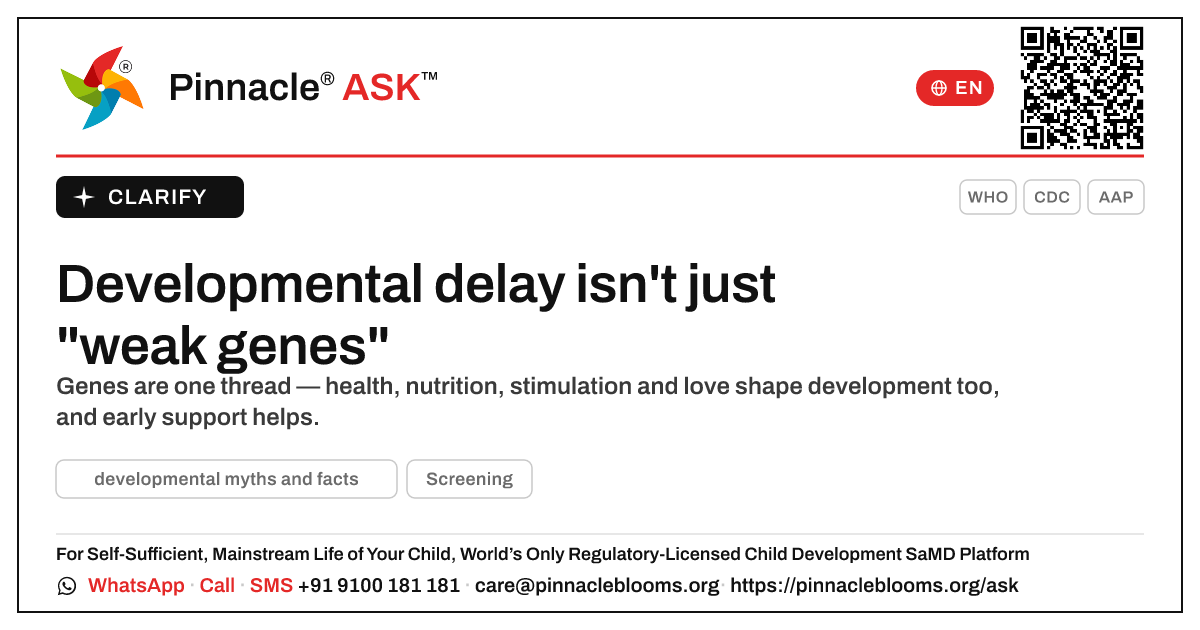
YOUR QUESTION. A CLEARER NEXT STEP.
Is developmental delay simply caused by weak genes?
Developmental delay is rarely just "weak genes". It arises from a mix of genetics, health, nutrition, hearing and vision, and early stimulation — and the brain's plasticity means timely, joyful support very often brings real progress.
In this answer 5 sections
When a little one is slow to reach a milestone, it's natural to wonder if it's simply "in the genes" — but the real story is warmer and far more hopeful.
In short
No — developmental delay is rarely just about "weak genes". Development is shaped by a rich mix of genetics, pregnancy and birth health, nutrition, hearing and vision, early stimulation, play, language exposure and love. Genes are only one thread in a much larger weave, and many of the other threads can be strengthened — which is exactly why early support works so well.
Myth vs fact
The myth: "My child is delayed because our family has weak genes — nothing can change that."
The fact: A child's growing brain is wonderfully shaped by experience. Even where genetics play a part, the brain's plasticity — its ability to build new pathways through repeated, joyful practice — means progress is almost always possible. What looks like a fixed limit is very often a starting point.
Delays can have many roots working together:
- Health factors — prematurity, birth complications, recurrent illness, or undetected hearing or vision difficulty
- Nutrition — iron, iodine and overall early nutrition matter for brain growth
- Environment & stimulation — opportunities to talk, play, explore and be responded to
- Genetic or syndromic factors — sometimes part of the picture, but seldom the whole story
Blaming "weak genes" can accidentally close a door — when in truth, identifying what is driving the delay opens several. Most children make meaningful gains with the right, timely support.
When to seek a check
If your child is consistently behind peers in speaking, moving, playing or connecting — or if you simply have a quiet, persistent worry — a developmental check is the kind, sensible next step. You don't need a label or a cause to begin; you only need to start.
The Pinnacle way
At Pinnacle Blooms Network we look at the whole child, never a single gene. Developmental measurement supports care planning; diagnosis requires an appropriately qualified healthcare professional. under qualified clinician care — our AbilityScore® is a clinician-administered structured assessment that maps strengths across every developmental domain, so support is tailored to your child. Where speech is the concern, our speech therapy team builds practical, play-based plans. Across 70+ centres in 4 states and 25 million+ therapy sessions, we've seen again and again that early action changes journeys.
Trusted sources
Guidance from the World Health Organization, the CDC's developmental milestones resources, and the American Academy of Pediatrics all describe development as the product of genes and environment together, with early identification and nurturing care central to better outcomes.
Next step — book a developmental assessment with Pinnacle Blooms Network on WhatsApp +91 91001 81181, and let's understand your child's full picture — not just one thread of it.
This is general information, not a diagnosis — individual assessment and diagnosis require an appropriately qualified healthcare professional.
CONNECT THE ANSWER TO YOUR CHILD’S DAY
Something to notice. Something to discuss.
What to notice
Watch for delays that persist across speaking, moving, playing or social connection, plus any possible hearing or vision difficulty. A consistent gap behind peers — or a steady parental worry — is reason enough to book a developmental check, regardless of family history.
In everyday life
Talk, sing and narrate your day to your child face-to-face — this rich, responsive language exposure is one of the most powerful brain-building experiences you can give, whatever the family history.
Bring your observations and questions to your child’s professional. Choose activities that suit your child’s comfort, abilities and agreed plan.
Bring your questions to a first visitQuestions families ask
Can a child with a family history of delay still catch up?
Yes — family history is not destiny. The young brain is highly plastic, and with early, consistent, play-based support many children make meaningful gains. Identifying what is driving the delay helps tailor that support.
If it's not genes, what causes developmental delay?
Usually a combination of factors: pregnancy and birth health, prematurity, nutrition, undetected hearing or vision difficulty, opportunities for stimulation and play, and sometimes genetic factors. It is rarely one single cause.
Do I need to know the cause before starting support?
No. You don't need a label or a confirmed cause to begin. A developmental check identifies your child's strengths and needs so support can start straight away while any underlying factors are explored.
FOLLOW THE SOURCE
References behind this answer.
- Source referenceWHO — Early childhood development & nurturing care
- Source referenceCDC — Developmental milestones (Learn the Signs. Act Early.)
- Source referenceAAP HealthyChildren — Ages & stages of development
References are supplied with this answer. An organisation homepage offers further reading; it does not establish an independent review of this page.
Content attribution: SETU Consortium · Pinnacle Blooms Network.
PEOPLE, TOPICS & DEVELOPMENT
See the connections.
Browse the wider question collections connected with this answer’s audience, developmental area and stage.
FROM UNDERSTANDING TO PURPOSEFUL SUPPORT
One question. Your child’s whole life.
Your child’s self-sufficient, mainstream-included life is the purpose from the beginning. At Pinnacle, that purpose shapes what we understand, the goals we choose, the people we bring together, everyday practice and review.
Connect this question with the right support.
Explore how the relevant service contributes to everyday abilities, then speak with us about your child.
Make the next conversation useful.
Bring the situations you notice at home or school. We’ll explain a suitable service, centre and first visit, including availability and fees, before you decide.
How PinnacleAI® connects the journeyExplore the seven stages
- 1Understand abilities
A starting picture of your child’s capabilities.
- 2Choose meaningful goals
Readiness and a plan shaped around the child.
- 3Bring the right support together
Suitable therapies and people for those goals.
- 4Carry practice into everyday life
Guidance for family, home and school.
- 5Track and correct
Use observations to adjust the plan.
- 6Reassess and review
Decide what to continue, change or do next.
- 7Grow independence and participation
The child’s life gives each step its purpose.
Explore the whole PinnacleAI® system → · Participation at school and in the community →
PINNACLE’S EVIDENCE, OPEN TO YOU
Look at the evidence behind our work.
Read our research, inspect the original regulatory documents and check what each institutional measure means.
General information supports a conversation with an appropriately qualified professional. Advice, goals and support depend on the individual child.