
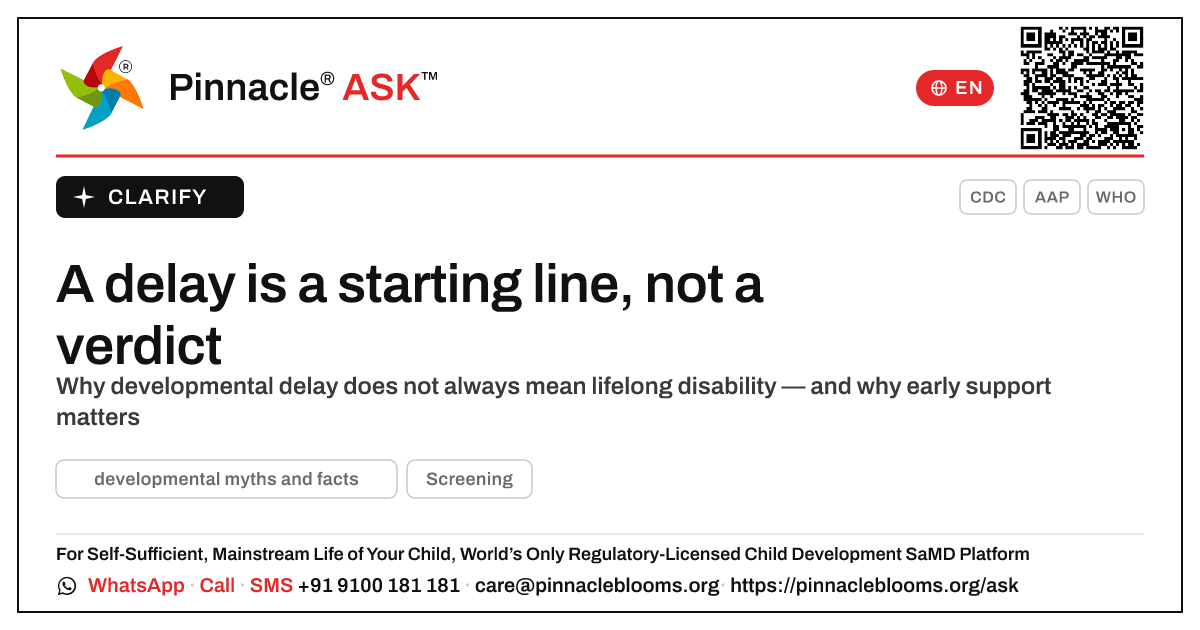
YOUR QUESTION. A CLEARER NEXT STEP.
Does a developmental delay always mean a lifelong disability?
No — a developmental delay describes later-than-expected timing, not a fixed lifelong disability. Many children catch up, especially with early support, while some delays reflect a longer-term condition. Only a qualified clinician can tell the difference over time, and early help improves outcomes either way.
In this answer 5 sections
When you hear the words "developmental delay", it can feel like a door closing — but for many children, it is simply a starting line, not a verdict.
In short
No — a developmental delay does not always mean a lifelong disability. "Delay" means a child is reaching certain milestones later than expected, and many children catch up beautifully, especially with early support. Some delays do reflect a longer-term condition, but only a qualified clinician can tell the difference over time — and even then, early help changes the story for the better.
Myth vs fact
Myth: "A delay now means my child will struggle forever."
Fact: A delay is a description of timing, not a fixed diagnosis of ability. The young brain is remarkably adaptable — this is called neuroplasticity — and it responds especially well to support in the early years. Many children who start late in speech, movement or social skills go on to thrive within the typical range.
What the evidence tells us:
- Delays have many causes — some are temporary (a child who is a "late talker" and then blooms), some respond strongly to therapy, and some are part of a lasting condition. They are not all the same thing.
- Early support matters most. The earlier a child receives the right input, the more their development can change course.
- A delay is a signal to look closer, not a label. It tells us to act, calmly and early — not to fear the future.
When to seek a check
If your child is reaching milestones noticeably later than peers — in speech, movement, play or social connection — a developmental check is the kind, sensible next step. You are not over-reacting; you are giving your child the best possible head start. Trust your instinct, and let a professional help you understand what the delay does, and does not, mean.
The Pinnacle way
At Pinnacle Blooms Network, we see delays not as deficits but as opportunities to support your child early and well. Developmental measurement supports care planning; diagnosis requires an appropriately qualified healthcare professional., under the care of a qualified clinician — never from an online article or a single observation. Our structured developmental assessment gives you a clear, hopeful baseline, and early intervention therapy helps your child move forward at their own pace.
Trusted sources
Guidance aligns with the CDC's "Learn the Signs. Act Early." programme, the American Academy of Pediatrics through HealthyChildren.org, and the WHO–UNICEF Nurturing Care Framework — all of which emphasise that early identification and support, not labelling, shape a child's path.
Next step — if you're noticing a delay, book a developmental assessment with Pinnacle Blooms Network or reach our team on WhatsApp at +91 91001 81181, and let's understand your child's strengths together.
This is general information, not a diagnosis — individual assessment and diagnosis require an appropriately qualified healthcare professional.
CONNECT THE ANSWER TO YOUR CHILD’S DAY
Something to notice. Something to discuss.
What to notice
Watch for delays that persist or widen across several areas (speech, movement, play, social connection) despite support, or any loss of skills a child once had — these warrant a prompt developmental check rather than waiting.
In everyday life
Note milestones as you see them, not as you fear them. If your child is behind in one area but connecting, playing and responding well overall, share this with a professional — context matters as much as the delay itself.
Bring your observations and questions to your child’s professional. Choose activities that suit your child’s comfort, abilities and agreed plan.
Bring your questions to a first visitQuestions families ask
Is a developmental delay the same as a disability?
No. A delay means a child is reaching milestones later than expected — a description of timing. A disability is a longer-term condition. Some delays resolve, some respond strongly to therapy, and some are part of a lasting condition. Only a clinician can tell which over time.
Can children catch up from a developmental delay?
Many do, especially with early, well-matched support. The young brain is highly adaptable, and timely therapy can change a child's developmental course. Early action gives the best chance of catching up.
Should I wait to see if my child catches up on their own?
If you have a persistent concern, a developmental check is the kinder, safer choice than waiting. Early support helps whether the delay is temporary or longer-term — and a professional can reassure you if all is well.
FOLLOW THE SOURCE
References behind this answer.
- Source referenceCDC — Learn the Signs. Act Early.
- Organisation website · further readingAAP — HealthyChildren.org developmental milestones
- Organisation website · further readingWHO–UNICEF Nurturing Care Framework
References are supplied with this answer. An organisation homepage offers further reading; it does not establish an independent review of this page.
Content attribution: SETU Consortium · Pinnacle Blooms Network.
PEOPLE, TOPICS & DEVELOPMENT
See the connections.
Browse the wider question collections connected with this answer’s audience, developmental area and stage.
FROM UNDERSTANDING TO PURPOSEFUL SUPPORT
One question. Your child’s whole life.
Your child’s self-sufficient, mainstream-included life is the purpose from the beginning. At Pinnacle, that purpose shapes what we understand, the goals we choose, the people we bring together, everyday practice and review.
Connect this question with the right support.
Explore how the relevant service contributes to everyday abilities, then speak with us about your child.
Make the next conversation useful.
Bring the situations you notice at home or school. We’ll explain a suitable service, centre and first visit, including availability and fees, before you decide.
How PinnacleAI® connects the journeyExplore the seven stages
- 1Understand abilities
A starting picture of your child’s capabilities.
- 2Choose meaningful goals
Readiness and a plan shaped around the child.
- 3Bring the right support together
Suitable therapies and people for those goals.
- 4Carry practice into everyday life
Guidance for family, home and school.
- 5Track and correct
Use observations to adjust the plan.
- 6Reassess and review
Decide what to continue, change or do next.
- 7Grow independence and participation
The child’s life gives each step its purpose.
Explore the whole PinnacleAI® system → · Participation at school and in the community →
PINNACLE’S EVIDENCE, OPEN TO YOU
Look at the evidence behind our work.
Read our research, inspect the original regulatory documents and check what each institutional measure means.
General information supports a conversation with an appropriately qualified professional. Advice, goals and support depend on the individual child.