
YOUR QUESTION. A CLEARER NEXT STEP.
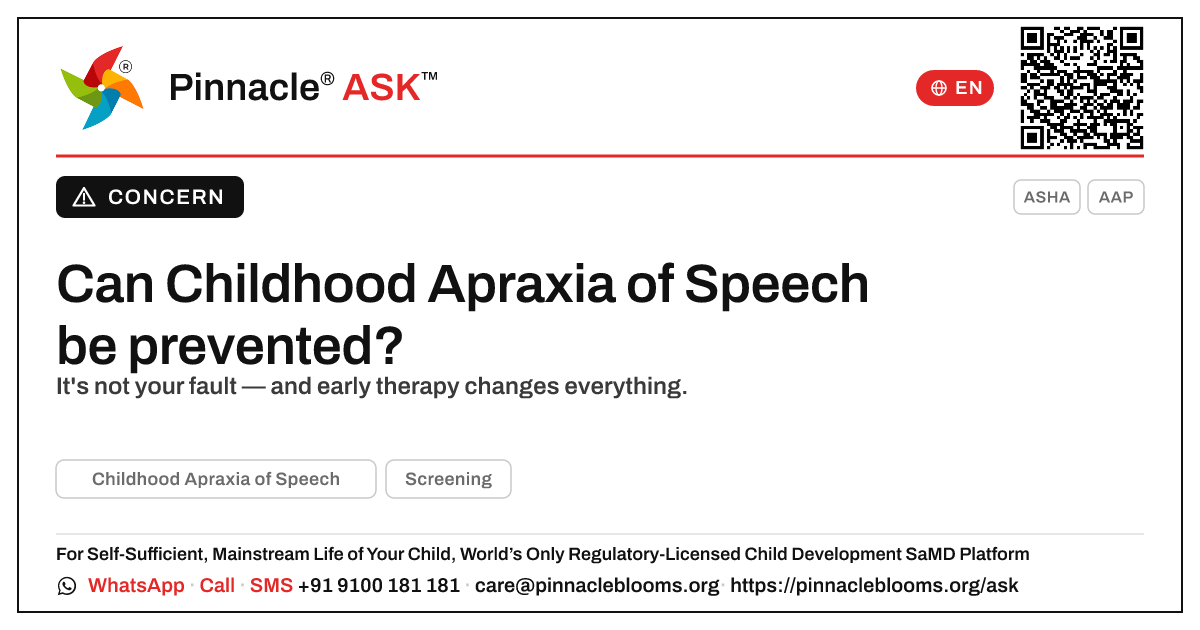
Can Childhood Apraxia of Speech be prevented?
You almost certainly could not have prevented Childhood Apraxia of Speech — and it is not caused by anything you did. It is a motor-planning difficulty in the brain. The real power lies not in prevention but in early identification and specialist speech therapy, which can transform a child's clarity and confidence over time.
In this answer 5 sections
When your little one struggles to turn thoughts into words, it's natural to wonder if something you did — or could have done — caused it. Let's take that worry gently apart.
In short
For most children, Childhood Apraxia of Speech (CAS) cannot be "prevented" — and importantly, it is not caused by anything you did or didn't do as a parent. CAS is a motor-planning difficulty: the brain knows the word but struggles to coordinate the precise movements of the lips, tongue and jaw to say it. The hopeful truth is that while we cannot usually prevent it, we can change its course dramatically with early, specialist speech therapy.
Why prevention isn't the right question
CAS most often has no single, avoidable cause. It can occur on its own (idiopathic), alongside a known genetic or neurological condition, or as part of a wider developmental picture. None of these arise from parenting style, screen time, bilingual homes, or how much you talked to your baby — so there is no "prevention checklist" to feel guilty about missing.
A few sensible, general steps support healthy speech development for every child, and are worth doing regardless:
- Protect hearing — treat ear infections promptly and attend newborn and routine hearing checks, since clear hearing underpins clear speech.
- Nurture rich back-and-forth talk — narrate your day, sing, name things, and pause for your child to respond.
- Attend developmental checks — so any difficulty is spotted early, when help works best.
These build the strongest foundation possible — but if CAS is present, the real power lies not in prevention but in early identification and the right therapy.
What changes the outcome
CAS responds best to frequent, specialised, motor-based speech therapy delivered by a speech-language pathologist. Started early, it helps the brain build reliable pathways for speech movements — turning effortful, hard-to-understand attempts into clearer, more confident communication over time. The earlier this begins, the kinder the journey.
The Pinnacle way
Developmental measurement supports care planning; diagnosis requires an appropriately qualified healthcare professional., under the care of a qualified clinician — never from an online form or a worry. At Pinnacle, a speech-language pathologist distinguishes CAS from other speech-sound difficulties using a structured, clinician-administered assessment, then builds a plan paced to your child's own progress. Explore how specialist speech therapy supports children with verbal dyspraxia.
Trusted sources
American Speech-Language-Hearing Association (ASHA) guidance on Childhood Apraxia of Speech; WHO classification of developmental speech and language disorders; American Academy of Pediatrics developmental-surveillance guidance.
Next step — You can't prevent CAS, but you can change its course. Book a speech assessment with a Pinnacle speech-language pathologist.
This is general information, not a diagnosis — individual assessment and diagnosis require an appropriately qualified healthcare professional.
CONNECT THE ANSWER TO YOUR CHILD’S DAY
Something to notice. Something to discuss.
What to notice
Seek a speech assessment if, by age 3, your child says very few words, is hard for familiar adults to understand, uses mostly vowels or simple sounds, or visibly struggles and gropes to form words despite clearly wanting to communicate.
In everyday life
Make speech fun and low-pressure: sing favourite songs slowly, exaggerate sounds playfully, and reward any attempt warmly. For a child working on motor planning, frequent gentle practice of the same simple words beats lots of new ones.
Bring your observations and questions to your child’s professional. Choose activities that suit your child’s comfort, abilities and agreed plan.
Bring your questions to a first visitQuestions families ask
Did I cause my child's apraxia of speech?
No. Childhood Apraxia of Speech is a motor-planning difficulty in the brain — it is not caused by parenting style, screen time, bilingual homes or how much you talked to your child. There is nothing you did or failed to do that brought it on.
If it can't be prevented, is there anything I can do?
Yes — the most powerful thing is early action. Protect your child's hearing, keep developmental checks up to date, and if you have concerns, seek a speech assessment. Early, specialist speech therapy can change the course of CAS markedly.
Will my child outgrow apraxia of speech on its own?
CAS does not usually resolve without targeted therapy, unlike some passing late-talking phases. The good news is that frequent, motor-based speech therapy with a speech-language pathologist helps children build clearer, more reliable speech over time.
FOLLOW THE SOURCE
References behind this answer.
- Source referenceASHA — Childhood Apraxia of Speech
- Source referenceAAP HealthyChildren — early development
References are supplied with this answer. An organisation homepage offers further reading; it does not establish an independent review of this page.
Content attribution: SETU Consortium · Pinnacle Blooms Network.
PEOPLE, TOPICS & DEVELOPMENT
See the connections.
Browse the wider question collections connected with this answer’s audience, developmental area and stage.
FROM UNDERSTANDING TO PURPOSEFUL SUPPORT
One question. Your child’s whole life.
Your child’s self-sufficient, mainstream-included life is the purpose from the beginning. At Pinnacle, that purpose shapes what we understand, the goals we choose, the people we bring together, everyday practice and review.
Connect this question with the right support.
Explore how the relevant service contributes to everyday abilities, then speak with us about your child.
Make the next conversation useful.
Bring the situations you notice at home or school. We’ll explain a suitable service, centre and first visit, including availability and fees, before you decide.
How PinnacleAI® connects the journeyExplore the seven stages
- 1Understand abilities
A starting picture of your child’s capabilities.
- 2Choose meaningful goals
Readiness and a plan shaped around the child.
- 3Bring the right support together
Suitable therapies and people for those goals.
- 4Carry practice into everyday life
Guidance for family, home and school.
- 5Track and correct
Use observations to adjust the plan.
- 6Reassess and review
Decide what to continue, change or do next.
- 7Grow independence and participation
The child’s life gives each step its purpose.
Explore the whole PinnacleAI® system → · Participation at school and in the community →
PINNACLE’S EVIDENCE, OPEN TO YOU
Look at the evidence behind our work.
Read our research, inspect the original regulatory documents and check what each institutional measure means.
General information supports a conversation with an appropriately qualified professional. Advice, goals and support depend on the individual child.