
YOUR QUESTION. A CLEARER NEXT STEP.
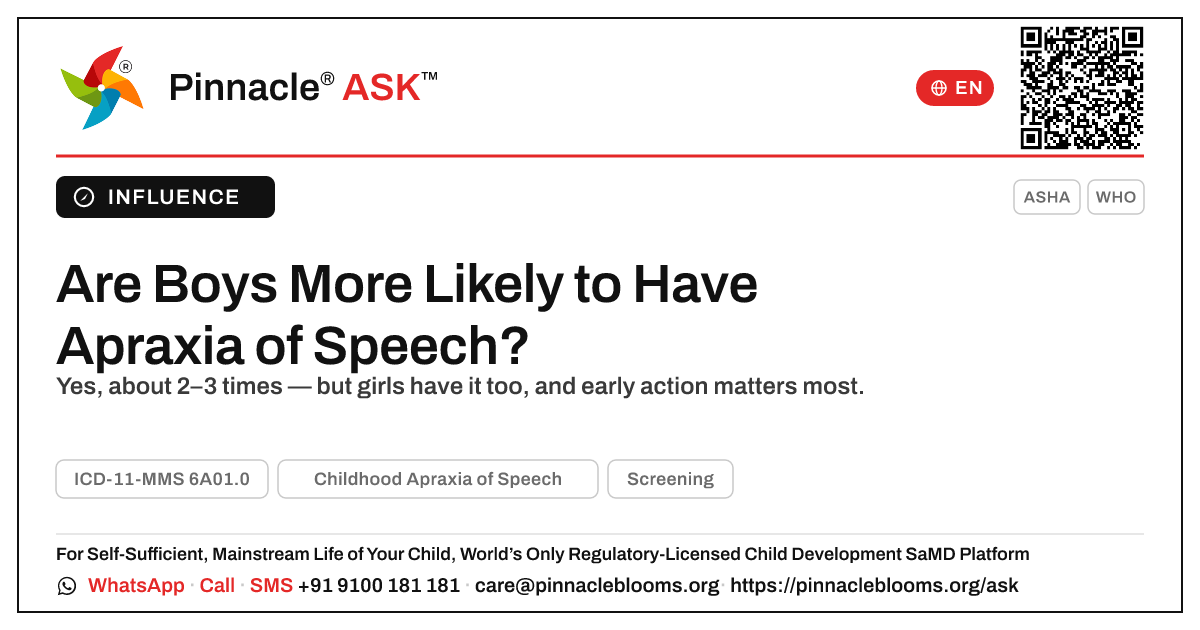
Are Boys More Likely to Have Childhood Apraxia of Speech?
Boys are diagnosed with Childhood Apraxia of Speech roughly 2–3 times more often than girls, but sex is only one factor. CAS is a motor-planning difference, and girls can have it too — so early speech concerns deserve the same attentive response regardless of gender. Acting early matters far more than the male skew.
In this answer 4 sections
Many parents notice it's their son who's struggling to get words out — and wonder whether boys are simply more prone to this.
In short
Yes — boys are diagnosed with Childhood Apraxia of Speech (CAS) more often than girls, with most studies reporting roughly 2 to 3 boys for every girl. But sex is just one thread in the story: CAS is a motor-planning difference, and what matters far more than your child's gender is how early you act on the signs you're seeing. A girl can absolutely have CAS too, so concern should never be brushed aside because "she's a girl".
What the pattern means for your child
Childhood Apraxia of Speech is not a problem with the muscles themselves, and it isn't caused by anything you did. The brain knows what it wants to say, but has difficulty planning and sequencing the precise movements of the lips, tongue and jaw to say it. That is why a child may say a word perfectly one moment and be unable to repeat it the next.
The slight male skew is observed across many developmental-communication conditions and likely reflects a mix of biological and developmental factors rather than a single cause. The practical takeaway is simple:
- Don't wait on the basis of sex. Early speech difficulty deserves the same attentive response in a daughter as in a son.
- Watch the pattern, not the label. Inconsistent errors, groping for sounds, and far better understanding than speaking are more telling than gender.
- Early support changes the trajectory. CAS responds well to frequent, specialised speech therapy started early.
The Pinnacle way
Developmental measurement supports care planning; diagnosis requires an appropriately qualified healthcare professional., under qualified clinician care — never from an online checklist or your child's gender alone. Our speech therapy pathway is built specifically for motor-planning difficulties like CAS, and you can start by understanding where your child stands today. Explore how we support families across every stage of the journey.
Trusted sources
American Speech-Language-Hearing Association (ASHA) guidance on Childhood Apraxia of Speech; WHO ICD-11 classification of developmental speech sound disorders.
Next step — If your child's speech feels effortful or inconsistent, book a speech screening with a Pinnacle clinician.
This is general information, not a diagnosis — individual assessment and diagnosis require an appropriately qualified healthcare professional.
CONNECT THE ANSWER TO YOUR CHILD’S DAY
Something to notice. Something to discuss.
What to notice
Inconsistent speech errors (a word said well once, then not again), visible groping or effort to find sounds, and much stronger understanding than spoken output — in a son or a daughter.
In everyday life
Don't delay seeking help because your child is a girl, or wait expecting your boy to 'catch up'. If speech feels effortful or inconsistent, a simple screening is the kindest next step for either.
Bring your observations and questions to your child’s professional. Choose activities that suit your child’s comfort, abilities and agreed plan.
Bring your questions to a first visitQuestions families ask
How much more common is Childhood Apraxia of Speech in boys?
Most studies report roughly 2 to 3 boys diagnosed for every girl. It's a real skew, but girls can and do have CAS, so concern should never be dismissed because a child is a girl.
Does my daughter being a girl mean she's unlikely to have apraxia?
No. CAS is less common in girls but absolutely occurs. If her speech is effortful, inconsistent, or far behind her understanding, she deserves the same prompt screening as a boy would.
Why are boys more affected?
The slight male skew appears across many developmental-communication conditions and likely reflects a mix of biological and developmental factors rather than a single known cause. What matters most for your child is early, specialised support.
What should I do if I'm worried about my child's speech?
Watch for inconsistent errors and effortful speech, and arrange a speech screening. A clinician at a Pinnacle centre can establish where your child stands and recommend the right support.
FOLLOW THE SOURCE
References behind this answer.
- Source referenceASHA: Childhood Apraxia of Speech
- Organisation website · further readingWHO ICD-11
References are supplied with this answer. An organisation homepage offers further reading; it does not establish an independent review of this page.
Content attribution: SETU Consortium · Pinnacle Blooms Network.
PEOPLE, TOPICS & DEVELOPMENT
See the connections.
Browse the wider question collections connected with this answer’s audience, developmental area and stage.
FROM UNDERSTANDING TO PURPOSEFUL SUPPORT
One question. Your child’s whole life.
Your child’s self-sufficient, mainstream-included life is the purpose from the beginning. At Pinnacle, that purpose shapes what we understand, the goals we choose, the people we bring together, everyday practice and review.
Connect this question with the right support.
Explore how the relevant service contributes to everyday abilities, then speak with us about your child.
Make the next conversation useful.
Bring the situations you notice at home or school. We’ll explain a suitable service, centre and first visit, including availability and fees, before you decide.
How PinnacleAI® connects the journeyExplore the seven stages
- 1Understand abilities
A starting picture of your child’s capabilities.
- 2Choose meaningful goals
Readiness and a plan shaped around the child.
- 3Bring the right support together
Suitable therapies and people for those goals.
- 4Carry practice into everyday life
Guidance for family, home and school.
- 5Track and correct
Use observations to adjust the plan.
- 6Reassess and review
Decide what to continue, change or do next.
- 7Grow independence and participation
The child’s life gives each step its purpose.
Explore the whole PinnacleAI® system → · Participation at school and in the community →
PINNACLE’S EVIDENCE, OPEN TO YOU
Look at the evidence behind our work.
Read our research, inspect the original regulatory documents and check what each institutional measure means.
General information supports a conversation with an appropriately qualified professional. Advice, goals and support depend on the individual child.