
YOUR QUESTION. A CLEARER NEXT STEP.
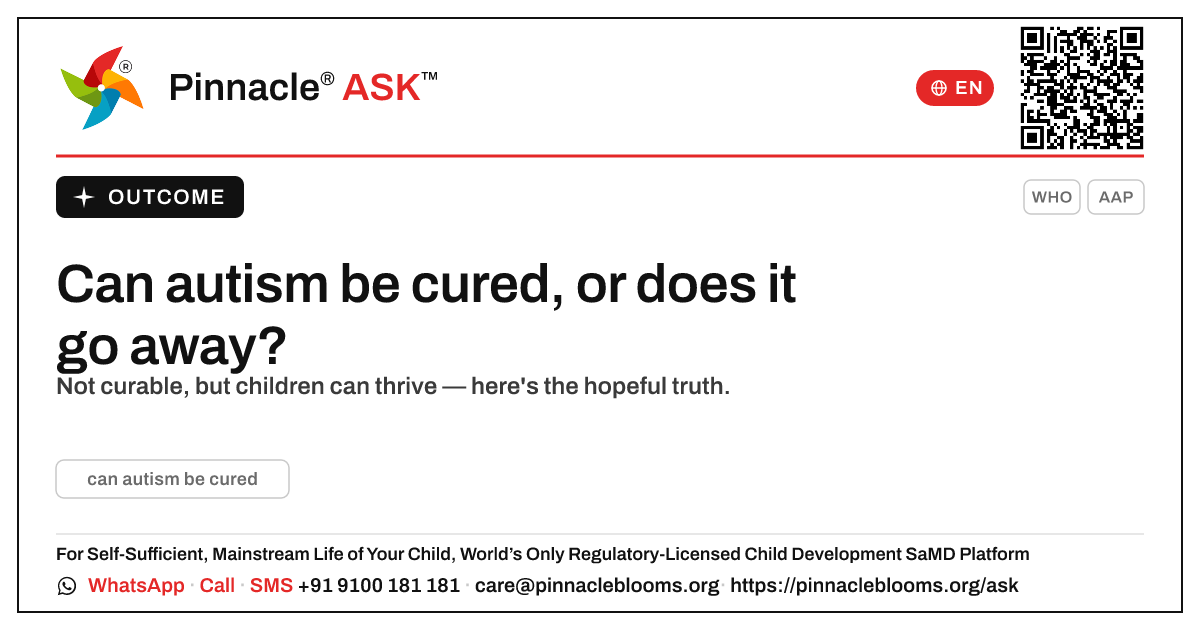
Can autism be cured, or does it go away?
Autism is a lifelong difference in how the brain develops, not an illness to be cured, and it does not simply go away. But with early, evidence-based support, children make enormous progress in communication, social skills and independence. The goal is never to erase the child but to unlock their full potential — and any 'cure' promise should be treated with great caution.
In this answer 4 sections
"Will my child be cured?" is the question behind every late-night search — and the honest, hopeful answer changes everything about what comes next.
In short
Autism is not an illness to be cured, and it does not simply "go away" — it is a different way the brain is wired, and it stays part of who your child is. But here is the hope that matters most: with early, consistent support, children grow enormously. Skills in communication, social connection and daily living can flourish, and many children become wonderfully independent. We don't aim to erase your child — we aim to unlock everything they are capable of.
What "outcome" really means
Think of autism not as a sickness but as a way of being. The goal of good therapy is never to make your child someone else — it is to build bridges: a way to communicate needs, to manage big feelings, to navigate a busy classroom, to make friends.
- Brains are changeable, especially when young. Early support takes advantage of neuroplasticity — the brain's natural ability to form new pathways. This is why starting early matters so much.
- Progress is real and measurable. With the right support, many children gain speech, reduce distress around change, build friendships, and move toward independence.
- Support evolves, it doesn't end abruptly. As your child grows, the kind of help they need shifts — and many need far less over time.
- Beware "cure" promises. Any product or programme claiming to cure autism is not trustworthy and may cause harm. Real progress comes from evidence-based therapy and a loving, consistent environment.
Autism being lifelong is not a sad ending — it is simply the truth that lets you stop searching for a cure and start building the support that genuinely helps.
The Pinnacle way
A clinical AbilityScore® and any diagnosis are formed only at a Pinnacle Blooms Network centre, under the care of qualified clinicians — never from an online form or an app. From there, your child's plan is built around their strengths. Across 70+ centres, our therapists use approaches like speech therapy and structured developmental support to help your child reach their fullest potential. Understanding what autism really is — and isn't is the first, most empowering step a parent can take.
Trusted sources
World Health Organization guidance on autism describes it as a lifelong developmental condition where early, appropriate support improves communication and wellbeing; the American Academy of Pediatrics (HealthyChildren.org) emphasises that early intervention builds skills and that no treatment "cures" autism.
Next step — Swap the search for a cure for a clear plan that fits your child. Book a developmental assessment with a Pinnacle clinician.
This is general information, not a diagnosis — individual assessment and diagnosis require an appropriately qualified healthcare professional.
CONNECT THE ANSWER TO YOUR CHILD’S DAY
Something to notice. Something to discuss.
What to notice
Be cautious of anyone promising a 'cure', a special diet or a single treatment that 'reverses' autism — these can be costly, unsafe and untrue. Trust steady, evidence-based progress instead.
In everyday life
Celebrate small wins daily — a new word, a shared smile, sitting through a meal. Following your child's interests is one of the most powerful ways to build connection and skills at home.
Bring your observations and questions to your child’s professional. Choose activities that suit your child’s comfort, abilities and agreed plan.
Bring your questions to a first visitQuestions families ask
So autism is permanent?
Autism is lifelong — it is a way the brain is wired rather than an illness that ends. But that does not mean things stay the same. With support, children grow, learn and gain independence, and many need much less help as they get older.
Why do some people say their child 'recovered' from autism?
Some children make such strong progress that they no longer show obvious difficulties day to day. This reflects real skill-building and adaptation, not the autism disappearing. Beware any product or programme claiming to 'cure' autism — these are not trustworthy.
If it can't be cured, what is the point of therapy?
Therapy builds genuine, lasting skills — communication, managing feelings, social connection and daily independence. The aim is not to erase your child but to help them thrive as themselves. Starting early makes a real difference because young brains adapt so readily.
When should we get an assessment?
As soon as you have a concern. Early support has the greatest impact, and a structured developmental assessment at a Pinnacle centre gives you a clear baseline and a plan to follow.
FOLLOW THE SOURCE
References behind this answer.
- Source referenceWHO: Autism spectrum disorders
- Source referenceAAP HealthyChildren.org: Autism
References are supplied with this answer. An organisation homepage offers further reading; it does not establish an independent review of this page.
Content attribution: SETU Consortium · Pinnacle Blooms Network.
PEOPLE, TOPICS & DEVELOPMENT
See the connections.
Browse the wider question collections connected with this answer’s audience, developmental area and stage.
FROM UNDERSTANDING TO PURPOSEFUL SUPPORT
One question. Your child’s whole life.
Your child’s self-sufficient, mainstream-included life is the purpose from the beginning. At Pinnacle, that purpose shapes what we understand, the goals we choose, the people we bring together, everyday practice and review.
Connect this question with the right support.
Explore how the relevant service contributes to everyday abilities, then speak with us about your child.
Make the next conversation useful.
Bring the situations you notice at home or school. We’ll explain a suitable service, centre and first visit, including availability and fees, before you decide.
How PinnacleAI® connects the journeyExplore the seven stages
- 1Understand abilities
A starting picture of your child’s capabilities.
- 2Choose meaningful goals
Readiness and a plan shaped around the child.
- 3Bring the right support together
Suitable therapies and people for those goals.
- 4Carry practice into everyday life
Guidance for family, home and school.
- 5Track and correct
Use observations to adjust the plan.
- 6Reassess and review
Decide what to continue, change or do next.
- 7Grow independence and participation
The child’s life gives each step its purpose.
Explore the whole PinnacleAI® system → · Participation at school and in the community →
PINNACLE’S EVIDENCE, OPEN TO YOU
Look at the evidence behind our work.
Read our research, inspect the original regulatory documents and check what each institutional measure means.
General information supports a conversation with an appropriately qualified professional. Advice, goals and support depend on the individual child.