
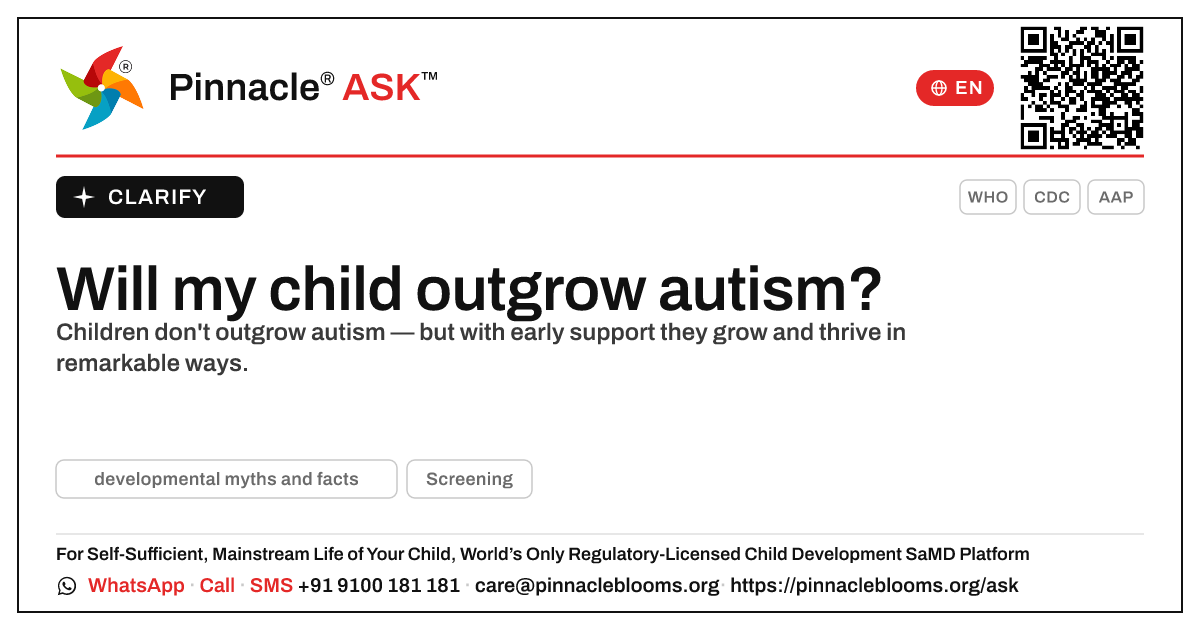
YOUR QUESTION. A CLEARER NEXT STEP.
Will my child outgrow autism?
Children do not simply outgrow autism — it is a lifelong neurodevelopmental difference, not an illness. But that is hopeful, not heavy: with early, consistent support, autistic children make remarkable progress in communication, play and daily life. A few show such growth they no longer meet full diagnostic criteria, but the real question is how early support can begin.
In this answer 5 sections
"Will she grow out of it?" is one of the most loving, hopeful questions a parent can ask — and it deserves an honest, warm answer.
In short
Autism is a lifelong way the brain is wired — it is not an illness a child catches and then shakes off, so children do not simply "outgrow" it. But this is genuinely hopeful news, not heavy news: with early, consistent support, autistic children grow, learn, communicate and thrive in remarkable ways, and many develop so many skills that everyday life becomes far easier. The goal is never to erase who your child is — it is to help them flourish as themselves.
The myth, and the fact
The myth — "If we wait, the signs will fade and my child will become 'typical'."
The fact — Autism is a neurodevelopmental difference that stays with a person across life. What does change — often dramatically — is how a child copes, communicates and participates. A small number of children show such significant progress that they no longer meet the full criteria for an autism diagnosis later on; researchers call this an "optimal outcome." Even then, subtle differences usually remain, and these children almost always had early, intensive support. So the right question isn't "Will my child outgrow autism?" but "How early can we start helping my child grow?"
Early years are when the brain is most adaptable. Starting support sooner — for communication, play, sensory needs and daily skills — tends to lead to stronger long-term outcomes. Waiting rarely helps; acting early almost always does.
When to act
If you have a hunch something is different in how your child plays, points, responds to their name or uses words, that hunch is worth a gentle check — not panic, just a conversation. You do not need a confirmed diagnosis to begin a developmental check, and you should never "wait and see" if your child has lost words or skills they once had. Early observation and autism therapy work alongside each other; one need not wait for the other.
The Pinnacle way
Developmental measurement supports care planning; diagnosis requires an appropriately qualified healthcare professional., under the care of qualified clinicians — never from a website, a checklist or a quiz. Our team across 70+ centres has supported 4.95 lakh+ families to help their children grow into their fullest selves. Start here:
- Explore developmental myths and facts
- How autism therapy supports your child
- What is the AbilityScore® and how is it calculated
Trusted sources
This aligns with the WHO ICD-11 description of autism spectrum disorder as a neurodevelopmental condition, and with guidance from the CDC and the American Academy of Pediatrics emphasising that early identification and support lead to better outcomes, while autism remains a lifelong way of being rather than a temporary illness.
Next step — book a friendly developmental check with the Pinnacle clinical team on WhatsApp: +91 91001 81181, and let's help your child grow into their best self.
This is general information, not a diagnosis — individual assessment and diagnosis require an appropriately qualified healthcare professional.
CONNECT THE ANSWER TO YOUR CHILD’S DAY
Something to notice. Something to discuss.
What to notice
Act sooner rather than later if your child loses words, babble or social skills they once had, or if your hunch about their play and communication persists across home and other settings. Early support, not waiting, drives the best outcomes.
In everyday life
Instead of waiting for signs to fade, build five minutes of face-to-face play into each day — singing, peekaboo or copying your child's actions. Following their lead today grows the skills that change tomorrow.
Bring your observations and questions to your child’s professional. Choose activities that suit your child’s comfort, abilities and agreed plan.
Bring your questions to a first visitQuestions families ask
Can a child be cured of autism?
Autism is not an illness, so there is no cure — it is a lifelong way the brain is wired. The hopeful truth is that with early, consistent support, autistic children grow, learn and thrive, and many develop skills that make everyday life much easier. The aim is to help your child flourish as themselves, not to change who they are.
Do some children stop being autistic as they grow up?
A small number of children make such significant progress that they no longer meet the full criteria for an autism diagnosis later in life — researchers call this an optimal outcome. Even then, subtle differences usually remain, and these children almost always had early, intensive support. Most autistic people remain autistic across their lives and continue to grow in their own way.
Is it too late to help my older child?
It is never too late to support a child. While the early years are when the brain is most adaptable, children, teenagers and adults all continue to learn new skills, communication strategies and ways to cope with the world. A developmental check can identify the supports that will help most at any age.
FOLLOW THE SOURCE
References behind this answer.
- Organisation website · further readingWHO ICD-11: Autism spectrum disorder (6A02)
- Source referenceCDC: Autism spectrum disorder — early identification
- Organisation website · further readingAAP HealthyChildren: understanding autism and early support
References are supplied with this answer. An organisation homepage offers further reading; it does not establish an independent review of this page.
Content attribution: SETU Consortium · Pinnacle Blooms Network.
PEOPLE, TOPICS & DEVELOPMENT
See the connections.
Browse the wider question collections connected with this answer’s audience, developmental area and stage.
FROM UNDERSTANDING TO PURPOSEFUL SUPPORT
One question. Your child’s whole life.
Your child’s self-sufficient, mainstream-included life is the purpose from the beginning. At Pinnacle, that purpose shapes what we understand, the goals we choose, the people we bring together, everyday practice and review.
Connect this question with the right support.
Explore how the relevant service contributes to everyday abilities, then speak with us about your child.
Make the next conversation useful.
Bring the situations you notice at home or school. We’ll explain a suitable service, centre and first visit, including availability and fees, before you decide.
How PinnacleAI® connects the journeyExplore the seven stages
- 1Understand abilities
A starting picture of your child’s capabilities.
- 2Choose meaningful goals
Readiness and a plan shaped around the child.
- 3Bring the right support together
Suitable therapies and people for those goals.
- 4Carry practice into everyday life
Guidance for family, home and school.
- 5Track and correct
Use observations to adjust the plan.
- 6Reassess and review
Decide what to continue, change or do next.
- 7Grow independence and participation
The child’s life gives each step its purpose.
Explore the whole PinnacleAI® system → · Participation at school and in the community →
PINNACLE’S EVIDENCE, OPEN TO YOU
Look at the evidence behind our work.
Read our research, inspect the original regulatory documents and check what each institutional measure means.
General information supports a conversation with an appropriately qualified professional. Advice, goals and support depend on the individual child.