
YOUR QUESTION. A CLEARER NEXT STEP.
Can a Child With DCD Take Part in Sports and Physical Play?
Children with Developmental Coordination Disorder can and should take part in sports and physical play — movement builds the coordination, strength and confidence DCD makes harder. Self-paced activities like swimming, cycling and climbing, skills broken into small steps, patient coaching and adapted equipment help children enjoy being active. AbilityScore® is part of Pinnacle’s developmental assessment. Diagnosis, where needed, requires an appropriately qualified healthcare professional.
In this answer 5 sections
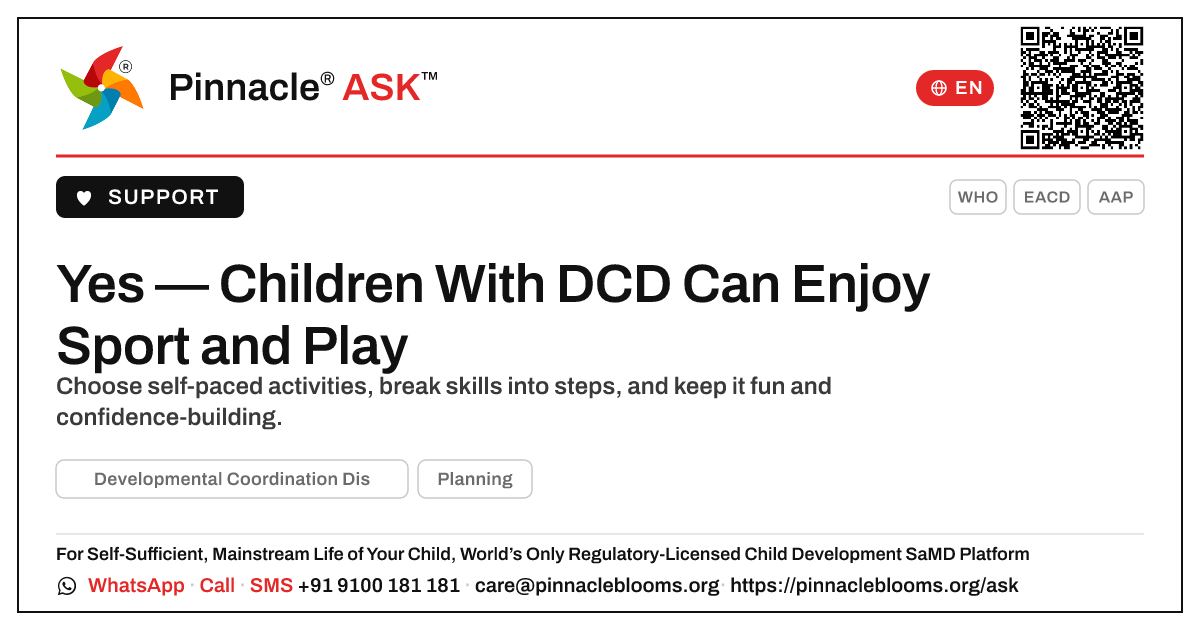
Yes — and not only can they play, the right kind of movement is one of the best things for a child with Developmental Coordination Disorder.
In short
Absolutely yes. A child with Developmental Coordination Disorder (DCD) can and should take part in sports and physical play — movement builds the very coordination, strength and confidence that DCD makes harder to develop on its own. The trick is choosing activities that match your child's strengths, breaking skills into small steps, and keeping it fun rather than competitive. With the right setup, your child can enjoy being active for life.
How to make sport and play work
Children with DCD often struggle with the planning and smooth execution of movement — catching a ball, riding a bike, or keeping up in fast team games. This is not a reason to step back from sport; it is a reason to choose it wisely.
- Lean towards individual or self-paced activities — swimming, cycling, climbing, martial arts, running, dance or yoga let a child progress at their own speed without the pressure of fast group play.
- Break skills into small steps — practise one part of a skill at a time (just the throw, then just the catch) and build up slowly. Repetition in a calm setting helps movement patterns settle.
- Choose forgiving environments — a patient coach, smaller groups, and play that rewards effort over winning protects a child's confidence.
- Adapt the equipment — a larger, slower ball, a lower hoop, or a longer turn-taking window can turn frustration into success.
- Protect the joy — children with DCD can tire faster and feel self-conscious, so celebrate effort and keep sessions short and positive. A child who enjoys moving will keep moving.
Active play also supports attention, mood, sleep and friendships — benefits that reach well beyond the playground.
When to seek guidance
If your child consistently avoids physical play, comes home upset after sport, complains of being clumsy or "bad at games", or is falling behind peers in everyday motor skills like dressing or handwriting, a developmental check can help. An occupational or physiotherapist can pinpoint which movement skills to target and show you and any coach exactly how to set your child up to succeed.
The Pinnacle way
AbilityScore® is part of Pinnacle’s developmental assessment. Diagnosis, where needed, requires an appropriately qualified healthcare professional — never from an app or online form. From there your child receives a precise movement and developmental profile and a plan that builds coordination through play, delivered via our occupational therapy support. You can also learn more about how we support children's development at every step.
Trusted sources
WHO ICD-11 entry for Developmental motor coordination disorder; European Academy of Childhood Disability (EACD) clinical guidance on DCD; American Academy of Pediatrics (HealthyChildren.org) guidance on physical activity and play for children.
Next step — Want a movement plan that lets your child enjoy sport and play with confidence? Book an assessment with a Pinnacle clinician.
This is general information, not a diagnosis — individual assessment and diagnosis require an appropriately qualified healthcare professional.
CONNECT THE ANSWER TO YOUR CHILD’S DAY
Something to notice. Something to discuss.
What to notice
Watch for a child who avoids physical play, comes home upset after sport, calls themselves clumsy or bad at games, or lags peers in everyday motor skills like dressing and handwriting — signs a developmental check could help.
In everyday life
Pick one self-paced activity your child enjoys — swimming, cycling or climbing — and practise just one small part of a skill at a time, celebrating effort over winning so movement stays fun.
Bring your observations and questions to your child’s professional. Choose activities that suit your child’s comfort, abilities and agreed plan.
Bring your questions to a first visitQuestions families ask
What sports are best for a child with DCD?
Self-paced, individual activities tend to work best — swimming, cycling, climbing, martial arts, running, dance and yoga let a child progress at their own speed without the pressure of fast team games. The best sport is ultimately the one your child enjoys, because enjoyment keeps them moving.
Should I avoid team sports for my child with DCD?
Not necessarily. Team sports can work well with a patient coach, smaller groups, and play that rewards effort over winning. If competitive team games cause distress, it is fine to favour individual activities and revisit team play later as confidence and skills grow.
Will sport make my child's coordination better?
Regular, enjoyable movement is one of the most helpful things for DCD — it builds coordination, strength, planning and confidence through practice. Breaking skills into small steps and repeating them in a calm setting helps movement patterns settle over time.
FOLLOW THE SOURCE
References behind this answer.
- Organisation website · further readingWHO ICD-11: Developmental motor coordination disorder
- Organisation website · further readingEACD clinical guidance on Developmental Coordination Disorder
- Organisation website · further readingAAP HealthyChildren.org: physical activity and play
References are supplied with this answer. An organisation homepage offers further reading; it does not establish an independent review of this page.
Content attribution: SETU Consortium · Pinnacle Blooms Network.
PEOPLE, TOPICS & DEVELOPMENT
See the connections.
Browse the wider question collections connected with this answer’s audience, developmental area and stage.
FROM UNDERSTANDING TO PURPOSEFUL SUPPORT
One question. Your child’s whole life.
Your child’s self-sufficient, mainstream-included life is the purpose from the beginning. At Pinnacle, that purpose shapes what we understand, the goals we choose, the people we bring together, everyday practice and review.
Connect this question with the right support.
Explore how the relevant service contributes to everyday abilities, then speak with us about your child.
Make the next conversation useful.
Bring the situations you notice at home or school. We’ll explain a suitable service, centre and first visit, including availability and fees, before you decide.
How PinnacleAI® connects the journeyExplore the seven stages
- 1Understand abilities
A starting picture of your child’s capabilities.
- 2Choose meaningful goals
Readiness and a plan shaped around the child.
- 3Bring the right support together
Suitable therapies and people for those goals.
- 4Carry practice into everyday life
Guidance for family, home and school.
- 5Track and correct
Use observations to adjust the plan.
- 6Reassess and review
Decide what to continue, change or do next.
- 7Grow independence and participation
The child’s life gives each step its purpose.
Explore the whole PinnacleAI® system → · Participation at school and in the community →
PINNACLE’S EVIDENCE, OPEN TO YOU
Look at the evidence behind our work.
Read our research, inspect the original regulatory documents and check what each institutional measure means.
General information supports a conversation with an appropriately qualified professional. Advice, goals and support depend on the individual child.