
YOUR QUESTION. A CLEARER NEXT STEP.
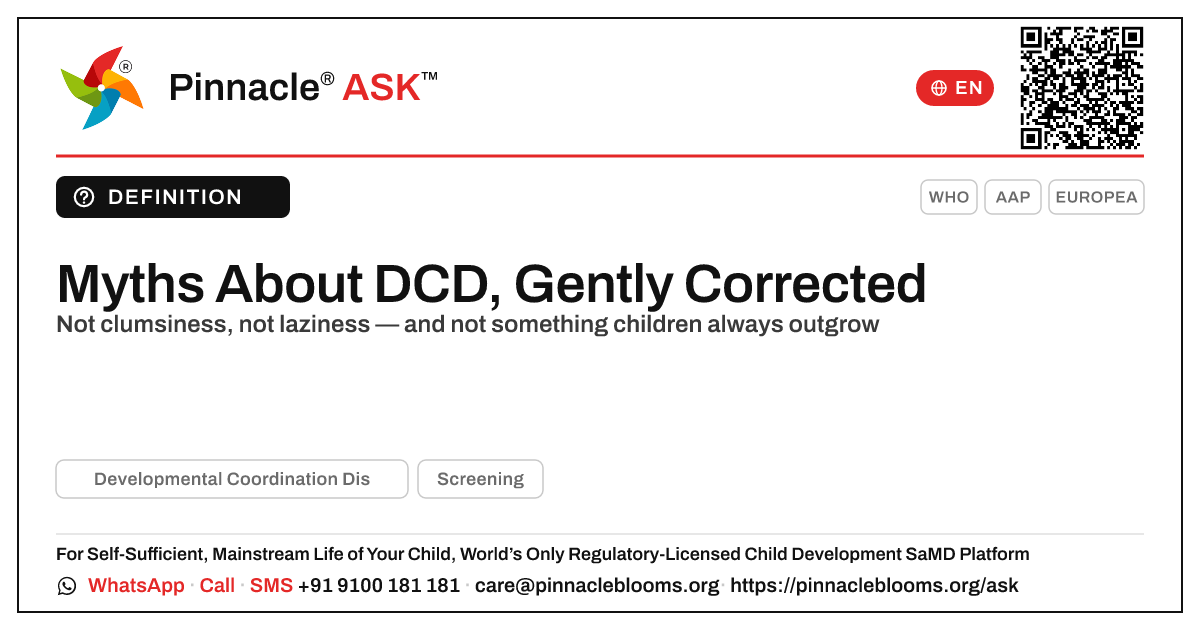
Common Myths About Developmental Coordination Disorder
DCD is a real difference in motor planning and coordination — not clumsiness, laziness or low intelligence. Common myths are that children always outgrow it, that it reflects effort, and that it affects only sport. With early, targeted support children make lasting gains. Developmental measurement supports care planning; diagnosis requires an appropriately qualified healthcare professional.
In this answer 5 sections
"He's just clumsy, he'll grow out of it" — it's one of the kindest-sounding sentences a parent can hear, and one of the most misleading.
In short
Developmental Coordination Disorder (DCD) is a real, recognised difference in how a child learns and coordinates movement — not laziness, not low intelligence, and not simply "being clumsy". The biggest myths are that children always outgrow it on their own, that it reflects how hard they try, or that it affects only sport. In truth, DCD often persists without support, has nothing to do with effort or cleverness, and can touch handwriting, dressing, self-care and confidence as much as the playground. The good news: with the right understanding and targeted support, children make real, lasting gains.
Common myths, gently corrected
Myth: "It's just clumsiness — they'll grow out of it." Many children do not simply outgrow DCD; the difficulties can quietly carry into school and teenage years. Early support helps far more than waiting.
Myth: "He's not trying hard enough." DCD is about how the brain plans and coordinates movement, not about willpower. In fact, these children often work harder than their peers to do everyday tasks.
Myth: "It means my child isn't bright." DCD is unrelated to intelligence. Many children with DCD are curious, capable learners who simply find motor tasks effortful.
Myth: "It only matters for sport." Coordination shapes handwriting, buttons and zips, using cutlery, riding a bike — and the confidence that grows around all of these.
Myth: "It's the same as being lazy or careless." Spilled drinks or messy work are the result of a motor-planning difference, never a lack of care.
When to look closer
If movement skills seem noticeably behind same-age peers — and this affects daily life at home or school — it's worth a friendly developmental check rather than a wait-and-see. Persistent difficulty with everyday motor tasks, not explained by another medical condition, is what professionals look at together.
The Pinnacle way
Developmental measurement supports care planning; diagnosis requires an appropriately qualified healthcare professional., under qualified clinician care — never from an article or an app. Understanding Developmental Coordination Disorder clearly is the first step; targeted occupational therapy builds the motor planning and confidence behind everyday skills; and the AbilityScore gives your family a clear starting point and a plan to follow.
Trusted sources
WHO ICD-11 framework for developmental motor coordination; American Academy of Pediatrics guidance on motor development; European Academy of Childhood Disability recommendations on DCD support.
Next step — Curious where your child stands? A Pinnacle clinician can establish a clear baseline.
This is general information, not a diagnosis — individual assessment and diagnosis require an appropriately qualified healthcare professional.
CONNECT THE ANSWER TO YOUR CHILD’S DAY
Something to notice. Something to discuss.
What to notice
Movement skills noticeably behind same-age peers that affect everyday life — difficulty with handwriting, buttons, zips, cutlery, balance or learning to ride a bike — that persists rather than fading with time.
In everyday life
Break tricky tasks into small steps and celebrate the effort, not just the result. Practising one part of dressing or one letter at a time builds confidence faster than expecting the whole skill at once.
Bring your observations and questions to your child’s professional. Choose activities that suit your child’s comfort, abilities and agreed plan.
Bring your questions to a first visitQuestions families ask
Will my child outgrow Developmental Coordination Disorder?
Many children do not simply outgrow DCD on their own — difficulties can carry into school years and beyond. Early, targeted support helps far more than waiting, and children can make real, lasting progress with the right help.
Does DCD mean my child isn't intelligent?
No. DCD is unrelated to intelligence. It affects how the brain plans and coordinates movement, not thinking or learning ability. Many children with DCD are curious, capable learners who simply find motor tasks effortful.
Is DCD just a fancy word for being clumsy?
No. While clumsiness can be visible, DCD is a recognised difference in motor planning and coordination that can affect handwriting, dressing, self-care and confidence — not only sport or balance.
FOLLOW THE SOURCE
References behind this answer.
- Organisation website · further readingWHO ICD-11 framework for developmental motor coordination
- Organisation website · further readingAmerican Academy of Pediatrics — motor development guidance
- Organisation website · further readingEuropean Academy of Childhood Disability — DCD recommendations
References are supplied with this answer. An organisation homepage offers further reading; it does not establish an independent review of this page.
Content attribution: SETU Consortium · Pinnacle Blooms Network.
PEOPLE, TOPICS & DEVELOPMENT
See the connections.
Browse the wider question collections connected with this answer’s audience, developmental area and stage.
FROM UNDERSTANDING TO PURPOSEFUL SUPPORT
One question. Your child’s whole life.
Your child’s self-sufficient, mainstream-included life is the purpose from the beginning. At Pinnacle, that purpose shapes what we understand, the goals we choose, the people we bring together, everyday practice and review.
Connect this question with the right support.
Explore how the relevant service contributes to everyday abilities, then speak with us about your child.
Make the next conversation useful.
Bring the situations you notice at home or school. We’ll explain a suitable service, centre and first visit, including availability and fees, before you decide.
How PinnacleAI® connects the journeyExplore the seven stages
- 1Understand abilities
A starting picture of your child’s capabilities.
- 2Choose meaningful goals
Readiness and a plan shaped around the child.
- 3Bring the right support together
Suitable therapies and people for those goals.
- 4Carry practice into everyday life
Guidance for family, home and school.
- 5Track and correct
Use observations to adjust the plan.
- 6Reassess and review
Decide what to continue, change or do next.
- 7Grow independence and participation
The child’s life gives each step its purpose.
Explore the whole PinnacleAI® system → · Participation at school and in the community →
PINNACLE’S EVIDENCE, OPEN TO YOU
Look at the evidence behind our work.
Read our research, inspect the original regulatory documents and check what each institutional measure means.
General information supports a conversation with an appropriately qualified professional. Advice, goals and support depend on the individual child.