
YOUR QUESTION. A CLEARER NEXT STEP.
Should I be worried my child might have Developmental Coordination Disorder?
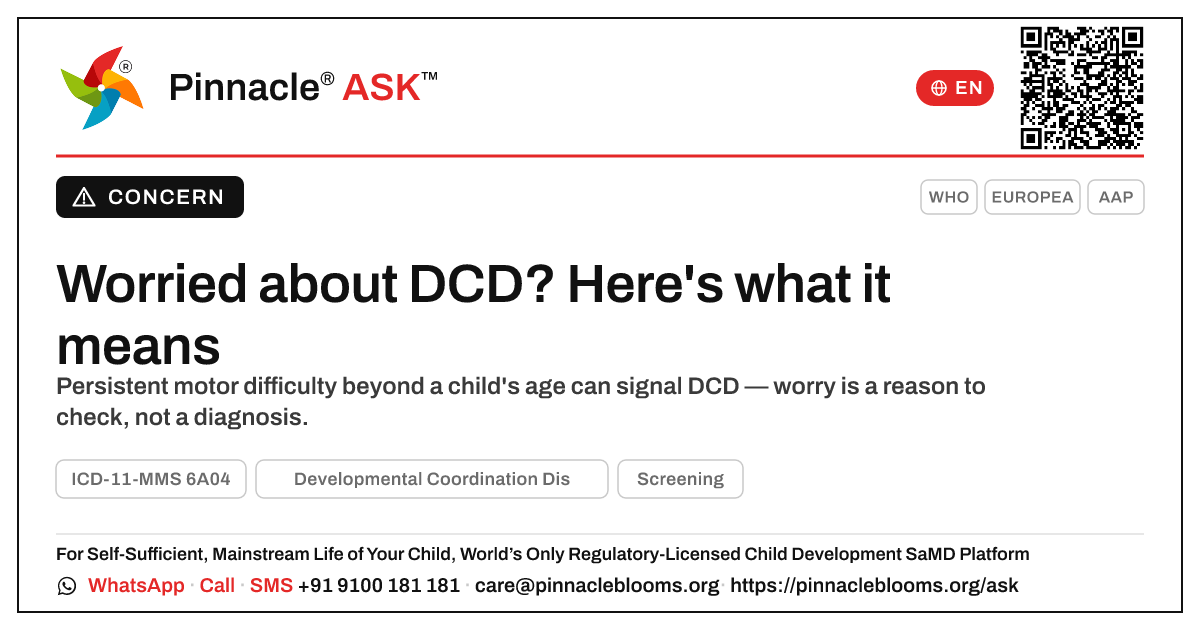
Occasional clumsiness is normal; a persistent pattern of motor difficulty beyond a child's age — affecting daily tasks and usually clearer from around age 5 — can signal DCD. Worry is a reason to check, not a diagnosis. Only a clinician can confirm it.
In this answer 5 sections
If your child trips often, struggles with buttons or seems clumsier than other children their age, that worry is real — and worth understanding gently.
In short
Developmental Coordination Disorder (DCD) is a persistent difficulty with motor coordination — far beyond what's expected for a child's age — that isn't explained by another medical or neurological condition. It shows up in everyday motor tasks, not in a single clumsy moment. A pattern that lasts and interferes with daily life is the real flag — not a one-off stumble. Worry is a good reason to check, but it is not, by itself, a diagnosis.
Signs worth attention
DCD typically becomes clearer once a child is around 5 years or older, when motor demands rise. Look for a lasting pattern such as:
- Gross motor — frequent tripping, bumping into things, trouble with running, jumping, hopping, catching or riding a bicycle
- Fine motor — difficulty with buttons, zips, cutlery, scissors, or messy and effortful handwriting
- Self-care — dressing, brushing teeth or pouring a drink taking far longer than peers
- Avoidance — sidestepping sport, drawing or play that needs coordination
Occasional clumsiness is part of growing up. What matters is whether the difficulty persists and affects school, play or daily routines.
The science, briefly
DCD affects roughly 5–6% of children and is classified by the WHO within neurodevelopmental disorders (ICD-11 6A04). It is often missed because these children are bright and capable in other ways. Identified early, targeted occupational and motor therapy helps children build skill, confidence and independence — and prevents the quiet knock to self-esteem that unaddressed motor struggles can bring.
The Pinnacle way
Only a qualified clinician can tell whether this is DCD or a passing phase — and that clarity comes from a clinician-administered structured assessment, your child's own AbilityScore® baseline, measured at a Pinnacle Blooms Network centre. No diagnosis is ever made from an online form. From there, occupational therapy builds real-world motor skills, step by step. The aim is always the same: your child moving, doing and thriving with confidence.
Trusted sources
WHO ICD-11 (6A04); European Academy of Childhood Disability (EACD) recommendations on DCD; American Academy of Pediatrics; Pinnacle Blooms Network clinical studies.
Next step — The kindest thing you can do with worry is check. Book a developmental assessment with a Pinnacle occupational therapist.
This is general information, not a diagnosis — individual assessment and diagnosis require an appropriately qualified healthcare professional.
CONNECT THE ANSWER TO YOUR CHILD’S DAY
Something to notice. Something to discuss.
What to notice
Seek assessment sooner if motor difficulty is worsening, if your child avoids play or school tasks out of frustration, or if there is any loss of skills they once had — and always rule out vision or hearing concerns first.
In everyday life
Build motor confidence through play, not pressure: threading beads, playdough, drawing, ball games or an obstacle course in the garden. Keep it short, fun and celebratory — ten relaxed minutes a day strengthens coordination far better than drills.
Bring your observations and questions to your child’s professional. Choose activities that suit your child’s comfort, abilities and agreed plan.
Bring your questions to a first visitQuestions families ask
At what age can Developmental Coordination Disorder be identified?
DCD usually becomes clearer from around age 5, when motor demands increase, though concerns may be noted earlier. A clinician looks for a persistent pattern affecting daily life, not a single clumsy phase, before any assessment conclusions are drawn.
Is clumsiness in young children always a sign of DCD?
No. Occasional tripping, dropping things or messy handwriting is a normal part of development. DCD is suspected only when the difficulty is significant, persistent, and interferes with everyday tasks like dressing, school work or play.
Can therapy help a child with DCD?
Yes. Occupational and motor-focused therapy helps children build coordination, independence and confidence in real-life tasks. Identified early, outcomes improve markedly and children often thrive in mainstream settings.
FOLLOW THE SOURCE
References behind this answer.
- Organisation website · further readingWHO ICD-11: Developmental motor coordination disorder
- Organisation website · further readingEuropean Academy of Childhood Disability (EACD) — DCD recommendations
- Organisation website · further readingAAP HealthyChildren: motor development milestones
References are supplied with this answer. An organisation homepage offers further reading; it does not establish an independent review of this page.
Content attribution: SETU Consortium · Pinnacle Blooms Network.
PEOPLE, TOPICS & DEVELOPMENT
See the connections.
Browse the wider question collections connected with this answer’s audience, developmental area and stage.
FROM UNDERSTANDING TO PURPOSEFUL SUPPORT
One question. Your child’s whole life.
Your child’s self-sufficient, mainstream-included life is the purpose from the beginning. At Pinnacle, that purpose shapes what we understand, the goals we choose, the people we bring together, everyday practice and review.
Connect this question with the right support.
Explore how the relevant service contributes to everyday abilities, then speak with us about your child.
Make the next conversation useful.
Bring the situations you notice at home or school. We’ll explain a suitable service, centre and first visit, including availability and fees, before you decide.
How PinnacleAI® connects the journeyExplore the seven stages
- 1Understand abilities
A starting picture of your child’s capabilities.
- 2Choose meaningful goals
Readiness and a plan shaped around the child.
- 3Bring the right support together
Suitable therapies and people for those goals.
- 4Carry practice into everyday life
Guidance for family, home and school.
- 5Track and correct
Use observations to adjust the plan.
- 6Reassess and review
Decide what to continue, change or do next.
- 7Grow independence and participation
The child’s life gives each step its purpose.
Explore the whole PinnacleAI® system → · Participation at school and in the community →
PINNACLE’S EVIDENCE, OPEN TO YOU
Look at the evidence behind our work.
Read our research, inspect the original regulatory documents and check what each institutional measure means.
General information supports a conversation with an appropriately qualified professional. Advice, goals and support depend on the individual child.