
YOUR QUESTION. A CLEARER NEXT STEP.
Will a child with cerebral palsy live independently as an adult?
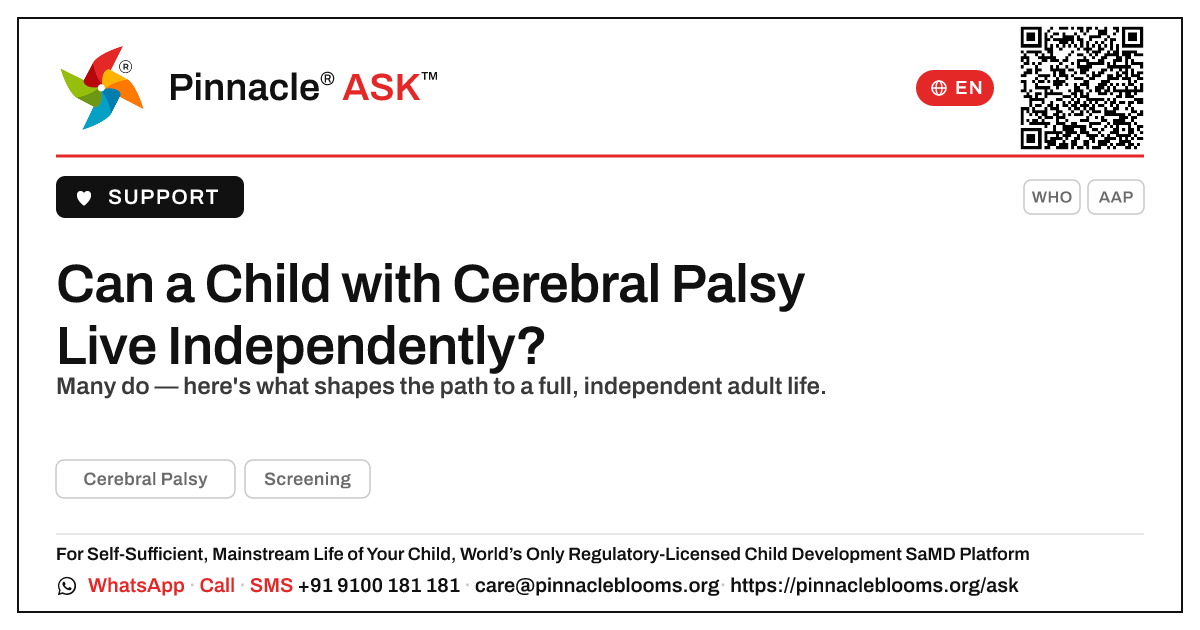
Many children with cerebral palsy live independently as adults — studying, working and raising families — while others thrive with assistive technology or some support. CP is non-progressive, and outcomes depend on function, early therapy, communication access and an inclusive environment, not on the label alone.
In this answer 4 sections
The question every parent of a child with cerebral palsy carries quietly: what will adulthood look like — and the honest, hopeful answer is that many do live full, independent lives.
In short
Many children with cerebral palsy (CP) grow into adults who live independently — studying, working, driving, partnering and raising families of their own. CP is non-progressive, meaning the underlying brain difference does not worsen over time, and outcomes vary enormously: some young people need little or no daily support, while others thrive with assistive technology, accessible environments or some personal assistance. The single biggest predictors are not a label but functional ability, early and sustained therapy, communication access, and how disability-inclusive the surrounding world is. "Independence" is best understood broadly — having choice, control and a meaningful life — not only doing everything unaided.
What shapes the path to independence
CP describes a group of conditions affecting movement and posture; how it affects daily life differs from child to child. Clinicians often describe function using profiles such as gross motor levels and communication ability — these help predict the kinds of support that will be most useful, not a fixed ceiling.
Factors that strongly support adult independence:
- Early, consistent intervention — physiotherapy, occupational therapy and speech-language therapy that build mobility, self-care and communication.
- Communication access — when a child can express themselves, by speech or augmentative tools, doors to education, work and relationships open.
- Adaptive skills and assistive technology — wheelchairs, communication devices, home modifications and adapted vehicles extend what is possible.
- Inclusive education and vocational planning — skills, qualifications and confidence built across the school years.
- Accessible, attitude-inclusive environments — independence is shaped as much by the world's barriers as by the child.
Intellect is unaffected in many children with CP, and even where learning is harder, supported and semi-independent living arrangements allow a great deal of autonomy and dignity.
The Pinnacle way
Developmental measurement supports care planning; diagnosis requires an appropriately qualified healthcare professional., under qualified clinician care — never from a website or an app. From there, your family receives a clear baseline and a practical roadmap that grows with your child toward the fullest possible independence. Begin with an understanding of cerebral palsy, how the AbilityScore® is established, and the occupational therapy that builds everyday self-care and adaptive skills.
Trusted sources
WHO ICF framework, which frames disability as the interaction between a person's functioning and their environment; WHO ICD-11; American Academy of Pediatrics guidance for families; Indian Academy of Pediatrics. These emphasise function, participation and lifelong support rather than fixed prognosis.
Next step — Want a clear picture of your child's strengths and the path ahead? Book an assessment with a Pinnacle clinician.
This is general information, not a diagnosis — individual assessment and diagnosis require an appropriately qualified healthcare professional.
CONNECT THE ANSWER TO YOUR CHILD’S DAY
Something to notice. Something to discuss.
What to notice
Track functional milestones over time — mobility, self-care, communication and how your child solves everyday problems. Steady progress with the right support, rather than any single score, is the most encouraging sign for future independence.
In everyday life
Build independence in small daily moments — let your child make choices, attempt self-care tasks at their own pace, and use any tool (a grab rail, a communication app, a spoon adaptation) that helps them do it themselves. Autonomy grows through practice, not protection.
Bring your observations and questions to your child’s professional. Choose activities that suit your child’s comfort, abilities and agreed plan.
Bring your questions to a first visitQuestions families ask
Does cerebral palsy get worse as a child grows older?
No. Cerebral palsy is non-progressive — the underlying brain difference does not worsen over time. Day-to-day function can actually improve with therapy, growth and the right supports, though some adults benefit from ongoing management of muscles, joints or comfort.
Can a child with cerebral palsy go to a regular school and get a job?
Many do. With inclusive education, adaptive support and vocational planning, young people with CP attend mainstream school, gain qualifications and work in a wide range of careers. Intellect is unaffected in many children with CP.
What helps most in building independence for the future?
Early and consistent therapy, strong communication access, assistive technology, adaptive self-care skills and an accessible, inclusive environment matter most — far more than any single label or prediction made early in childhood.
FOLLOW THE SOURCE
References behind this answer.
- Source referenceWHO ICF — functioning and participation framework
- Source referenceWHO ICD-11
- Organisation website · further readingAmerican Academy of Pediatrics — HealthyChildren.org
References are supplied with this answer. An organisation homepage offers further reading; it does not establish an independent review of this page.
Content attribution: SETU Consortium · Pinnacle Blooms Network.
PEOPLE, TOPICS & DEVELOPMENT
See the connections.
Browse the wider question collections connected with this answer’s audience, developmental area and stage.
FROM UNDERSTANDING TO PURPOSEFUL SUPPORT
One question. Your child’s whole life.
Your child’s self-sufficient, mainstream-included life is the purpose from the beginning. At Pinnacle, that purpose shapes what we understand, the goals we choose, the people we bring together, everyday practice and review.
Connect this question with the right support.
Start with your child’s strengths, your observations and what you want everyday life to become.
Make the next conversation useful.
Bring the situations you notice at home or school. We’ll explain a suitable service, centre and first visit, including availability and fees, before you decide.
How PinnacleAI® connects the journeyExplore the seven stages
- 1Understand abilities
A starting picture of your child’s capabilities.
- 2Choose meaningful goals
Readiness and a plan shaped around the child.
- 3Bring the right support together
Suitable therapies and people for those goals.
- 4Carry practice into everyday life
Guidance for family, home and school.
- 5Track and correct
Use observations to adjust the plan.
- 6Reassess and review
Decide what to continue, change or do next.
- 7Grow independence and participation
The child’s life gives each step its purpose.
Explore the whole PinnacleAI® system → · Participation at school and in the community →
PINNACLE’S EVIDENCE, OPEN TO YOU
Look at the evidence behind our work.
Read our research, inspect the original regulatory documents and check what each institutional measure means.
General information supports a conversation with an appropriately qualified professional. Advice, goals and support depend on the individual child.