
YOUR QUESTION. A CLEARER NEXT STEP.
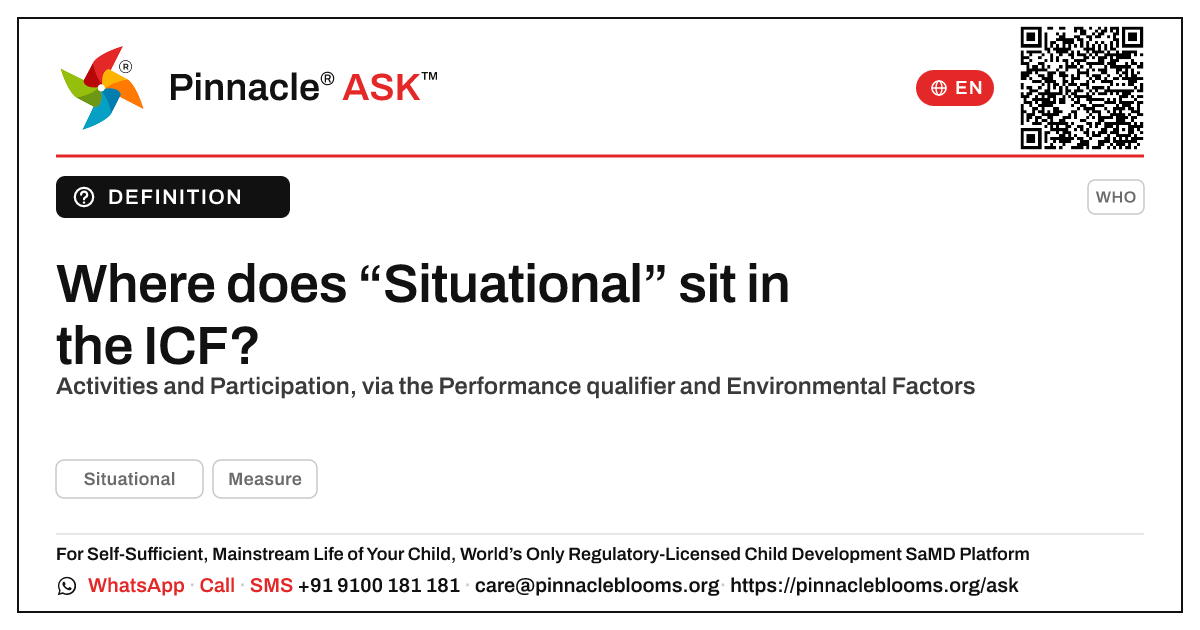
Which ICF domain does “Situational” map to in early childhood?
In the ICF, the "Situational" lens maps to the Activities and Participation component, read through the Performance qualifier and contextualised by Environmental Factors. It is not a single body-function domain but a context-dependent reading of what a child actually does in everyday settings, as distinct from capacity in a standardised setting. The ICF-CY is the appropriate developmental frame for early childhood.
In this answer 5 sections
In the ICF, a child's situational functioning is read not as one fixed score but as performance shaped by the real-world context around them.
In short
The Situational lens maps most directly onto the ICF's Activities and Participation component — specifically the distinction the ICF draws between Capacity (what a child can do in a standardised setting) and Performance (what a child actually does in their everyday environment). In early childhood, "situational" functioning is captured by the Performance qualifier, modulated by Environmental Factors (Part 2 of the ICF) such as the home, caregivers, routines and sensory surroundings. It is therefore not a single body-function domain but a context-dependent reading of activity and participation.
The science: where "Situational" sits in the ICF architecture
The ICF organises functioning into Body Functions and Structures, Activities and Participation, and Contextual Factors (Environmental and Personal). A child who manages an activity well in a quiet assessment room yet struggles in a noisy classroom is showing a capacity–performance gap — and "situational" functioning is precisely the language for that gap. It lives in the Activities and Participation domains (for example d2 General tasks and demands, d3 Communication, d7 Interpersonal interactions), with the score qualified by the Performance qualifier and explained by Environmental Factors (e2–e5: products, support, attitudes, services). For early childhood, the ICF-CY (Children & Youth version) is the appropriate frame, because it adds developmentally sensitive codes recognising that a young child's functioning is inseparable from caregiver and setting. So the short answer for researchers: Situational → Activities and Participation (Performance qualifier), contextualised by Environmental Factors.
Why this matters for measurement
Reading functioning situationally guards against under- or over-estimating a child from a single clinic snapshot. It anchors goal-setting in the environments where a child actually lives and learns, and aligns with family-centred, ecological models of early intervention.
The Pinnacle way
This is conceptual reference information, not a diagnosis — a clinical AbilityScore® and any diagnosis are formed only at a Pinnacle Blooms Network centre, under qualified clinician care, and our structured assessment is administered by a clinician rather than generated from a form or app. We map a child's functioning across multiple real-world contexts, drawing on occupational therapy and allied supports where helpful. Explore more across our knowledge engine.
Trusted sources
WHO International Classification of Functioning, Disability and Health (ICF) and its capacity–performance qualifier framework; the WHO ICF-CY (Children and Youth derivative) for developmentally appropriate coding; the WHO Nurturing Care Framework on the role of environment and caregiving in early childhood functioning.
Next step — If you are mapping early-childhood functioning to the ICF in research or practice, connect with our clinical team to discuss how situational, multi-context observation strengthens your framework.
CONNECT THE ANSWER TO YOUR CHILD’S DAY
Something to notice. Something to discuss.
What to notice
A capacity–performance gap: a child who manages a task in a quiet assessment room but struggles in noisy or unfamiliar settings, signalling that environmental factors are shaping observed functioning.
In everyday life
When observing a young child, note the setting alongside the skill — the same activity recorded across home, clinic and play group reveals far more than any single snapshot.
Bring your observations and questions to your child’s professional. Choose activities that suit your child’s comfort, abilities and agreed plan.
Bring your questions to a first visitQuestions families ask
Is “Situational” a single ICF domain?
No. It maps to the Activities and Participation component as a whole, read through the Performance qualifier rather than corresponding to one body-function code. It captures what a child actually does in real environments.
What is the capacity–performance distinction?
Capacity is what a child can do in a standardised or assisted setting; Performance is what they actually do in their usual environment. The situational reading focuses on Performance and on the Environmental Factors that explain the gap.
Why use the ICF-CY rather than the standard ICF for young children?
The ICF-CY (Children and Youth version) adds developmentally sensitive codes that recognise how a young child's functioning is inseparable from caregiving and setting, making it the appropriate frame for early childhood.
FOLLOW THE SOURCE
References behind this answer.
- Organisation website · further readingWHO ICF classification and the capacity–performance framework
- Organisation website · further readingWHO ICF-CY (Children and Youth derivative)
- Organisation website · further readingWHO Nurturing Care Framework on environment and early functioning
References are supplied with this answer. An organisation homepage offers further reading; it does not establish an independent review of this page.
Content attribution: SETU Consortium · Pinnacle Blooms Network.
PEOPLE, TOPICS & DEVELOPMENT
See the connections.
Browse the wider question collections connected with this answer’s audience, developmental area and stage.
FROM UNDERSTANDING TO PURPOSEFUL SUPPORT
One question. Your child’s whole life.
Your child’s self-sufficient, mainstream-included life is the purpose from the beginning. At Pinnacle, that purpose shapes what we understand, the goals we choose, the people we bring together, everyday practice and review.
Connect this question with the right support.
Start with your child’s strengths, your observations and what you want everyday life to become.
Make the next conversation useful.
Bring the situations you notice at home or school. We’ll explain a suitable service, centre and first visit, including availability and fees, before you decide.
How PinnacleAI® connects the journeyExplore the seven stages
- 1Understand abilities
A starting picture of your child’s capabilities.
- 2Choose meaningful goals
Readiness and a plan shaped around the child.
- 3Bring the right support together
Suitable therapies and people for those goals.
- 4Carry practice into everyday life
Guidance for family, home and school.
- 5Track and correct
Use observations to adjust the plan.
- 6Reassess and review
Decide what to continue, change or do next.
- 7Grow independence and participation
The child’s life gives each step its purpose.
Explore the whole PinnacleAI® system → · Participation at school and in the community →
PINNACLE’S EVIDENCE, OPEN TO YOU
Look at the evidence behind our work.
Read our research, inspect the original regulatory documents and check what each institutional measure means.
General information supports a conversation with an appropriately qualified professional. Advice, goals and support depend on the individual child.