
YOUR QUESTION. A CLEARER NEXT STEP.
Which ICF Domain Does Restricted Behaviors Map To?
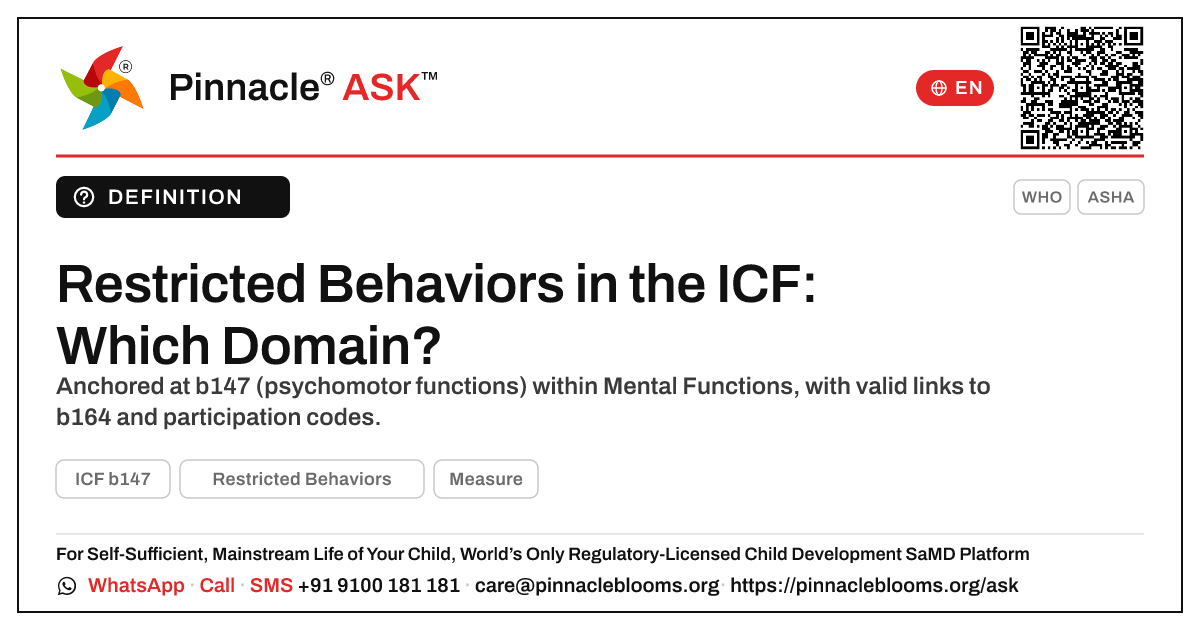
In the ICF, Restricted Behaviors in early childhood map principally to the Body Functions domain of Mental Functions, anchored at code b147 (psychomotor functions), which governs control of motor and psychological events. Because restricted and repetitive behaviour is multidimensional, valid ICF coding links b147 with higher-level cognitive functions (b164, cognitive flexibility) and with Activities and Participation domains. This is a functioning-classification question, not a diagnostic one, and ICF-CY descriptors are preferred for young children.
In this answer 5 sections
In the ICF, restricted and repetitive behaviour patterns sit at the intersection of mental functioning and activity — and code b147 anchors them in the domain of psychomotor functions.
In short
Within the International Classification of Functioning, Disability and Health (ICF), Restricted Behaviors in early childhood map principally to Body Functions — Chapter 1, Mental Functions, specifically b147 Psychomotor functions, which govern the regulation and control of motor and psychological events at the body level. Because restricted and repetitive behaviour is multidimensional, it is most validly described through linked ICF codes rather than a single tag — pairing b147 with mental functions of cognitive flexibility and with Activities and Participation domains. This is a functioning-and-classification question, not a diagnostic one.
The science: why b147, and why it is rarely b147 alone
The ICF describes functioning, not disorders. Restricted, repetitive behaviours and interests (RRBIs) — motor stereotypies, insistence on sameness, ritualised routines, and narrow intense interests — are best captured by mapping the underlying functions they express. Code b147 (Psychomotor functions) covers the specific mental functions of control over both motor and psychological events at the body level, including psychomotor control, and is the canonical anchor for stereotyped and repetitive motor behaviours.
However, ICF Core Set work for autism spectrum disorder and rigorous linking-rule methodology (Cieza linking rules) consistently show that RRBIs require a constellation. Insistence on sameness and cognitive rigidity link more naturally to higher mental functions of b164 (higher-level cognitive functions, including cognitive flexibility); the participation impact of restricted interests links to Activities and Participation chapters such as d2 (general tasks and routines — undertaking and managing daily routine) and d880 (engagement in play). So the precise answer to "which domain" is: the Mental Functions domain of Body Functions, anchored at b147, with valid secondary links into b164 and the d-codes. In early childhood, where behaviours are developmentally emerging, clinicians are urged to document the functional consequence rather than over-fit a single body-function code.
For the clinician and researcher
When coding for early-childhood cohorts, prefer the ICF-CY (Children & Youth derivative) descriptors and record qualifiers for severity and environmental facilitators/barriers. Treat b147 as the primary descriptor for the motor-repetitive dimension and explicitly link the sameness/flexibility dimension elsewhere, so your dataset preserves construct validity rather than collapsing a multidimensional phenotype into one code.
The Pinnacle way
This is classification and functioning information for professional use — it is not a diagnosis. A clinical AbilityScore® and any diagnosis are formed only at a Pinnacle Blooms Network centre, under qualified clinician care, never from an app or form. Our clinical teams describe restricted and repetitive behaviour profiles through linked, function-led behaviour-therapy frameworks, and you can read more about our approach to functioning-led measurement on our home resources.
Trusted sources
The WHO ICF browser provides the authoritative definition of code b147 and the structure of the Body Functions classification; the WHO ICF and its ICF-CY derivative frame functioning, activity and participation; ASHA and AAP resources outline developmental observation of repetitive behaviours in young children. All paraphrased.
Next step — If you are coding or assessing restricted-behaviour profiles in young children, partner with Pinnacle Blooms Network to align your functioning framework with a clinician-administered, function-led assessment.
CONNECT THE ANSWER TO YOUR CHILD’S DAY
Something to notice. Something to discuss.
What to notice
Whether the coding captures both the motor-repetitive dimension (b147) and the insistence-on-sameness/cognitive-flexibility dimension (b164), plus the participation impact in daily routines and play — collapsing these into one code reduces construct validity.
In everyday life
When linking RRBIs to the ICF, document the functional consequence and use ICF-CY descriptors for young children rather than over-fitting a single body-function code.
Bring your observations and questions to your child’s professional. Choose activities that suit your child’s comfort, abilities and agreed plan.
Bring your questions to a first visitQuestions families ask
Is b147 the only ICF code for restricted behaviours?
No. b147 (psychomotor functions) is the primary anchor for the motor-repetitive dimension, but valid coding also links to b164 (higher-level cognitive functions, including cognitive flexibility) for insistence on sameness, and to Activities and Participation codes such as managing daily routine and engagement in play. RRBIs are multidimensional and best described through linked codes.
Should I use the ICF or the ICF-CY for young children?
For early-childhood cohorts, prefer the ICF-CY (Children & Youth) derivative, which provides developmentally calibrated descriptors and qualifiers. Record severity qualifiers and environmental facilitators or barriers so the functioning profile remains valid for young, developmentally emerging behaviours.
Does the ICF diagnose autism or restricted behaviours?
No. The ICF classifies functioning, activity and participation — not diagnoses. It complements, rather than replaces, diagnostic systems. Any clinical diagnosis is formed only by a qualified clinician through structured assessment, never from a classification code alone.
FOLLOW THE SOURCE
References behind this answer.
- Organisation website · further readingWHO ICF — classification of functioning and Body Functions structure
- Organisation website · further readingWHO ICF and ICF-CY framework overview
- Organisation website · further readingASHA — developmental observation resources
References are supplied with this answer. An organisation homepage offers further reading; it does not establish an independent review of this page.
Content attribution: SETU Consortium · Pinnacle Blooms Network.
PEOPLE, TOPICS & DEVELOPMENT
See the connections.
Browse the wider question collections connected with this answer’s audience, developmental area and stage.
FROM UNDERSTANDING TO PURPOSEFUL SUPPORT
One question. Your child’s whole life.
Your child’s self-sufficient, mainstream-included life is the purpose from the beginning. At Pinnacle, that purpose shapes what we understand, the goals we choose, the people we bring together, everyday practice and review.
Connect this question with the right support.
Explore how the relevant service contributes to everyday abilities, then speak with us about your child.
Make the next conversation useful.
Bring the situations you notice at home or school. We’ll explain a suitable service, centre and first visit, including availability and fees, before you decide.
How PinnacleAI® connects the journeyExplore the seven stages
- 1Understand abilities
A starting picture of your child’s capabilities.
- 2Choose meaningful goals
Readiness and a plan shaped around the child.
- 3Bring the right support together
Suitable therapies and people for those goals.
- 4Carry practice into everyday life
Guidance for family, home and school.
- 5Track and correct
Use observations to adjust the plan.
- 6Reassess and review
Decide what to continue, change or do next.
- 7Grow independence and participation
The child’s life gives each step its purpose.
Explore the whole PinnacleAI® system → · Participation at school and in the community →
PINNACLE’S EVIDENCE, OPEN TO YOU
Look at the evidence behind our work.
Read our research, inspect the original regulatory documents and check what each institutional measure means.
General information supports a conversation with an appropriately qualified professional. Advice, goals and support depend on the individual child.