
YOUR QUESTION. A CLEARER NEXT STEP.
Which ICF domain do early-childhood motor skills map to?
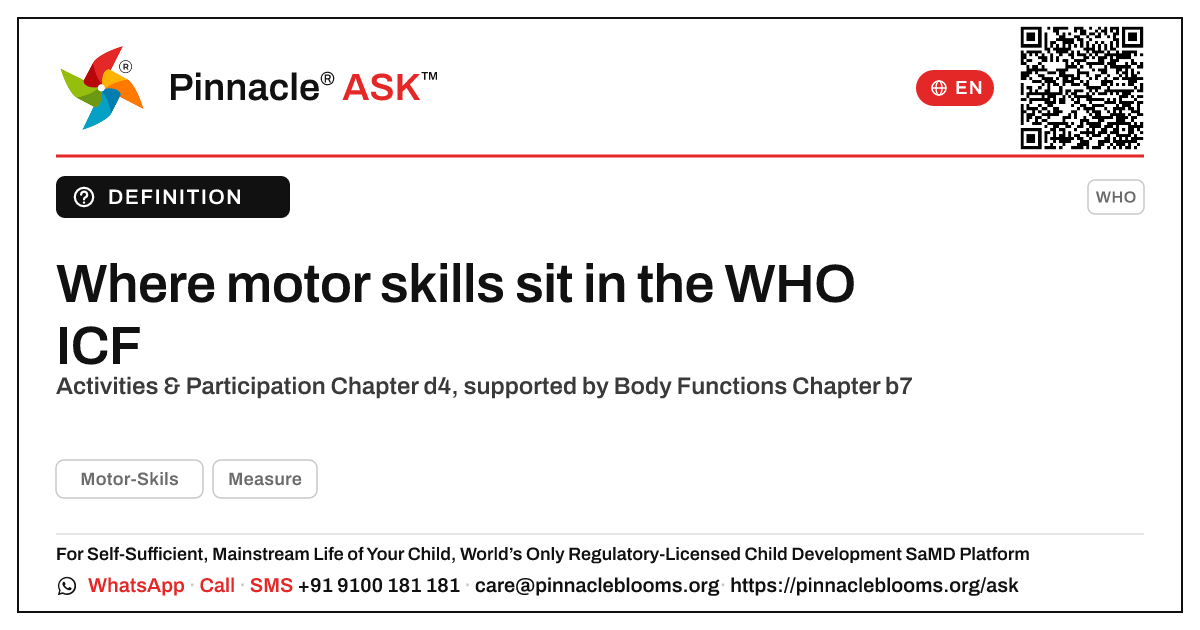
In the WHO ICF, early-childhood motor skills map principally to the Activities and Participation component, Chapter d4 (Mobility) — including changing and maintaining body position (d410–d429), fine hand use (d440), and walking and moving about (d450–d469). Their body-level substrate sits in Body Functions Chapter b7 (Neuromusculoskeletal and movement-related functions), such as muscle tone, power and voluntary movement control. The ICF-CY refines these for developmental relevance, distinguishing capacity from everyday performance.
In this answer 5 sections
When a toddler reaches, crawls, grasps and walks, the ICF gives us a precise language for naming exactly what is changing — and where.
In short
In the WHO International Classification of Functioning, Disability and Health (ICF), motor skills in early childhood map principally to the Activities and Participation component — specifically Chapter d4 (Mobility), covering changing and maintaining body position, carrying and handling objects, fine hand use, walking and moving about. Their underlying capacity is supported by Body Functions Chapter b7 (Neuromusculoskeletal and movement-related functions) — for example muscle tone (b735), muscle power (b730) and control of voluntary movement (b760). In short: motor performance and participation sit in d4, while the body-level substrate of that performance sits in b7.
The science: capacity, performance and the ICF-CY lens
The ICF is biopsychosocial rather than purely diagnostic, so a single construct like "motor skills" is intentionally distributed across components. For paediatric work the ICF-CY (Children and Youth version) refines these codes for developmental relevance. Gross-motor function — rolling, sitting, standing, walking — is captured under d410–d469 (changing basic body position, maintaining position, walking and moving). Fine-motor function — reaching, grasping, releasing, manipulating — falls under d440 (fine hand use) and d445 (hand and arm use). The distinction between capacity (what a child can do in a standardised environment) and performance (what they actually do in their everyday setting) is central, and is why the same child may code differently across contexts. Body Functions codes in b7 then describe the neuromuscular foundation, while Environmental Factors (e) and Personal Factors contextualise how that motor ability is expressed at home, in play and in early-years settings.
Why this mapping matters for measurement
Locating motor skills correctly in the ICF allows assessment tools and outcome measures to align with a shared, internationally comparable framework rather than isolated milestone checklists. It supports goal-setting that is participation-oriented — not merely "improve grasp" but "handle a spoon at mealtimes" — and lets multidisciplinary teams document both the body-structure level and the functional-activity level coherently.
The Pinnacle way
This is general framework information, not a diagnosis — a clinical AbilityScore® and any diagnosis are formed only at a Pinnacle Blooms Network centre, under qualified clinician care, never from an app or form. Our clinicians map early motor development to ICF activity and body-function domains within a structured, clinician-administered assessment, and translate that into participation-focused goals supported where needed by occupational therapy. This rests on 2.5 billion+ data points and 25 million+ therapy sessions across 70+ centres.
Trusted sources
WHO International Classification of Functioning, Disability and Health and its Children and Youth derivative describe the Activities and Participation (d) and Body Functions (b) components; WHO guidance situates motor function within mobility and neuromusculoskeletal domains.
Next step — If you are mapping a paediatric motor assessment to the ICF or seeking a structured developmental review, connect with our clinical team to align measurement with participation-focused goals.
CONNECT THE ANSWER TO YOUR CHILD’S DAY
Something to notice. Something to discuss.
What to notice
When mapping a motor construct, watch the capacity–performance distinction: the same child may code differently in a standardised setting versus everyday play, so document both rather than collapsing them into a single milestone score.
In everyday life
When framing motor goals, phrase them at the participation level (d4) — for example 'manage a spoon at mealtimes' rather than only 'improve grasp' — so assessment and intervention stay functionally meaningful.
Bring your observations and questions to your child’s professional. Choose activities that suit your child’s comfort, abilities and agreed plan.
Bring your questions to a first visitQuestions families ask
Which ICF chapter covers gross-motor skills?
Gross-motor function maps to Activities and Participation Chapter d4 (Mobility), particularly d410–d429 (changing and maintaining body position) and d450–d469 (walking and moving about).
Where do fine-motor skills sit in the ICF?
Fine-motor skills map mainly to d440 (fine hand use) and d445 (hand and arm use) within the Mobility chapter of Activities and Participation.
Do motor skills appear in Body Functions too?
Yes. The neuromuscular substrate of motor skill is captured in Body Functions Chapter b7 (Neuromusculoskeletal and movement-related functions), including muscle tone (b735), power (b730) and control of voluntary movement (b760).
What is the ICF-CY?
The ICF-CY is the Children and Youth derivative of the ICF, refining codes so they capture developmentally relevant functioning across infancy, childhood and adolescence.
FOLLOW THE SOURCE
References behind this answer.
- Organisation website · further readingWHO ICF classification (Activities & Participation, Body Functions)
- Organisation website · further readingWHO guidance on functioning and disability frameworks
References are supplied with this answer. An organisation homepage offers further reading; it does not establish an independent review of this page.
Content attribution: SETU Consortium · Pinnacle Blooms Network.
PEOPLE, TOPICS & DEVELOPMENT
See the connections.
Browse the wider question collections connected with this answer’s audience, developmental area and stage.
FROM UNDERSTANDING TO PURPOSEFUL SUPPORT
One question. Your child’s whole life.
Your child’s self-sufficient, mainstream-included life is the purpose from the beginning. At Pinnacle, that purpose shapes what we understand, the goals we choose, the people we bring together, everyday practice and review.
Connect this question with the right support.
Explore how the relevant service contributes to everyday abilities, then speak with us about your child.
Make the next conversation useful.
Bring the situations you notice at home or school. We’ll explain a suitable service, centre and first visit, including availability and fees, before you decide.
How PinnacleAI® connects the journeyExplore the seven stages
- 1Understand abilities
A starting picture of your child’s capabilities.
- 2Choose meaningful goals
Readiness and a plan shaped around the child.
- 3Bring the right support together
Suitable therapies and people for those goals.
- 4Carry practice into everyday life
Guidance for family, home and school.
- 5Track and correct
Use observations to adjust the plan.
- 6Reassess and review
Decide what to continue, change or do next.
- 7Grow independence and participation
The child’s life gives each step its purpose.
Explore the whole PinnacleAI® system → · Participation at school and in the community →
PINNACLE’S EVIDENCE, OPEN TO YOU
Look at the evidence behind our work.
Read our research, inspect the original regulatory documents and check what each institutional measure means.
General information supports a conversation with an appropriately qualified professional. Advice, goals and support depend on the individual child.