
YOUR QUESTION. A CLEARER NEXT STEP.
Which ICF Domain Does Fluid Reasoning Map To?
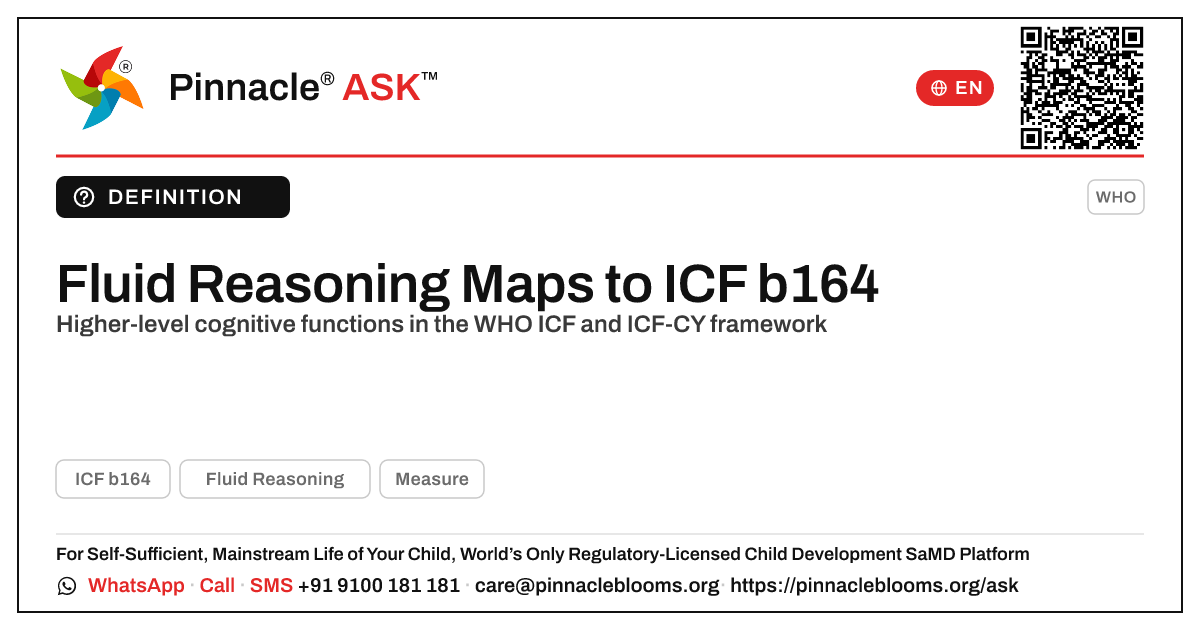
In the WHO ICF, fluid reasoning maps to b164 — Higher-level cognitive functions — within the Mental functions (b1) chapter, the domain covering abstraction, reasoning, problem-solving and planning. In early childhood the ICF-CY frames these as emerging functions observed through play-based problem-solving rather than formal abstraction. Adjacent codes such as b117 (intellectual functions), b140 (attention) and b144 (memory) provide supporting context.
In this answer 5 sections
Fluid reasoning — the ability to solve novel problems without relying on learned knowledge — maps cleanly onto the ICF's higher cognitive functions, coded b164.
In short
In the International Classification of Functioning, Disability and Health (ICF), fluid reasoning maps to b164 — Higher-level cognitive functions, within the broader chapter of Mental functions (b1). This is the domain covering abstraction, reasoning, problem-solving, organisation and planning — the executive and conceptual capacities that fluid reasoning draws upon. In early childhood, these emerge developmentally and are observed through play-based problem-solving rather than formal abstraction, so the mapping is interpreted in an age-appropriate, functional way.
The science of the mapping
Fluid reasoning, as defined in the Cattell–Horn–Carroll (CHC) framework, is the capacity to reason, form concepts and solve unfamiliar problems independent of acquired knowledge or crystallised vocabulary. The ICF does not classify cognitive constructs directly; it classifies functioning. The closest functional anchor is b164 (higher-level cognitive functions), which the ICF specifies as including abstraction, organisation of ideas, time management, insight, judgement, and problem-solving. Related codes provide adjacent texture — b117 (intellectual functions) captures global cognitive capacity, while b140 (attention) and b144 (memory) support the working substrate that fluid reasoning operates on. For early childhood, the ICF-CY (Children and Youth version) frames these as emerging functions, observed through a child's ability to sort, sequence, match novel patterns and adapt strategies during play — not through formal abstract reasoning.
How this is used in practice
For researchers and clinicians, the value of the b164 mapping is that it translates a psychometric construct (fluid reasoning, Gf) into a functioning domain that can be described, profiled and linked to participation and environmental factors. This matters when aligning assessment data with the ICF's biopsychosocial model, where a child's reasoning capacity is always read alongside the supports and contexts that shape how it shows up in daily life. It positions fluid reasoning as an activity-and-function consideration rather than a fixed trait.
The Pinnacle way
This is general classificatory information, not a diagnosis — a clinical AbilityScore® and any diagnosis are formed only at a Pinnacle Blooms Network centre, under qualified clinician care, never from an app or form. Our clinicians read cognitive functioning across the whole child — reasoning, attention, language and play — and build an individualised plan that may draw on cognitive and developmental support and, where helpful, occupational therapy. Explore more at PinnacleAI.
Trusted sources
WHO ICF and ICF-CY framework, classifying higher-level cognitive functions under code b164 within the chapter of mental functions; WHO guidance on the biopsychosocial model of functioning. CHC theory of cognitive abilities informs the construct definition of fluid reasoning that is then mapped to ICF functioning domains.
Next step — If you are profiling a child's cognitive functioning and want an ICF-aligned, clinician-led assessment, partner with a Pinnacle Blooms Network centre to map reasoning strengths within the whole developmental picture.
CONNECT THE ANSWER TO YOUR CHILD’S DAY
Something to notice. Something to discuss.
What to notice
In early childhood, fluid reasoning shows through play-based problem-solving — sorting and matching novel patterns, sequencing, adapting strategies and solving unfamiliar puzzles — rather than formal abstract reasoning, which emerges later.
In everyday life
Offer open-ended play that invites problem-solving without a fixed answer — sorting objects in new ways, simple pattern games, or 'what happens if?' experiments — so reasoning grows through exploration rather than drill.
Bring your observations and questions to your child’s professional. Choose activities that suit your child’s comfort, abilities and agreed plan.
Bring your questions to a first visitQuestions families ask
Which ICF code does fluid reasoning map to?
Fluid reasoning maps most closely to ICF code b164 — higher-level cognitive functions — within the Mental functions (b1) chapter, which covers abstraction, reasoning, organisation, planning and problem-solving.
Does the ICF classify fluid reasoning directly?
No. The ICF classifies functioning, not psychometric constructs. Fluid reasoning, a CHC construct, is interpreted through the functional domain b164, with adjacent codes b117 (intellectual functions), b140 (attention) and b144 (memory) providing context.
How is this applied in early childhood?
The ICF-CY version frames higher-level cognitive functions as emerging capacities, observed through play-based problem-solving — sorting, sequencing and adapting to novel patterns — rather than formal abstract reasoning.
FOLLOW THE SOURCE
References behind this answer.
- Organisation website · further readingWHO ICF / ICF-CY classification of functioning
- Organisation website · further readingWHO biopsychosocial model of functioning and disability
References are supplied with this answer. An organisation homepage offers further reading; it does not establish an independent review of this page.
Content attribution: SETU Consortium · Pinnacle Blooms Network.
PEOPLE, TOPICS & DEVELOPMENT
See the connections.
Browse the wider question collections connected with this answer’s audience, developmental area and stage.
FROM UNDERSTANDING TO PURPOSEFUL SUPPORT
One question. Your child’s whole life.
Your child’s self-sufficient, mainstream-included life is the purpose from the beginning. At Pinnacle, that purpose shapes what we understand, the goals we choose, the people we bring together, everyday practice and review.
Connect this question with the right support.
Start with your child’s strengths, your observations and what you want everyday life to become.
Make the next conversation useful.
Bring the situations you notice at home or school. We’ll explain a suitable service, centre and first visit, including availability and fees, before you decide.
How PinnacleAI® connects the journeyExplore the seven stages
- 1Understand abilities
A starting picture of your child’s capabilities.
- 2Choose meaningful goals
Readiness and a plan shaped around the child.
- 3Bring the right support together
Suitable therapies and people for those goals.
- 4Carry practice into everyday life
Guidance for family, home and school.
- 5Track and correct
Use observations to adjust the plan.
- 6Reassess and review
Decide what to continue, change or do next.
- 7Grow independence and participation
The child’s life gives each step its purpose.
Explore the whole PinnacleAI® system → · Participation at school and in the community →
PINNACLE’S EVIDENCE, OPEN TO YOU
Look at the evidence behind our work.
Read our research, inspect the original regulatory documents and check what each institutional measure means.
General information supports a conversation with an appropriately qualified professional. Advice, goals and support depend on the individual child.