
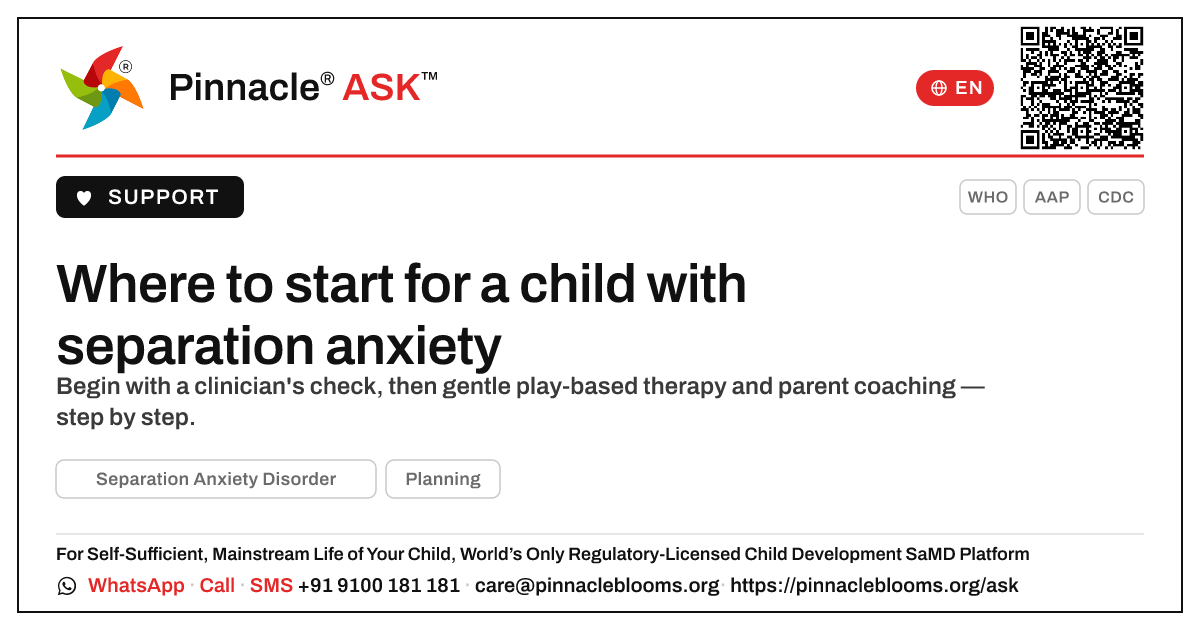
YOUR QUESTION. A CLEARER NEXT STEP.
Where to start for a child with Separation Anxiety Disorder
Help for a child with separation anxiety starts with a developmental and emotional check by a qualified clinician, who can tell apart normal clinginess from anxiety worth supporting. The main support is gentle, play-based child psychology and behaviour therapy with strong parent coaching and school partnership, so confidence grows step by step. AbilityScore® is part of Pinnacle’s developmental assessment. Diagnosis, where needed, requires an appropriately qualified healthcare professional.
In this answer 5 sections
When goodbyes feel like the hardest part of your child's day, the right support can help those tears soften into trust — for both of you.
In short
The best place to start is a developmental and emotional check with a qualified clinician, who can understand what your child is feeling and whether it goes beyond the everyday clinginess most children show. From there, the main support is gentle, play-based child psychology and behaviour therapy, with strong parent coaching so confidence grows at home, at school and at drop-offs. Most children make real, reassuring progress when separation is approached step by step — never rushed.
Where to begin, step by step
- Start with a developmental check — a clinician listens to your story, observes your child, and tells apart normal developmental clinginess from anxiety that is worth supporting. This is your first, no-pressure step.
- Child psychology / counselling support — gentle, play-based sessions help your child name big feelings, practise short separations and build the inner sense that you always come back.
- Parent coaching — you are your child's safe base. The team shows you calm goodbye routines, predictable check-ins and how to praise brave moments without making the worry bigger.
- School partnership — simple drop-off plans and a familiar adult at school can turn dreaded mornings into manageable ones.
- Small, steady steps — gradual practice (a few minutes apart, then a little longer) builds confidence far better than sudden long separations.
The goal is never to push your child away, but to grow their trust that the world stays safe even when you step out of sight.
When to seek a check
Some clinginess is completely normal, especially in younger children and during changes like a new school or sibling. Consider a check if the distress is intense, lasts for weeks, refuses to ease, causes school refusal, stomach aches or sleep trouble, or stops your child doing things they used to enjoy. An early review helps a clinician shape the right, reassuring support.
The Pinnacle way
AbilityScore® is part of Pinnacle’s developmental assessment. Diagnosis, where needed, requires an appropriately qualified healthcare professional — never from an app or online form. From there your child gets a precise developmental and emotional profile and a plan built around their strengths through our behaviour therapy programme. You can also explore how we support families at Pinnacle Blooms Network.
Trusted sources
WHO ICD-11 guidance on separation anxiety disorder; American Academy of Pediatrics family resources (HealthyChildren.org) on childhood anxiety and separation; CDC child mental-health information.
Next step — Ready to help your child feel safe and brave at goodbyes? Book a developmental assessment with a Pinnacle clinician.
This is general information, not a diagnosis — individual assessment and diagnosis require an appropriately qualified healthcare professional.
CONNECT THE ANSWER TO YOUR CHILD’S DAY
Something to notice. Something to discuss.
What to notice
Watch for intense distress lasting weeks, school refusal, frequent stomach aches or headaches at goodbyes, sleep trouble, or avoiding activities your child once enjoyed.
In everyday life
Use a short, calm and predictable goodbye ritual — the same hug, the same phrase, and a clear time you'll be back — then leave confidently; long, anxious goodbyes tend to make the worry bigger.
Bring your observations and questions to your child’s professional. Choose activities that suit your child’s comfort, abilities and agreed plan.
Bring your questions to a first visitQuestions families ask
Is separation anxiety just normal clinginess?
Some clinginess is completely normal, especially in younger children and during changes like a new school or sibling. It becomes worth a clinician's review when the distress is intense, lasts for weeks, refuses to ease, or causes school refusal, stomach aches or sleep trouble.
What kind of therapy helps separation anxiety?
The main support is gentle, play-based child psychology and behaviour therapy that helps your child name feelings and practise short separations, alongside parent coaching for calm goodbye routines and gradual, confidence-building steps.
Where exactly should I start?
Start with a developmental and emotional check by a qualified clinician, who can understand what your child is feeling and shape the right support. At Pinnacle Blooms Network this begins with a clinician-administered assessment at a centre.
FOLLOW THE SOURCE
References behind this answer.
- Organisation website · further readingWHO ICD-11 guidance on separation anxiety disorder
- Organisation website · further readingAAP HealthyChildren.org on childhood anxiety and separation
- Organisation website · further readingCDC children's mental health resources
References are supplied with this answer. An organisation homepage offers further reading; it does not establish an independent review of this page.
Content attribution: SETU Consortium · Pinnacle Blooms Network.
PEOPLE, TOPICS & DEVELOPMENT
See the connections.
Browse the wider question collections connected with this answer’s audience, developmental area and stage.
FROM UNDERSTANDING TO PURPOSEFUL SUPPORT
One question. Your child’s whole life.
Your child’s self-sufficient, mainstream-included life is the purpose from the beginning. At Pinnacle, that purpose shapes what we understand, the goals we choose, the people we bring together, everyday practice and review.
Connect this question with the right support.
Start with your child’s strengths, your observations and what you want everyday life to become.
Make the next conversation useful.
Bring the situations you notice at home or school. We’ll explain a suitable service, centre and first visit, including availability and fees, before you decide.
How PinnacleAI® connects the journeyExplore the seven stages
- 1Understand abilities
A starting picture of your child’s capabilities.
- 2Choose meaningful goals
Readiness and a plan shaped around the child.
- 3Bring the right support together
Suitable therapies and people for those goals.
- 4Carry practice into everyday life
Guidance for family, home and school.
- 5Track and correct
Use observations to adjust the plan.
- 6Reassess and review
Decide what to continue, change or do next.
- 7Grow independence and participation
The child’s life gives each step its purpose.
Explore the whole PinnacleAI® system → · Participation at school and in the community →
PINNACLE’S EVIDENCE, OPEN TO YOU
Look at the evidence behind our work.
Read our research, inspect the original regulatory documents and check what each institutional measure means.
General information supports a conversation with an appropriately qualified professional. Advice, goals and support depend on the individual child.