
YOUR QUESTION. A CLEARER NEXT STEP.
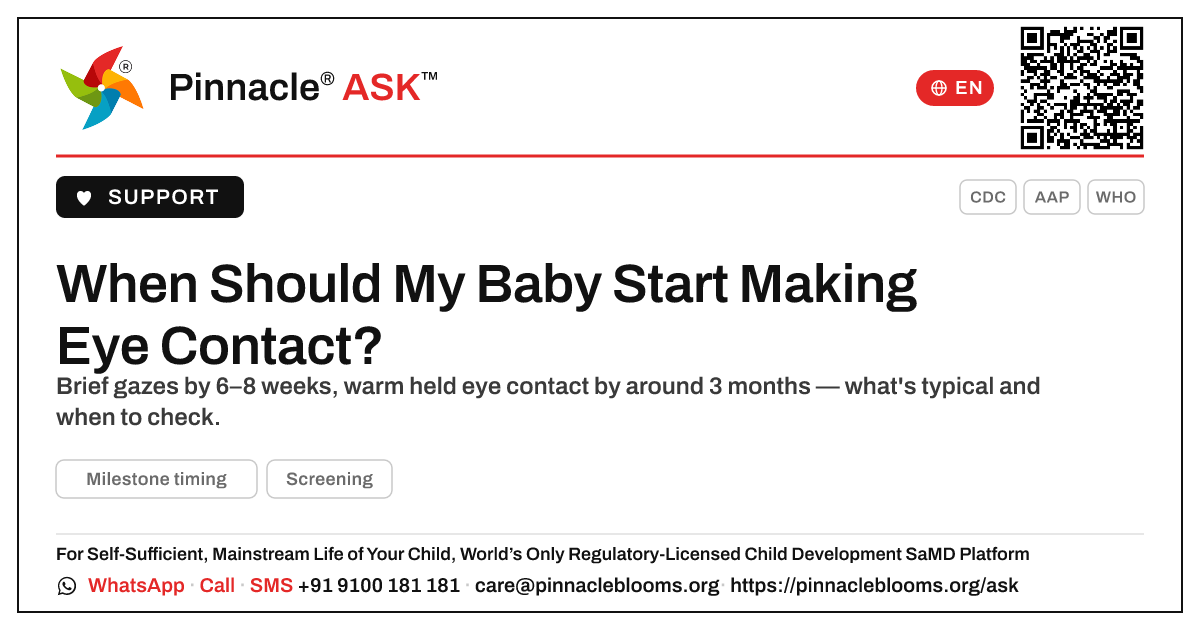
When should my child start making eye contact?
Most babies begin brief eye contact by 6–8 weeks and hold your gaze with social smiles by around 3 months, developing gradually and at their own pace. Look for a steady trend of growing social interest rather than one perfect moment. AbilityScore® is part of Pinnacle’s developmental assessment. Diagnosis, where needed, requires an appropriately qualified healthcare professional.
In this answer 5 sections
Those first held gazes are tiny conversations — your baby learning that you are their safe, fascinating world.
In short
Most babies begin making brief eye contact by 6 to 8 weeks of age, and by around 3 months they often hold your gaze, brighten and even smile back during face-to-face moments. Eye contact develops gradually and varies from baby to baby — some are simply more watchful or more easily distracted than others. What matters most is a steady trend of growing social interest over the early months, not a single perfect moment.
How eye contact unfolds
- Newborn (0–6 weeks) — your baby can focus best at about 20–30 cm (roughly the distance to your face during a feed) and is drawn to faces, but gaze is fleeting and unsteady. This is completely normal.
- 6–8 weeks — brief, intentional eye contact begins; your baby may lock eyes for a moment during calm, alert times.
- 2–3 months — gazing becomes longer and warmer, often paired with the first social smiles and little cooing "chats".
- 4–6 months — your baby follows your face as you move, looks between you and objects, and enjoys back-and-forth play like peek-a-boo.
Eye contact is easiest to see when a baby is calm, fed and alert — not when tired, hungry or overstimulated. Babies also look away to take a break from a lovely-but-intense interaction; that is healthy self-regulation, not disinterest.
When a gentle check helps
Eye contact is one thread in a baby's whole social tapestry, so look at the bigger picture. A developmental check is worth booking if, beyond around 3 months, your baby rarely fixes on faces, doesn't begin to smile socially by 2–3 months, doesn't follow a face or object with their eyes by about 3–4 months, or if you have any concern about how they see or respond to you. Early observation is reassuring far more often than not — and where support helps, starting early makes the biggest difference.
The Pinnacle way
This is general information, not a diagnosis — individual assessment and diagnosis require an appropriately qualified healthcare professional. If you'd like reassurance, our clinicians offer a warm, structured developmental check and explain how the AbilityScore® builds a clear picture of your child's strengths. Where early communication support is useful, our speech therapy team can guide playful next steps.
Trusted sources
CDC developmental milestone guidance on early social and visual responses; American Academy of Pediatrics family resources (HealthyChildren.org) on newborn vision and social smiling; WHO Nurturing Care guidance on responsive caregiving in infancy.
Next step — Curious or simply want reassurance? Book a gentle developmental check with a Pinnacle clinician.
CONNECT THE ANSWER TO YOUR CHILD’S DAY
Something to notice. Something to discuss.
What to notice
Brief eye contact emerging by 6–8 weeks; longer warm gazing with social smiles by 2–3 months; following your face by 3–4 months. A gentle check helps if your baby rarely fixes on faces or doesn't smile socially beyond around 3 months.
In everyday life
Hold your baby about 20–30 cm from your face during calm, alert moments — talk, smile and pause to give them time to gaze back. Following their lead, and letting them look away to rest, builds those first joyful eye-to-eye conversations.
Bring your observations and questions to your child’s professional. Choose activities that suit your child’s comfort, abilities and agreed plan.
Bring your questions to a first visitQuestions families ask
Is it normal for a newborn not to make much eye contact?
Yes. In the first few weeks gaze is fleeting and unsteady — newborns focus best at about 20–30 cm and are drawn to faces, but sustained eye contact develops gradually, usually becoming clearer around 6–8 weeks.
My baby looks away during play — should I worry?
Usually not. Babies often look away to take a short break from an intense, lovely interaction; this is healthy self-regulation. They typically turn back when ready for more.
When should I seek a developmental check about eye contact?
Consider a gentle check if, beyond around 3 months, your baby rarely fixes on faces, hasn't begun social smiling by 2–3 months, or doesn't follow a face with their eyes by about 3–4 months. Early observation is reassuring far more often than not.
FOLLOW THE SOURCE
References behind this answer.
- Source referenceCDC — Developmental milestones (social & visual)
- Organisation website · further readingAAP HealthyChildren.org — Newborn vision & social smiling
- Organisation website · further readingWHO Nurturing Care — Responsive caregiving in infancy
References are supplied with this answer. An organisation homepage offers further reading; it does not establish an independent review of this page.
Content attribution: SETU Consortium · Pinnacle Blooms Network.
PEOPLE, TOPICS & DEVELOPMENT
See the connections.
Browse the wider question collections connected with this answer’s audience, developmental area and stage.
FROM UNDERSTANDING TO PURPOSEFUL SUPPORT
One question. Your child’s whole life.
Your child’s self-sufficient, mainstream-included life is the purpose from the beginning. At Pinnacle, that purpose shapes what we understand, the goals we choose, the people we bring together, everyday practice and review.
Connect this question with the right support.
Start with your child’s strengths, your observations and what you want everyday life to become.
Make the next conversation useful.
Bring the situations you notice at home or school. We’ll explain a suitable service, centre and first visit, including availability and fees, before you decide.
How PinnacleAI® connects the journeyExplore the seven stages
- 1Understand abilities
A starting picture of your child’s capabilities.
- 2Choose meaningful goals
Readiness and a plan shaped around the child.
- 3Bring the right support together
Suitable therapies and people for those goals.
- 4Carry practice into everyday life
Guidance for family, home and school.
- 5Track and correct
Use observations to adjust the plan.
- 6Reassess and review
Decide what to continue, change or do next.
- 7Grow independence and participation
The child’s life gives each step its purpose.
Explore the whole PinnacleAI® system → · Participation at school and in the community →
PINNACLE’S EVIDENCE, OPEN TO YOU
Look at the evidence behind our work.
Read our research, inspect the original regulatory documents and check what each institutional measure means.
General information supports a conversation with an appropriately qualified professional. Advice, goals and support depend on the individual child.