
YOUR QUESTION. A CLEARER NEXT STEP.
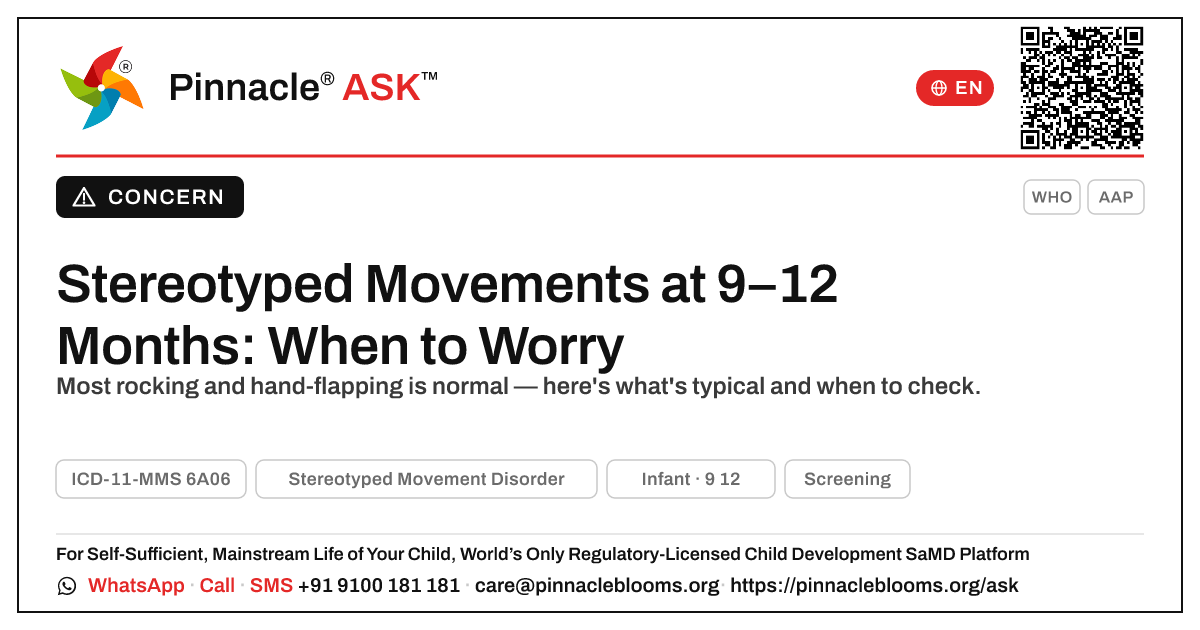
Worried About Stereotyped Movements at 9–12 Months?
Rhythmic repetitive movements — rocking, hand-flapping, head-rolling, gentle head-banging — are very common and usually normal self-soothing in babies aged 9–12 months. Stereotyped Movement Disorder (ICD-11 6A06) is rarely confirmed this early and matters only when movements are persistent, uninterruptible, harmful, or paired with loss of skills or reduced social connection. Observe and note rather than worry; raise concerns at a routine check, and seek prompt medical review for any sudden stiffening or jerking. Only a Pinnacle clinician can assess — never an online form.
In this answer 5 sections
If you've noticed your baby rocking, hand-flapping or repeating a movement and you're wondering whether something is wrong — that watchful, loving instinct is exactly right, and the reassuring news is that most of what you're seeing at this age is part of normal development.
In short
At 9–12 months, rhythmic, repetitive movements — body-rocking, hand-flapping when excited, head-rolling at sleep onset, even gentle head-banging into a cot — are extremely common and usually a normal, self-soothing part of how babies explore their bodies. Stereotyped Movement Disorder (ICD-11 6A06) is a clinical label that becomes meaningful only when such movements are persistent, hard to interrupt, interfere with everyday activity, or cause physical harm — and it is rarely confirmed this early. At this age the wise stance is to observe and note, not to worry alone.
What is normal at this age
Many healthy babies between 9 and 12 months show repetitive movements as they discover rhythm and learn to settle themselves:
- Body-rocking on hands and knees, often before crawling
- Hand-flapping or arm-waving when excited or happy
- Head-rolling or rhythmic head movements as they fall asleep
- Gentle, brief head-banging against the cot — surprisingly common and usually harmless
These typically happen when a baby is tired, excited or settling, stop easily when you engage them, and do not stop them smiling, babbling, reaching, or connecting with you.
When to mention it to a professional
These are observations to share at a routine check, not alarm signals — but do bring them up sooner if you notice that the movements:
- Are so frequent or forceful that they cause bruising, marks or injury
- Can't easily be interrupted and seem to take over playtime or feeding
- Come alongside loss of skills your baby once had (babbling, eye contact, reaching)
- Are paired with little response to your voice or face, or reduced social smiling
- Look like sudden stiffening, jerking or blank staring — these need prompt medical review to rule out a seizure, not therapy first
If any of these are present, a calm, prompt chat with your paediatrician or a developmental clinician is the right next step.
The Pinnacle way
A clinical AbilityScore® and any diagnosis are formed only at a Pinnacle Blooms Network centre, under qualified clinician care — never from an online form or a checklist. Our team looks at your baby's whole picture — movement, communication, play and connection — across more than 70 centres, drawing on 25 million+ therapy sessions of experience, so your questions are answered with warmth rather than worry. If a closer look is helpful, gentle occupational therapy supports a baby's sensory and motor development.
Trusted sources
WHO ICD-11 (6A06, Stereotyped Movement Disorder); American Academy of Pediatrics developmental guidance (healthychildren.org); WHO Nurturing Care Framework for early development.
Next step — If your instinct says it's worth a closer look, the kindest move is a calm developmental check. Book a developmental check with a Pinnacle clinician.
This is general information, not a diagnosis — individual assessment and diagnosis require an appropriately qualified healthcare professional.
CONNECT THE ANSWER TO YOUR CHILD’S DAY
Something to notice. Something to discuss.
What to notice
Watch for movements that cause bruising or injury, can't easily be interrupted, take over play or feeding, or come alongside loss of skills like babbling or eye contact and reduced social smiling. Seek prompt medical review for any sudden stiffening, jerking or blank staring, which needs to be checked rather than assumed to be a habit.
In everyday life
When you notice a repetitive movement, gently engage your baby with a toy, a cuddle or a song and see how easily they switch focus — movements that stop readily and happen mostly when tired or excited are usually a normal, self-soothing phase.
Bring your observations and questions to your child’s professional. Choose activities that suit your child’s comfort, abilities and agreed plan.
Bring your questions to a first visitQuestions families ask
Is it normal for my 9-month-old to rock back and forth?
Yes — body-rocking on hands and knees is very common around this age, often appearing just before crawling. It is usually a normal way babies explore rhythm and movement, especially when they are excited or settling. Mention it at a routine check if it seems forceful, constant, or hard to interrupt.
My baby bangs their head on the cot — should I worry?
Gentle, brief head-banging at sleep onset is surprisingly common in healthy babies and usually harmless self-soothing. Worry only if it is forceful enough to cause marks or bruising, can't be interrupted, or comes with loss of other skills — in which case have a calm chat with your paediatrician.
When can Stereotyped Movement Disorder actually be diagnosed?
It is rarely confirmed in infancy because repetitive movements are a normal part of early development. A clinical assessment becomes meaningful only when movements are persistent over time, interfere with daily activity or cause harm. A qualified clinician forms any diagnosis after a structured assessment — never an online checklist.
How do I tell a repetitive movement apart from a seizure?
Typical self-soothing movements are rhythmic, happen when your baby is tired or excited, and stop easily when you engage them. Sudden stiffening, jerking, blank staring or movements your baby can't be brought out of need prompt medical review to rule out a seizure — see a doctor rather than waiting.
FOLLOW THE SOURCE
References behind this answer.
- Source referenceWHO ICD-11: Stereotyped Movement Disorder
- Organisation website · further readingAAP HealthyChildren: infant development
- Organisation website · further readingWHO Nurturing Care Framework
References are supplied with this answer. An organisation homepage offers further reading; it does not establish an independent review of this page.
Content attribution: SETU Consortium · Pinnacle Blooms Network.
PEOPLE, TOPICS & DEVELOPMENT
See the connections.
Browse the wider question collections connected with this answer’s audience, developmental area and stage.
FROM UNDERSTANDING TO PURPOSEFUL SUPPORT
One question. Your child’s whole life.
Your child’s self-sufficient, mainstream-included life is the purpose from the beginning. At Pinnacle, that purpose shapes what we understand, the goals we choose, the people we bring together, everyday practice and review.
Connect this question with the right support.
Start with your child’s strengths, your observations and what you want everyday life to become.
Make the next conversation useful.
Bring the situations you notice at home or school. We’ll explain a suitable service, centre and first visit, including availability and fees, before you decide.
How PinnacleAI® connects the journeyExplore the seven stages
- 1Understand abilities
A starting picture of your child’s capabilities.
- 2Choose meaningful goals
Readiness and a plan shaped around the child.
- 3Bring the right support together
Suitable therapies and people for those goals.
- 4Carry practice into everyday life
Guidance for family, home and school.
- 5Track and correct
Use observations to adjust the plan.
- 6Reassess and review
Decide what to continue, change or do next.
- 7Grow independence and participation
The child’s life gives each step its purpose.
Explore the whole PinnacleAI® system → · Participation at school and in the community →
PINNACLE’S EVIDENCE, OPEN TO YOU
Look at the evidence behind our work.
Read our research, inspect the original regulatory documents and check what each institutional measure means.
General information supports a conversation with an appropriately qualified professional. Advice, goals and support depend on the individual child.