
YOUR QUESTION. A CLEARER NEXT STEP.
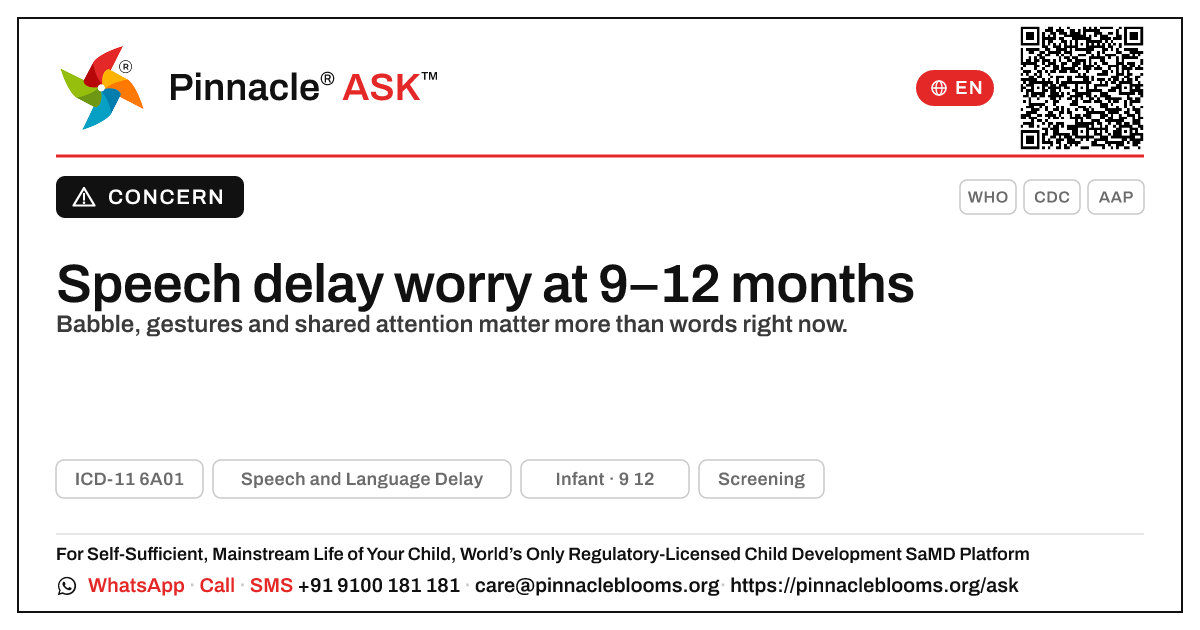
When to worry about speech delay at 9–12 months
At 9 to 12 months it is too early to diagnose Speech and Language Delay — communication now is babble, gestures and shared attention, not words. Watch for absent babble, no gestures by 12 months, no response to sound, or loss of a skill, and have hearing checked. Worry is a reason to screen, not a diagnosis.
In this answer 5 sections
If your baby isn't babbling or pointing the way you expected, the worry is real — and gentle to act on. Here's what truly matters at 9 to 12 months.
In short
At 9 to 12 months it is far too early to diagnose Speech and Language Delay — most communication at this age is pre-verbal: babble, gestures, eye contact and turn-taking, not words. What we watch for now are the building blocks of communication, not a vocabulary. A few quieter days are common; a persistent absence of these early signals is the real reason to check. Worry is a good reason to screen — it is never a diagnosis.
What to watch by 9–12 months
These are gentle prompts to discuss with your paediatrician, not a verdict:
- Babbling — by 9 months, repeated sounds like "bababa", "dadada"; very little or no babble is worth noting
- Gestures — pointing, waving, reaching up to be picked up, showing you things by around 12 months
- Responds to name and turns towards familiar voices
- Shared attention — looking where you point, following your gaze, back-and-forth "conversations" of sounds and smiles
- First words — one or two simple words around 12 months are lovely but not yet expected of every baby
The strongest early flag is the loss of a skill your baby once had, or no response to sound — both deserve a prompt check, including hearing.
The science, briefly
WHO classifies developmental speech and language disorders under ICD-11 6A01, but these are recognised over time, not from a single infant snapshot. CDC and AAP milestone guidance treats 9–12 months as a window for gesture and babble, with hearing being the first thing to rule out. Identified early, communication outcomes are excellent — which is why screening, not waiting, is the hopeful path.
The Pinnacle way
Developmental measurement supports care planning; diagnosis requires an appropriately qualified healthcare professional., under qualified clinician care — never from an online form. Our speech therapists look first at hearing and pre-verbal communication, then measure your child against their own developmental baseline, giving you clarity and a plan rather than a label.
Trusted sources
WHO ICD-11 (6A01); CDC Learn the Signs, Act Early milestones; American Academy of Pediatrics (HealthyChildren.org); Indian Academy of Pediatrics; RBSK developmental screening.
Next step — The kindest thing to do with worry is check. Book a developmental screen with a Pinnacle clinician, and ask for a hearing check too.
This is general information, not a diagnosis — individual assessment and diagnosis require an appropriately qualified healthcare professional.
CONNECT THE ANSWER TO YOUR CHILD’S DAY
Something to notice. Something to discuss.
What to notice
Seek a prompt check if your baby does not babble by 9 months, shows no gestures (pointing, waving) by 12 months, does not respond to sound or their name, or loses a skill they once had. Always include a hearing check.
In everyday life
Talk to your baby through your day and pause for a reply: say a sound, wait, and warmly copy any babble or gesture back. These back-and-forth 'conversations', plus naming what your baby looks at, are powerful early language practice.
Bring your observations and questions to your child’s professional. Choose activities that suit your child’s comfort, abilities and agreed plan.
Bring your questions to a first visitQuestions families ask
Is it normal that my 12-month-old isn't talking yet?
Yes — many babies have only one or two words, or none, at 12 months and develop typically. At this age we watch babble, gestures and response to sound far more than words. A persistent absence of these building blocks is what's worth checking.
Should I get my baby's hearing checked?
Hearing is always the first thing to rule out when communication seems delayed. If your baby doesn't respond to sound or their name, or babble has reduced, ask your paediatrician for a hearing check promptly.
What's the difference between worrying and needing assessment?
Worry is a feeling; assessment is a structured check that gives you clarity. If you notice no babble by 9 months, no gestures by 12 months, or loss of a skill, a screen is the kind, sensible step — not a sign something is certainly wrong.
FOLLOW THE SOURCE
References behind this answer.
- Source referenceWHO ICD-11 — Developmental speech or language disorders
- Source referenceCDC — Learn the Signs. Act Early. milestones
- Organisation website · further readingAmerican Academy of Pediatrics — HealthyChildren.org
References are supplied with this answer. An organisation homepage offers further reading; it does not establish an independent review of this page.
Content attribution: SETU Consortium · Pinnacle Blooms Network.
PEOPLE, TOPICS & DEVELOPMENT
See the connections.
Browse the wider question collections connected with this answer’s audience, developmental area and stage.
FROM UNDERSTANDING TO PURPOSEFUL SUPPORT
One question. Your child’s whole life.
Your child’s self-sufficient, mainstream-included life is the purpose from the beginning. At Pinnacle, that purpose shapes what we understand, the goals we choose, the people we bring together, everyday practice and review.
Connect this question with the right support.
Explore how the relevant service contributes to everyday abilities, then speak with us about your child.
Make the next conversation useful.
Bring the situations you notice at home or school. We’ll explain a suitable service, centre and first visit, including availability and fees, before you decide.
How PinnacleAI® connects the journeyExplore the seven stages
- 1Understand abilities
A starting picture of your child’s capabilities.
- 2Choose meaningful goals
Readiness and a plan shaped around the child.
- 3Bring the right support together
Suitable therapies and people for those goals.
- 4Carry practice into everyday life
Guidance for family, home and school.
- 5Track and correct
Use observations to adjust the plan.
- 6Reassess and review
Decide what to continue, change or do next.
- 7Grow independence and participation
The child’s life gives each step its purpose.
Explore the whole PinnacleAI® system → · Participation at school and in the community →
PINNACLE’S EVIDENCE, OPEN TO YOU
Look at the evidence behind our work.
Read our research, inspect the original regulatory documents and check what each institutional measure means.
General information supports a conversation with an appropriately qualified professional. Advice, goals and support depend on the individual child.